Cheerleading
Invented to support other sports and became one — and it began as an all-male activity before the war reversed it.
- Official
- Cheerleading
- Game category
- Outside this taxonomy
- Adjudication
- Judged
- Standing
- Never Olympic
- rule changes
- 4
- comparability break
- 1
- Olympic editions
- 0
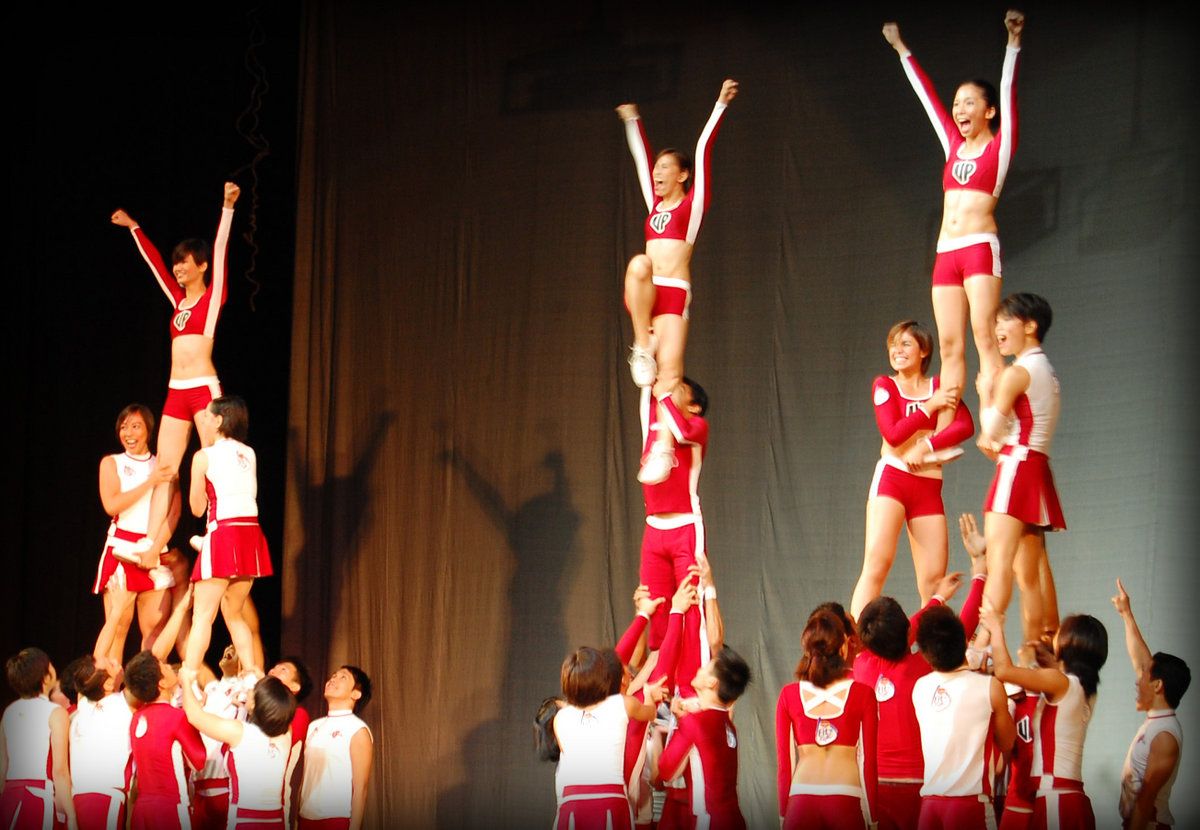
A pyramid on stage: a High Chair in the middle and 2-2-1 formations at the sides, 2009 · Cheerrebel · CC0
- Governing body
- International Cheer Union
- Founded
- Organised cheering dates from American universities in the 1890s; the International Cheer Union was formed in 2004 and received full IOC recognition in 2021.
- Olympic status
- Not on the Olympic programme
- Also contested at
- World Games
A judged team sport of stunts, pyramids, tosses and tumbling, performed to a routine of about two and a half minutes. It is the only sport covered here that was created to be an audience for something else, and one of very few whose participation flipped from almost entirely male to overwhelmingly female. Its safety rules exist because throwing people into the air produces one of the highest catastrophic injury rates in any sport.
The gamewhat it is now · sections 1 to 5
01How it is played
A team routine of about two and a half minutes on a matted floor, judged on difficulty and execution. The Cheer division contains stunts, pyramids, tosses and tumbling; Performance Cheer is dance-based with no stunting.
These figures were entered from the edition named above but have not been checked against its text line by line. Treat them as this site’s reading of the laws, not as a substitute for them.
The object of the game
Perform a routine and be marked higher than the other teams. Marks reward the difficulty of the skills attempted and the cleanliness of their execution, with deductions for falls, dropped stunts and safety violations.
A team performs once. There is no second attempt, and a stunt that fails has failed in front of the panel.
- Routine
- About 2 min 30 s
- Attempts
- One
This clause reads this way because of
The floor
A matted competition floor, sprung in senior competition. The surface is a safety requirement rather than a performance one: teams throw people several metres into the air, and what they land on is regulated.
A routine must stay within the marked area, and leaving it is penalised.
- Surface
- Matted, sprung at senior level
- Boundary
- Marked; leaving it is penalised
This clause reads this way because of
Equipment
Almost none. Uniforms, shoes, and — in Performance Cheer's pom category — poms.
The absence is worth stating because of what it implies. In a sport where people are thrown into the air and caught, there is no protective equipment at all: no helmets, no harnesses, no padding. The safety system is entirely procedural — restrictions on what may be attempted, and required spotters standing in defined positions.
- Protective equipment
- None
- Safety system
- Rules and spotters, not equipment
This clause reads this way because of
Competitors and officials
Teams of up to about twenty-four, in all-female and coed divisions. Roles are specialised: bases support and throw, flyers are lifted and thrown, spotters are positioned to catch, and tumblers perform the gymnastic passes.
A panel of judges marks difficulty and execution, with separate officials watching for safety violations, which carry deductions of their own.
- Team
- Up to about 24
- Divisions
- All-female and coed
- Roles
- Bases, flyers, spotters, tumblers
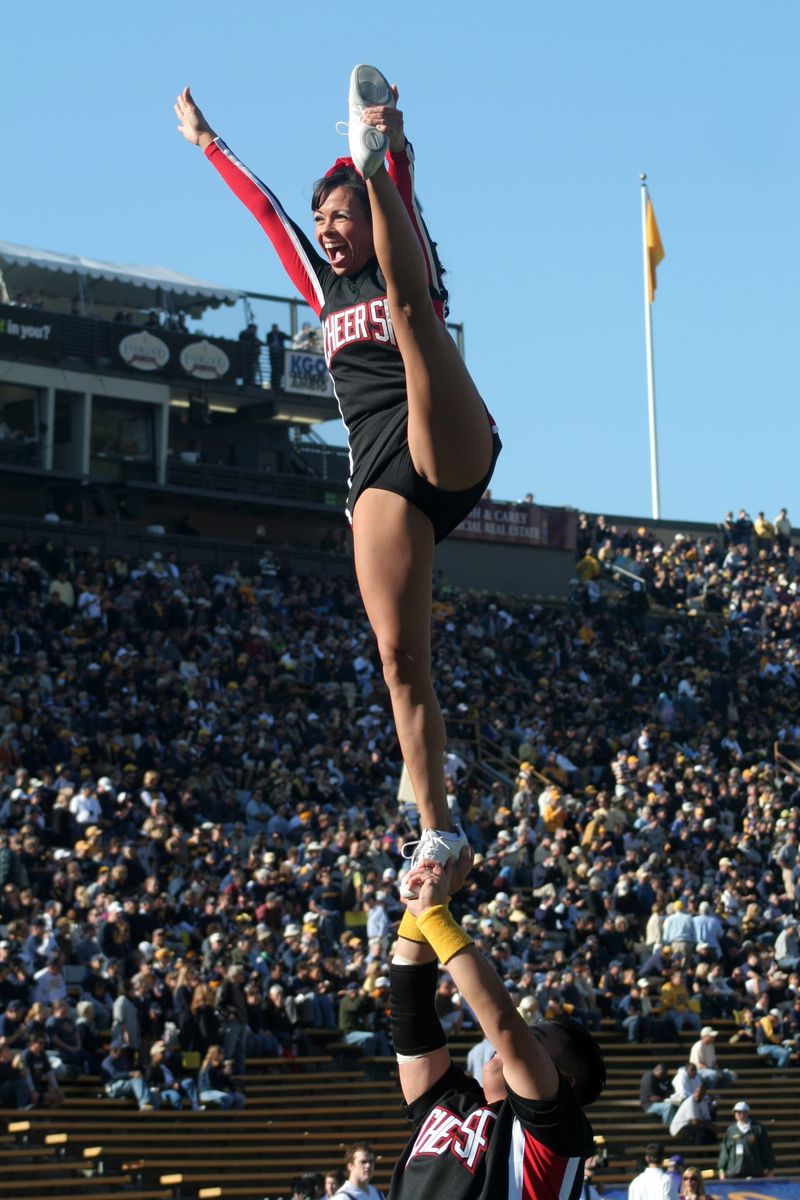
A base holding a flyer in a heel stretch above his head at a college game.
Two of the sport's roles in one frame: the base underneath, and the flyer on top.
John Martinez Pavliga · CC BY 2.0 · Wikimedia Commons
Time
About two and a half minutes, to music, with the routine's timing tightly specified — overrunning is penalised. Everything a team has trained for a season is delivered inside it.
- Routine
- About 2 min 30 s
Scoring
Difficulty and execution, marked by panel against a defined scoresheet covering stunts, pyramids, tosses, tumbling and — in the Cheer division — the crowd-leading elements the sport is named after.
Safety violations are deducted separately from execution errors, which is an unusual structure: a team can perform a skill cleanly and still lose marks because the skill was not permitted at that level.
This clause reads this way because of
The routine
There are none. A routine runs continuously from the first count to the last, and a fall is incorporated and continued through rather than stopped for.
Infringements
The prohibited list is the sport's most detailed rulebook section and it is almost entirely about stunting: pyramids above a permitted height, released stunts beyond a permitted class, basket tosses outside the allowed forms, insufficient spotters, and any skill above the level permitted for that age and division.
Also: overrunning the time, leaving the performance area, and inappropriate music or choreography.
The restrictions tighten as the age falls, so a skill that is legal at senior international level is banned at school level — the same graded approach this site records in ju-jitsu's submission rules.
Deciding the winner
Highest score. Because a team performs once, in two and a half minutes, with no second attempt, a single dropped stunt can decide a world championship.
Everything above is current law. Everything below is how Cheerleading got here.
02Disciplines and events
No Olympic events. Cheerleading holds full IOC recognition since 2021, was contested at the World Games from 2022, and runs ICU world championships in two divisions that share very little.
- Disciplines
- 2
- Olympic medal events
- 0
- Men’s and women’s counted separately.
- Contested elsewhere
- 8
- world games, world championship, federation only.
- Listed for context
- 1
- Not counted as this sport.
Cheer4
Stunts, pyramids, basket tosses and tumbling, judged on difficulty and execution.
- All-female teamWorld GamesWorld championship
- Coed teamWorld GamesWorld championship
Performance Cheer6
Dance-based, with no stunting. Pom, hip hop and jazz categories.
- PomWorld GamesWorld championship
- Hip hopWorld GamesWorld championship
- JazzWorld championship
Where the sport actually lives3
The overwhelming majority of cheerleading happens in the American school and club system, on a commercial competition circuit that the international federation does not run.
- School and collegiate squadsFederation onlyThe sideline role the activity was invented for, and still the largest participation.
- All-star club competitionFederation onlyA large commercial circuit in the United States, where much of the sport's competitive infrastructure — events, apparel and camps — is concentrated in a single company.
- Para cheerWorld championshipAdaptive divisions contested at ICU championships.
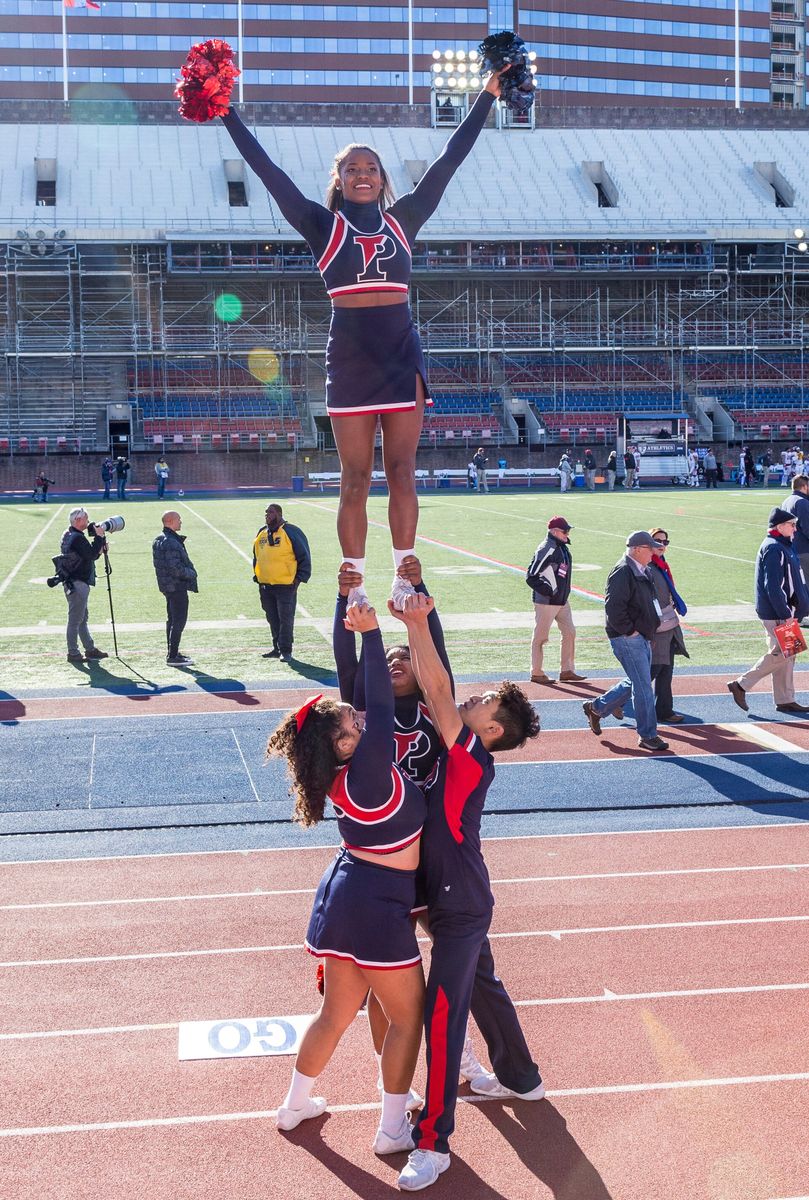
University of Pennsylvania cheerleaders at the Penn–Cornell game, November 2019.
School and collegiate squads: the sideline role the activity was invented for, and still where most of it happens.
Kenneth C. Zirkel · CC BY-SA 4.0 · Wikimedia Commons
03Officiating
Two panels doing two different jobs, and the second one exists because the sport is dangerous.
The scoring panel marks difficulty and execution against a detailed scoresheet: stunt classes attempted, pyramid construction, tosses, tumbling passes, synchronisation, and the crowd-leading elements in the Cheer division. The difficulties are the ones every judged sport on this site has — separating two clean routines of unequal difficulty, and doing it in one viewing with no replay in most competition.
The safety officials are the distinctive part. Separately from execution marks, officials watch for skills performed above the level permitted for that age and division, insufficient spotters, illegal pyramid heights and prohibited release forms. These carry their own deductions.
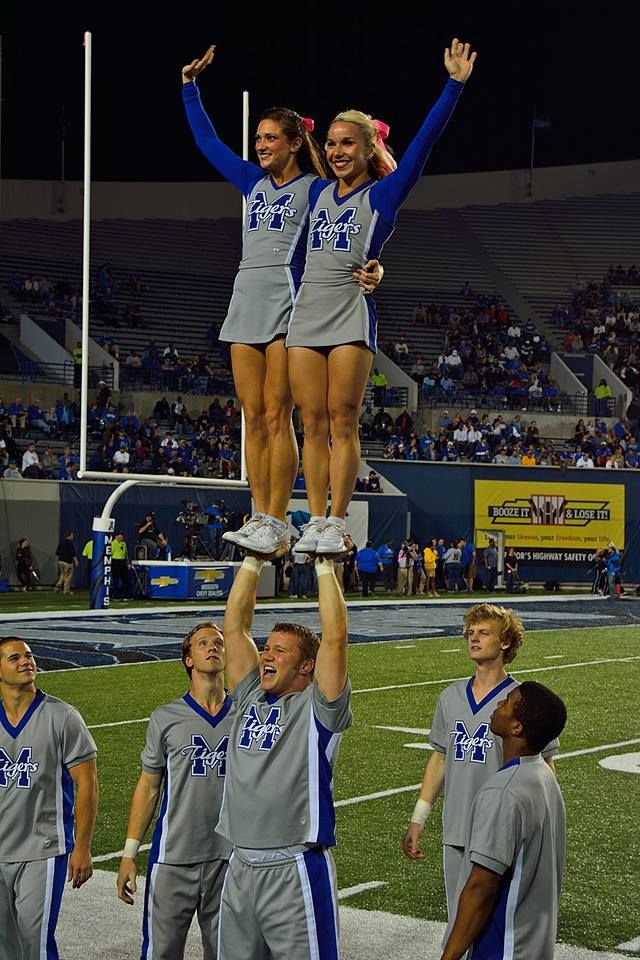
University of Memphis cheerleaders in a coed double Cupie, 2013.
Two flyers held overhead on one hand each, with team-mates standing close behind: the spotters whose number and positions the safety officials check.
Johnharrison1995 · CC BY 3.0 · Wikimedia Commons
That separation produces something rare: a team can perform a skill perfectly and lose marks for it, because the skill was not theirs to attempt. The scoresheet's ceiling is set by a safety code rather than by what athletes can physically do.
Compare gymnastics, which abolished its scoring ceiling in 2006 precisely so that difficulty could run open-ended. Cheerleading keeps a ceiling on purpose, and moves it when injury evidence warrants — which makes its governing document partly a medical one.
There is no instrumentation. Everything is judged by eye, once, on a routine that is delivered in two and a half minutes and cannot be repeated.
04Where it is played
One country, overwhelmingly, and a real but much thinner presence everywhere else.
The United States is cheerleading. It has by far the largest participation base — through school and collegiate squads and a very large all-star club circuit — the deepest coaching structure, and the commercial event system that the rest of the world's competitive calendar is modelled on. American teams have dominated ICU world championships.
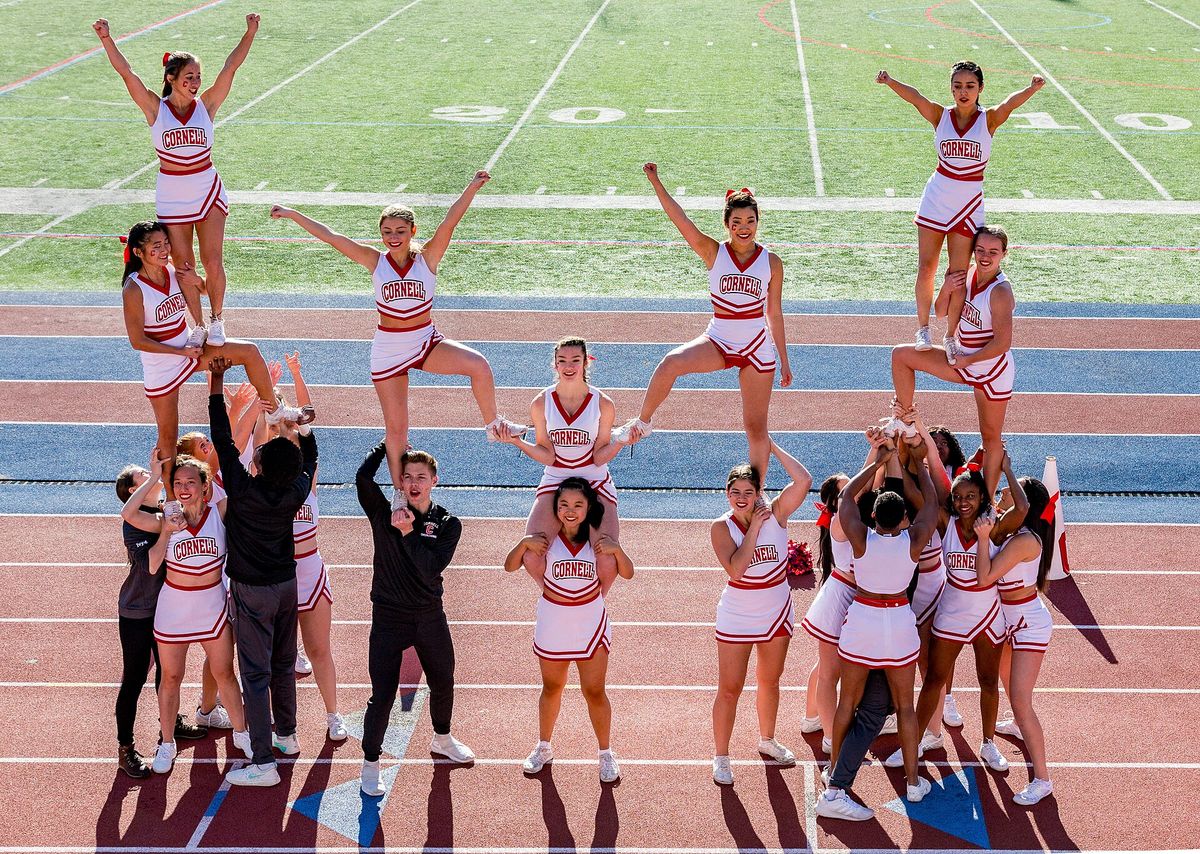
Cornell's squad on the sideline at the Cornell–Penn game, November 2019.
The United States is cheerleading: school and collegiate squads like this one are its largest participation base, still doing the sideline job the activity was invented for.
Kenneth C. Zirkel · CC BY-SA 4.0 · Wikimedia Commons
Beyond it, the sport has genuine competitive presence in Japan, which is probably the strongest nation outside the US, along with Canada, Mexico, Chinese Taipei, Thailand, Finland, Norway, Sweden, England, Germany and Australia.
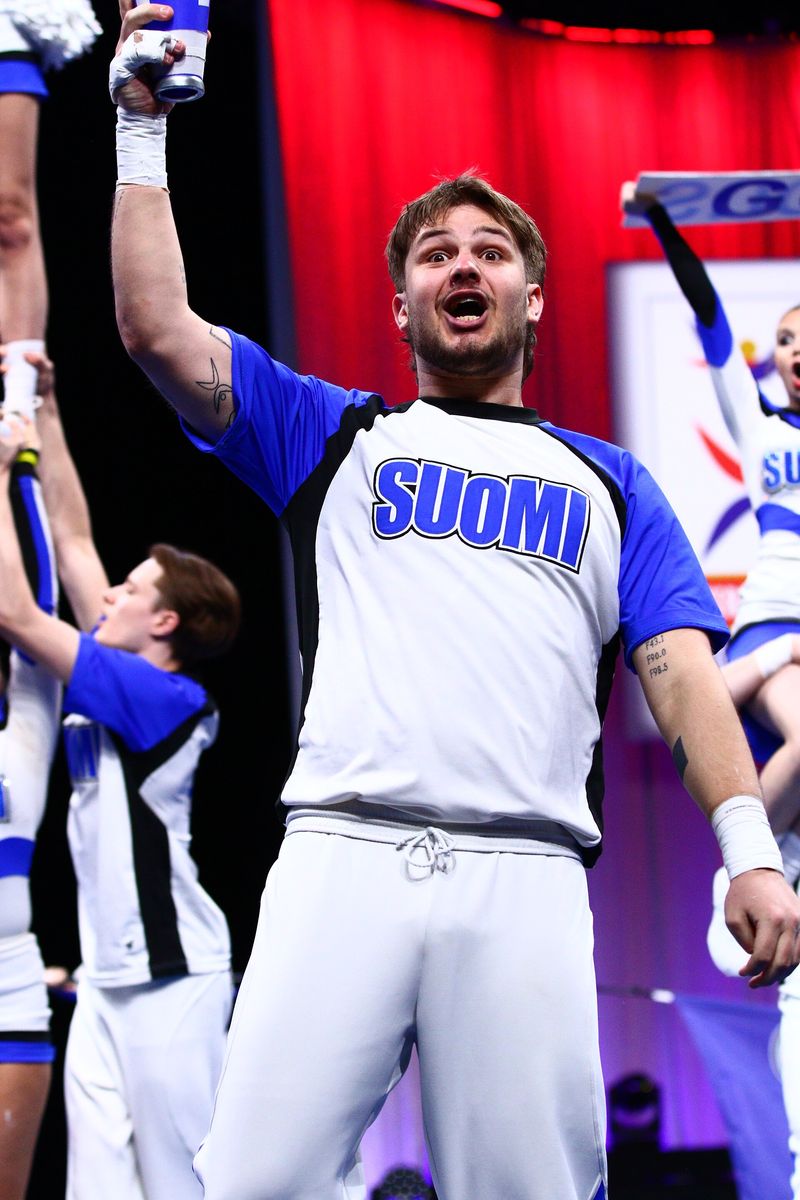
Finland's captain Cristian Tissari da Costa in the chant section of a routine, ICU World Championships, 2025.
Finland is one of the European nations with a real competitive presence, and the chant is where the crowd-leading origin survives inside the competitive routine.
CheerWriterFi · CC BY-SA 4.0 · Wikimedia Commons
The pattern of spread is worth naming because it is unlike most sports on this site. Cheerleading did not travel through a diaspora, a colonial administration or a federation's development programme. It travelled through American cultural export — film, television and the visibility of American college sport — and took root as an aspirational activity, which is why it is strong in countries with high exposure to American media and weak in countries with sporting traditions of their own in similar space.
Its participation profile is also distinct: overwhelmingly female, young, and concentrated in school and club structures rather than in the community clubs that carry most sports covered here.
05Learning curve
Enormously accessible in the United States through schools, and expensive everywhere it is competitive — with a ceiling that requires gymnastic ability and a genuine tolerance for physical risk.
Editorial — the site’s reading, not a sourced claim
Barrier to entry
How hard is it to get to a real game?
A school squad will take a beginner; a competitive club will cost you a season's fees.
Where cheerleading is embedded in a school system — which in practice means the United States — the entry barrier is close to nothing. Squads recruit beginners, teach the basics, and the sideline role that the sport was invented for requires no gymnastic background at all.
Everywhere else it is a club sport with real costs: coaching, mat time, travel, uniforms, and in the American competitive scene a calendar of commercial events with entry fees attached.
The other barrier is the graded skill ladder. A beginner cannot be thrown, and should not be. Progression through the permitted stunt classes takes time by design, because the restrictions tighten as the level falls.
Evidence
- Kit to startA uniform and shoesobserved
- FacilityMatted floor and coachingrule2004 — the rule this rests on
- Entry routeSchool squadsobserved
- SkillsGraded by age and levelruleBeginners cannot legally attempt senior stunts.2004 — the rule this rests on
- Time to a first competitionA seasonestimate
Barrier to the top
How hard is it to be good at?
Gymnastic tumbling, throwing and catching people, and one two-and-a-half-minute attempt a season.
Elite cheerleading requires three separable capacities in one team. Tumblers need gymnastic ability at a standard close to competitive gymnastics, on a sprung floor, in sequence with others. Bases throw and catch a person several metres up, repeatedly, with the timing shared across two or three people. Flyers hold body positions in the air with no contact with the ground and no control over where they are going.
The one-attempt structure raises the pressure further than most judged sports. A gymnast competes several apparatus; a cheerleading team delivers one routine of two and a half minutes, and a single dropped stunt in it is the season.
And the risk is real rather than notional. Cheerleading's stunting produces catastrophic injury rates among the highest recorded in any sport, with no protective equipment anywhere in it — the safety system is entirely rules and spotters. Competing at the top means accepting that.
Evidence
- No protective equipmentNone at allruleSafety is procedural — restrictions and spotters, not gear.2004 — the rule this rests on
- One routineAbout 2 min 30 s, onceruleNo second attempt, and a dropped stunt is the result.2004 — the rule this rests on
- Two divisionsCheer and Performance CheerruleEffectively separate sports with separate athletes.2004 — the rule this rests on
- Typical peak age18–25estimate
Why the two differ
Moderate to very high, and the sport's real distinction on this site is not the size of the gap but where it started.
Cheerleading was created in 1898 to be an audience. Its purpose was to organise a crowd supporting a different sport, and for most of a century that was all it was. What it became — a judged team sport of thrown human beings, with a scoresheet, a world federation and Olympic recognition — is not an evolution of the original activity so much as a replacement of it.
The historical inversion is worth recording alongside that. Cheerleading was an all-male university pursuit for its first four decades and became overwhelmingly female during the Second World War, when the men were conscripted and did not come back to it. Very few activities on this site have flipped their participation that completely, and none has flipped it in that direction.
The historyhow it got here · sections 6 to 10
06Origin and invention
Cheerleading is the only activity on this site invented to be an audience.
Organised crowd-leading began at American universities in the 1890s, and is conventionally dated to 1898, when a student at the University of Minnesota stood in front of a football crowd and directed it in unison. The purpose was not to compete. It was to make a crowd louder and more coordinated in support of a team playing a different sport.
The participants were men, and remained so for four decades. Cheerleading was a male university pursuit with a status attached to it — several American presidents led cheers as students — and it involved megaphones and organised chanting rather than anything gymnastic.
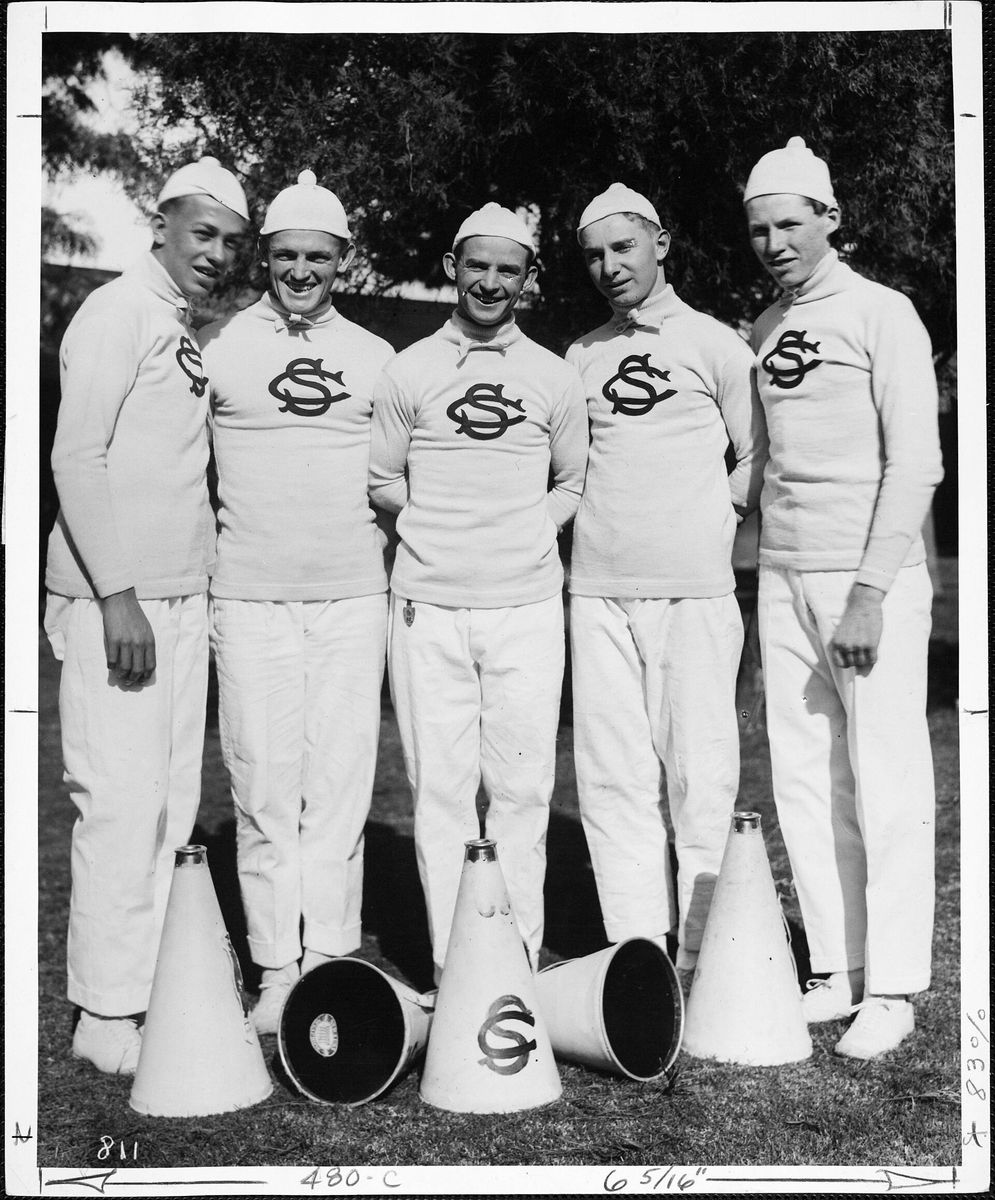
The University of Southern California's yell leaders, around 1915–17, with their megaphones at their feet.
Five men and five megaphones: the activity as it was invented, a job for male students leading a football crowd. The print is catalogued as 1917 and dated 1915 on the back.
Photographer unknown (USC Libraries) · Public domain · Wikimedia Commons
Two things changed it. The Second World War removed the men, women took the squads over, and when the war ended the activity did not revert. Cheerleading's participation flipped from almost entirely male to overwhelmingly female inside a decade, which very few activities anywhere have done in either direction.
And the skills escalated. Through the second half of the twentieth century, squads added tumbling, then partner stunts, then pyramids and tosses, and a competitive circuit grew up around them in the United States — largely commercial, run by event companies rather than by federations.
The International Cheer Union was formed in 2004 to govern it internationally, received provisional IOC recognition in 2016 and full recognition in 2021, and cheerleading was contested at the World Games from 2022.
What is contested there is not what was invented in 1898. It replaced it.
07Rule timeline
The sport’s own lane, expanded. Every entry carries a cause from the closed vocabulary and a citation, and says so where the citation is incomplete.
- 1898Participation and accessadopted 1898
Organised crowd-leading began at American universities, conventionally dated to a student at the University of Minnesota directing a crowd in unison in 1898. Its purpose was to be an audience. Every other sport on this site was created to be contested; this one was created to support something else being contested, and became a competitive activity in its own right over the following century. The participants were men. Cheerleading was an all-male university pursuit for its first four decades, and the inversion came later.
Trigger and citationIncomplete — no confirmed article
Trigger
American college football drew large crowds and universities wanted them organised and audible, so students were appointed to lead them.
ICU Rules and Scoring · ICU historical materials
- 2004Fairness and eligibilityadopted 2004
An international federation was formed and codified two competitive divisions. Cheer contains the stunting: partner stunts, pyramids, basket tosses and tumbling, performed as a routine and judged on difficulty and execution. Performance Cheer is dance-based — pom, hip hop and jazz categories — with no stunting, judged on choreography and execution. They are contested separately, and a competitor in one is generally not a competitor in the other, which makes them two sports under one federation in the way this site has recorded for wushu and ju-jitsu.
Comparability break · Scoped to one competition
Cheer and Performance Cheer are separately judged against separate scoresheets and have never been comparable. See the series
Trigger and citationIncomplete — no confirmed article
Trigger
Competitive cheerleading had grown enormously in the United States under commercial event organisers, with no international body and no common rules across countries.
ICU Rules and Scoring · ICU Rules and Scoring
- 2004Safetyadopted 2004
Codified safety restrictions on what may be thrown and how high: limits on pyramid height, on the number of people supporting a flyer, on basket tosses and released stunts, and requirements for spotters and for a matted surface. Cheerleading's stunting produces a catastrophic injury rate among the highest in any sport — a person is thrown several metres into the air and caught by other people — and the rules are unusually prescriptive about body positions, release heights and who must be standing where. Restrictions tighten as the age and grade fall, so the permitted skills at school level are substantially narrower than at senior international level.
Trigger and citationIncomplete — no confirmed article
Trigger
Catastrophic injuries — spinal and head injuries from falls during stunting — were documented at rates far above other school and collegiate activities, particularly in the United States.
ICU Rules and Scoring · ICU safety rules
- 2021Participation and accessalso commercialadopted 2021
The ICU received full IOC recognition, having held provisional recognition since 2016, and cheerleading was contested at the World Games from 2022. Recognition arrived for an activity most of whose participants are in one country and whose competitive infrastructure there is substantially owned by a single commercial company.
Trigger and citationIncomplete — no confirmed article
Trigger
The federation completed the governance and anti-doping requirements set by its provisional recognition.
ICU Rules and Scoring · IOC recognition, 2021
08Equipment evolution
The interesting thing about cheerleading's equipment is what is absent.
People are thrown several metres into the air and caught by other people, and there is no protective equipment at all. No helmet, no harness, no padding, no mat beneath the flyer other than the competition floor. In a sport with one of the highest catastrophic injury rates recorded anywhere, the entire safety system is procedural: rules about what may be attempted, and human spotters standing in defined positions.
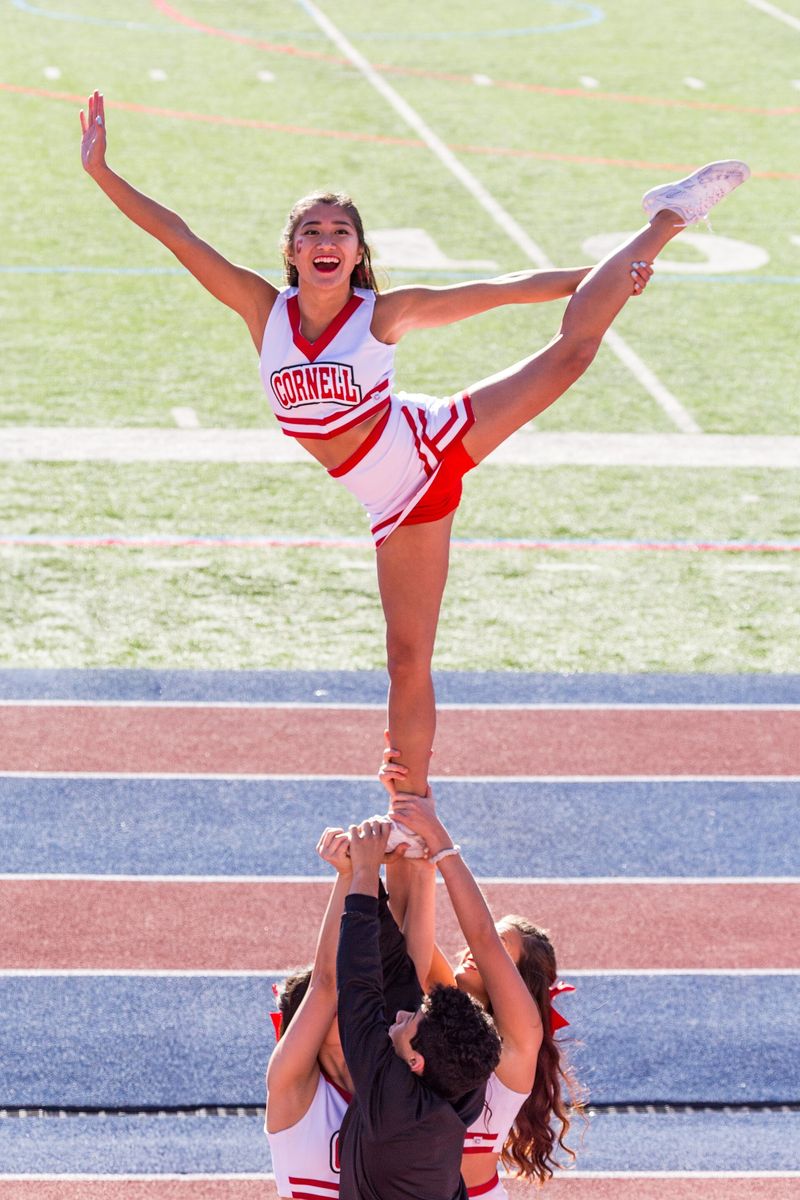
Cornell University cheerleaders in a Liberty stunt, Cornell against Penn, 2019.
A flyer standing on one leg on the hands of her bases, with no helmet, pad or harness anywhere. The safety system is the people underneath her and the rules about what they may attempt.
Kenneth C. Zirkel · CC BY 4.0 · Wikimedia Commons
That is a genuinely unusual answer. Every other sport on this site that produces head and spinal injuries has reached for equipment — helmets in cycling and ice hockey, headguards in amateur boxing and kickboxing, face masks in softball. Cheerleading reached for restriction instead: pyramid height limits, permitted toss forms, released-stunt classes graded by age, and a required number of spotters.
A pyramid on stage: a High Chair in the middle and 2-2-1 formations at the sides, 2009.
Height is the variable the rules restrict: how many people may stand on how many, graded by age and division.
Cheerrebel · CC0 · Wikimedia Commons
The surface is the one piece of hardware the rules govern closely. Competitive routines are performed on matted, sprung floors, and the surface requirement is a safety rule rather than a performance one — a substantial part of the sport's injury history involves what people landed on.
The megaphone, the original equipment of the activity, survives as a sideline prop and has no role in the competitive sport.
Poms are equipment in one Performance Cheer category and nowhere else.
Uniforms are regulated for modesty and safety — nothing that can catch, no jewellery — which is ordinary, and worth noting only because uniform regulation in a sport with this participation profile has a longer and more contested history than the rulebook conveys.
09Governing body politics
The ICU governs a sport whose competitive infrastructure it does not own.
The federation was formed in 2004, obtained provisional IOC recognition in 2016 and full recognition in 2021, and holds a World Games place. On the usual measures that is a successful two decades.
But the overwhelming majority of competitive cheerleading happens in the United States, on a commercial circuit of all-star club competitions, and that circuit — along with much of the apparel supply, the camp system and the event calendar — is concentrated to an unusual degree in a single company. Antitrust litigation has followed, brought by gyms and by families, alleging that the concentration allowed prices to be set across events, uniforms and training.
This site records governance problems in several sports: rival federations in powerlifting and kickboxing, a national professional body outside the international one in sumo and muaythai, and two bodies claiming dragon boat. Cheerleading's is a fourth kind and the only one of its type here — the sport's competitive structure is a commercial property, and the international federation is a separate thing that sits above it.
The recognition question follows from that. An IOC assessment of a sport normally asks about national federations, athlete pathways and governance independence. Cheerleading's answer in its largest market involves a company.
There is one further political dimension the federation handles carefully. Cheerleading in the United States is entangled with legal questions about whether it counts as a sport for the purposes of gender-equity requirements in education funding — a question courts have answered inconsistently, and one where being recognised as a sport has consequences far outside competition.
10Controversies that forced rule changes
Catastrophic injuries. The controversy that produced most of the rulebook. Stunting — throwing a person several metres up and catching them — has generated spinal and head injury rates that studies have repeatedly placed among the highest of any school or collegiate activity in the United States. The response has been restriction rather than equipment: limits on pyramid height, on released stunts, on basket toss forms, on the number of supporters required, and mandatory matted surfaces, all tightened as age falls.
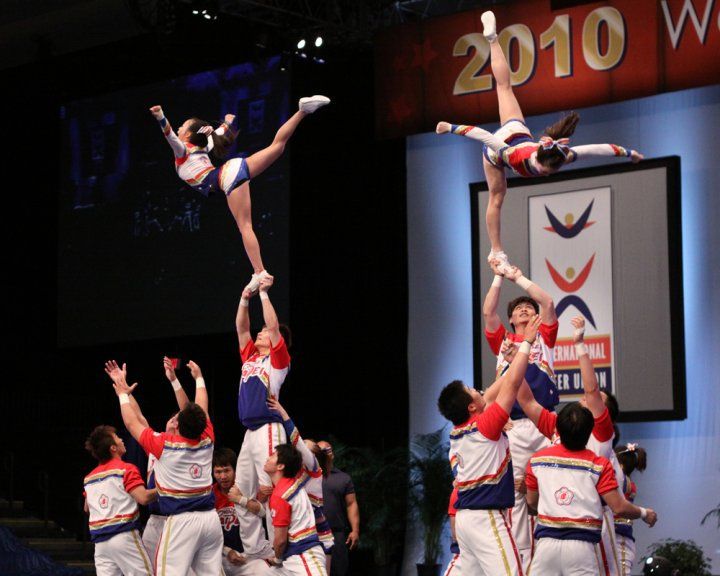
Chinese Taipei's coed team throwing flyers at the ICU World Championships.
Released stunts and tosses, the skills behind the injury record that produced most of the safety code. Chinese Taipei is one of the strongest nations outside the United States.
AndrewMT · CC BY-SA 3.0 · Wikimedia Commons
Whether it is a sport. Not an abstract question. In the United States it has been litigated, because whether cheerleading counts as a sport determines whether it can be used to satisfy gender-equity requirements in educational funding. Courts have not answered consistently, and the ICU's entire institutional posture — the scoresheet, the federation, the Olympic recognition — is partly an answer to it.
Commercial concentration. Much of the American competitive circuit, and the apparel and camp systems attached to it, is concentrated in a single company. Antitrust litigation has been brought. It is a governance problem of a kind no other sport covered here has.
Safeguarding. A sport with a young, majority-female participation base and a coach-dependent training structure has had abuse cases and has had to build safeguarding systems in response. This is recorded because the rule changes are real, not because the sport is unusual in having the problem.
The two divisions. Cheer and Performance Cheer share a federation and almost nothing else, which complicates any argument about what the sport is.
Where it standsthe record, and what is still open · sections 11 to 12
11Series
No series can exist
Routine scores
Cheerleading scores cannot form a series, for the reason every judged sport on this site gives and one that is particular to it. The general reason: a routine is marked against a scoresheet that is revised, and difficulty values change with it. A score is a statement about one performance against one season's rubric. The particular reason is more interesting. Cheerleading's scoresheet is bounded by its safety rules, and those rules are what change most. The permitted stunt classes, pyramid heights, released skills and toss forms are restricted by age and level and are tightened when injury evidence warrants it. So the ceiling on difficulty is set by a safety code rather than by what athletes can do — and when the code changes, the maximum achievable score changes with it. No other sport here has its scoring ceiling set by a medical argument. Gymnastics removed its ceiling in 2006 to let difficulty run open-ended; cheerleading keeps a ceiling deliberately, and moves it for reasons that have nothing to do with sport. The two divisions compound it. A Cheer score and a Performance Cheer score measure a stunting routine and a dance routine, and are not comparable at all.
2004Scoped to one competitionCheer and Performance Cheer are separately judged against separate scoresheets and have never been comparable.
12What is contested now
Recorded as unsettled.
Whether it is a sport. Still genuinely contested, and in the United States still legally consequential, because the answer affects gender-equity obligations in educational funding. Olympic recognition is a strong argument and it has not settled the question in the places where it matters.
The injury rate. The safety code restricts and does not eliminate. A sport that throws people into the air with no protective equipment has a floor on its risk, and whether the current restrictions sit in the right place is argued after every serious injury.
Commercial concentration. Much of the American competitive circuit and its attendant apparel and camp business sits with a single company, and antitrust litigation has been brought. No other sport covered here has its competitive infrastructure owned this way.
Which division represents the sport. Cheer and Performance Cheer are separately judged, separately populated, and would present very differently on any programme.
Olympic prospects. Full recognition since 2021, a World Games place, and a participation base concentrated in one country whose competitive structure is commercial. The federation is making the case; nothing about the obstacles has changed.
Safeguarding. A young, majority-female, coach-dependent participation base has produced abuse cases and continues to demand systems that the sport is still building.