Canoeing
One federation, two boats, and two disciplines that share nothing but a paddle.
- Official
- Canoeing
- Game category
- Performance
- Adjudication
- Measured
- Standing
- Added and kept
- rule changes
- 5
- comparability breaks
- 2
- Olympic editions
- 22
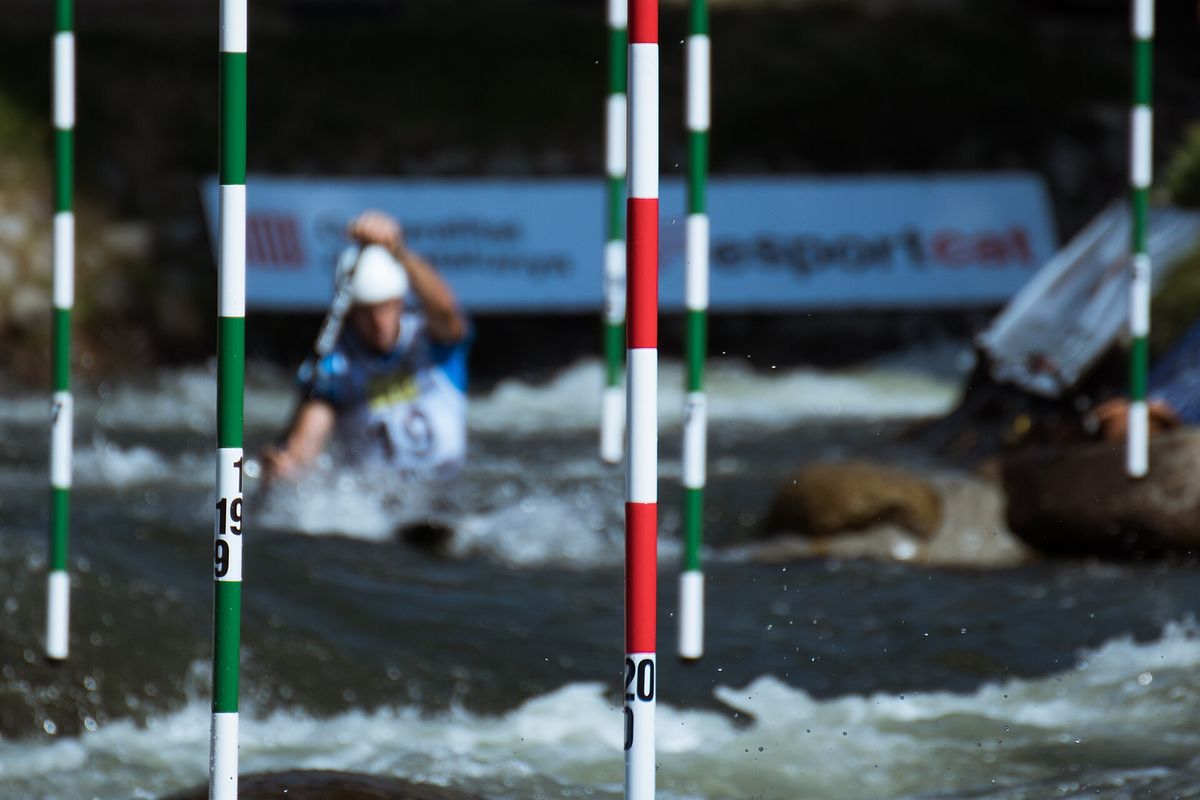
A paddler through the gates at La Seu d'Urgell, Spain, 2019 World Championships · Antoine Lamielle · CC BY-SA 4.0
- Governing body
- International Canoe Federation
- Founded
- International Representation for Canoeing founded 1924; ICF from 1946.
- Olympic status
- 22 editions
- on the 2028 programme
- Also contested at
- Asian Games, World Games
Canoeing is two sports under one name. Sprint is a straight-line race on flat water, timed to a thousandth. Slalom is a technical descent of a whitewater course against a clock with time penalties for touching gates. They share a paddle and a federation, and for a long time they did not share the same events for men and women — canoe classes were closed to women at the Games until 2020, which is the latest such exclusion of any sport on this site.
The gamewhat it is now · sections 1 to 5
01How it is played
Two boats and two sports. A kayak is paddled seated with a double-blade paddle; a canoe is paddled kneeling with a single blade. Sprint races them in a straight line on flat water; slalom sends them down whitewater through hanging gates. The federation governs both and they have almost nothing else in common.
These figures were entered from the edition named above but have not been checked against its text line by line. Treat them as this site’s reading of the laws, not as a substitute for them.
The object of the race
In sprint, cross the line first over a set distance in a marked lane. In slalom, descend a whitewater course through numbered gates in the least time, with penalties added for touching or missing them. In kayak cross, four boats descend together and the first down wins.
Slalom is therefore a measured event with a penalty structure, and kayak cross — added in 2024 — is a race with contact permitted. The same discipline now contains both.
The course
Sprint uses a flat-water course in buoyed lanes. Slalom uses whitewater, increasingly artificial: a purpose-built channel with controllable flow, the first of which was built for the 1972 Games.
Slalom gates are hung fresh for each competition, so the course is different at every event and the times are not comparable between them.
- Sprint distances
- 200 m and 500 m and 1000 m
- Sprint lanes
- 9
- Slalom gates
- Up to 25, set per competition
- Upstream gates
- Must be negotiated against the flow
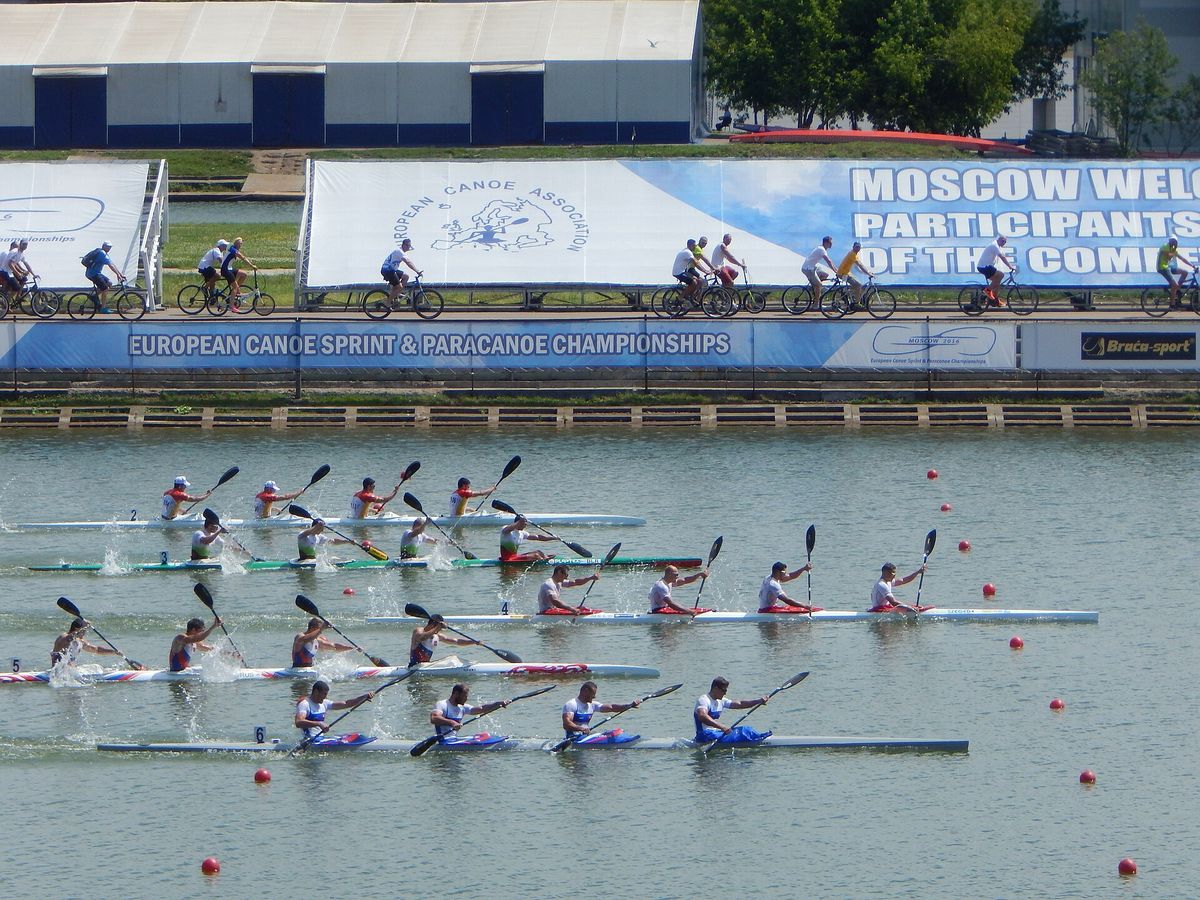
The men's K-4 500 m final at the 2016 European Championships, Moscow.
Crews in buoyed lanes on flat water, racing straight and never meeting: the whole of sprint's field of play.
Voltmetro · CC BY-SA 4.0 · Wikimedia Commons
This clause reads this way because of
Canoe and kayak
The distinction that names the sport. A kayak is paddled from a seated position with a double-bladed paddle and steered with a rudder in sprint. A canoe is paddled kneeling on one knee with a single-bladed paddle and no rudder, which makes holding a straight line a skill in itself.
Boats are specified by minimum length and weight, and slalom boats by minimum width — a limit set after composite construction had made them progressively narrower and faster.
- Kayak
- Seated, double blade
- Canoe
- Kneeling, single blade
- K1 sprint, minimum
- 12 kg
- Slalom boat width
- Minimum specified
This clause reads this way because of
Paddlers and officials
Solo, pairs and fours in sprint; solo in slalom; four at a time in kayak cross. Gate judges assess slalom penalties, and video review supports them.
Until 2021, Olympic women could compete only in kayak. Canoe classes — kneeling, single blade — were men's events at the Games, and women's canoe was added for Tokyo by removing men's events to fit the quota. It is the latest correction of a single-sex exclusion of any sport on this site.
This clause reads this way because of
Format
Sprint heats and finals over a day or two, with races lasting from about thirty seconds at 200 m to around three and a half minutes at 1000 m.
Slalom runs a timed descent of about ninety seconds, in heats, semi-finals and a final, with each round run afresh. Kayak cross is a knockout bracket of four-boat heats.
- Slalom run
- About 90 s
- Sprint 200 m
- Around 35 s
- Kayak cross
- Four boats, knockout
This clause reads this way because of
Timing and penalties
Sprint is a time, recorded to a thousandth of a second, and the sport recognises best times rather than records — the same position rowing takes, and for the same reason: wind and water are not standardised.
Slalom is a time plus penalties. Two seconds for touching a gate, fifty for missing one. Fifty seconds is larger than the spread of an entire field, so missing a gate ends a run's chances outright, while a fast messy descent can still lose to a slower clean one.
- Gate touch
- 2 s
- Gate missed
- 50 s
- Sprint timing
- 0.001 s
- Records
- Best times, not world records
This clause reads this way because of
Starts
Sprint uses a starting gate holding the boats level. Slalom runs are individual and timed from a start line. Kayak cross starts with all four boats dropping from a raised ramp into the water simultaneously, which is the most abrupt start of anything on this site.
Infringements
In sprint: leaving your lane to another competitor's disadvantage, and false starting. In slalom: negotiating a gate in the wrong direction or order, and the gate penalties themselves.
Kayak cross is the exception and the reason it sits oddly beside the rest. Contact between boats is permitted, and a competitor must perform a required roll at a designated point — deliberately capsizing and recovering — which no other event in the sport asks for.
This clause reads this way because of
Deciding the winner
First across the line in sprint and kayak cross; lowest time plus penalties in slalom.
Everything above is current law. Everything below is how Canoeing got here.
02Disciplines and events
Two disciplines and sixteen Olympic events, with the programme rebalanced repeatedly for gender parity within a fixed quota — which is how women's canoe events finally arrived in 2021, by removing men's events to make room.
- Disciplines
- 2
- Olympic medal events
- 17
- Men’s and women’s counted separately.
- Contested elsewhere
- 4
- paralympic, world games, world championship.
- Listed for context
- 1
- Not counted as this sport.
Sprint11
Flat water, buoyed lanes, timed to a thousandth.
- K-1 1000 m
- K-1 500 m
- K-2 500 m
- K-4 500 m
- C-1Women's C-1 added for 2021.
- C-2 500 m
Slalom6
Whitewater, hanging gates, time plus penalties.
- K-1 slalom
- C-1 slalomWomen's C-1 slalom added for 2021.
- Kayak crossAdded 2024. Four boats, contact permitted, a required roll.
Contested away from the Games4
- Canoe marathonWorld championshipWorld Games
- Canoe poloWorld championshipWorld Games
- Freestyle kayakWorld championshipWorld GamesJudged, on a single whitewater feature.
- ParacanoeParalympic
03Officiating and technology
Canoeing officiates two different problems and has largely solved both.
Sprint is a timing question. Boats race in lanes, do not interact, and the finish is instrumented to a thousandth of a second. There is almost nothing for an official to judge — leaving your lane and false starting are the whole list — which puts it alongside rowing as one of the least officiated sports here.
Slalom is a gate question, and the sport's answer to it is the interesting part. A gate judge decides whether a boat or a paddler's body touched a gate, and whether a gate was negotiated correctly and in order.
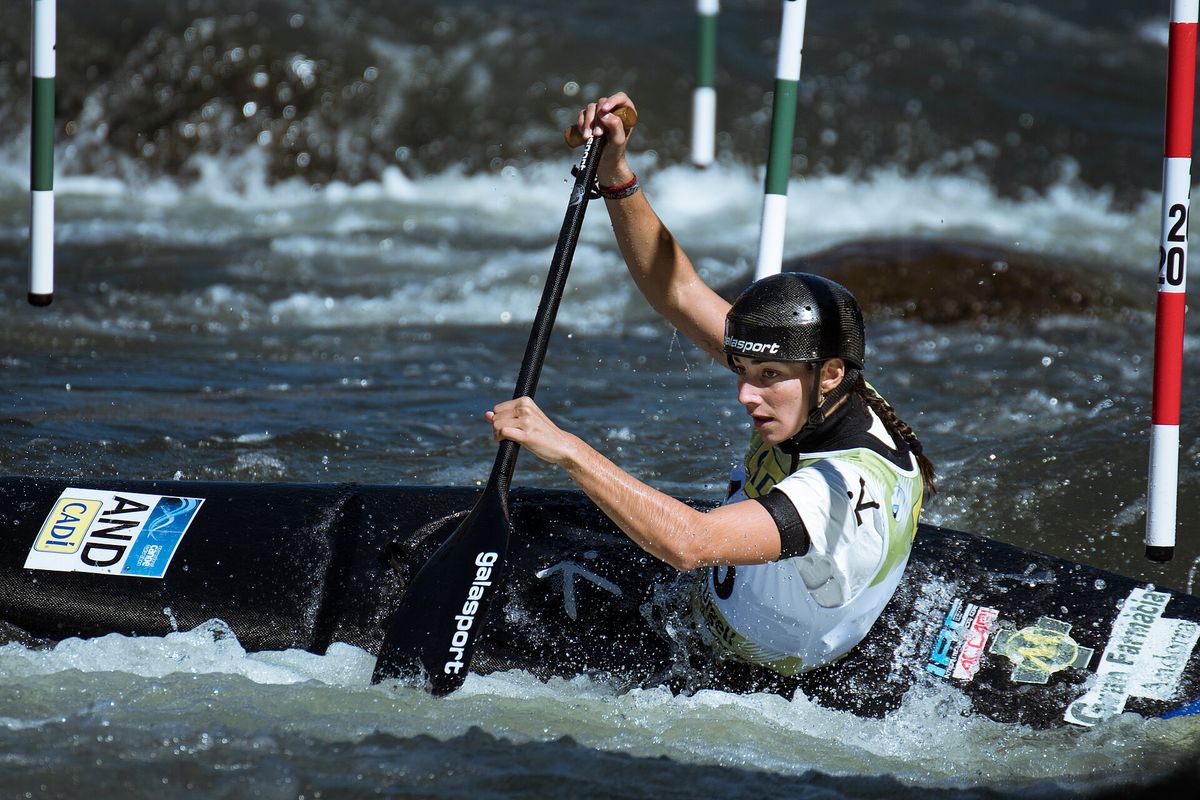
Mònica Doria of Andorra among the gates in the C-1, La Seu d'Urgell, 2019.
Every gate is two binary questions for a judge: was it touched, and was it negotiated. Two seconds for a touch, fifty for a miss.
Antoine Lamielle · CC BY-SA 4.0 · Wikimedia Commons
Both of those used to involve grading: how severe was the touch, how badly was the gate missed. Simplifying penalties to two values around 1990 removed the grading entirely. A judge no longer assesses severity — they answer two binary questions, touched or not, negotiated or not, and the penalty follows.
That is a judgement replaced by a classification rather than by an instrument, and it is a pattern this site has seen in badminton's fixed service height and rugby's sanction framework: where you cannot measure, at least remove the gradations.
Video review supports gate judges at major competitions, and the questions it answers are factual.
Kayak cross breaks all of this. Contact is permitted, four boats descend together, and officials must judge whether contact was legitimate — which is a racing judgement of the kind sailing makes about right of way, newly imported into a sport that had spent a century avoiding the need for one.
04Where it is played
Canoeing has two maps and the difference between them is a facility.
Sprint is broadly distributed: Hungary, Germany, Belarus, Ukraine, Spain, New Zealand, Australia, Canada, China and increasingly across Africa and Latin America. It needs flat water, which most countries have, and boats, which clubs can own. Hungary in particular treats sprint canoeing as a national sport and has produced more Olympic champions in it than any other country.
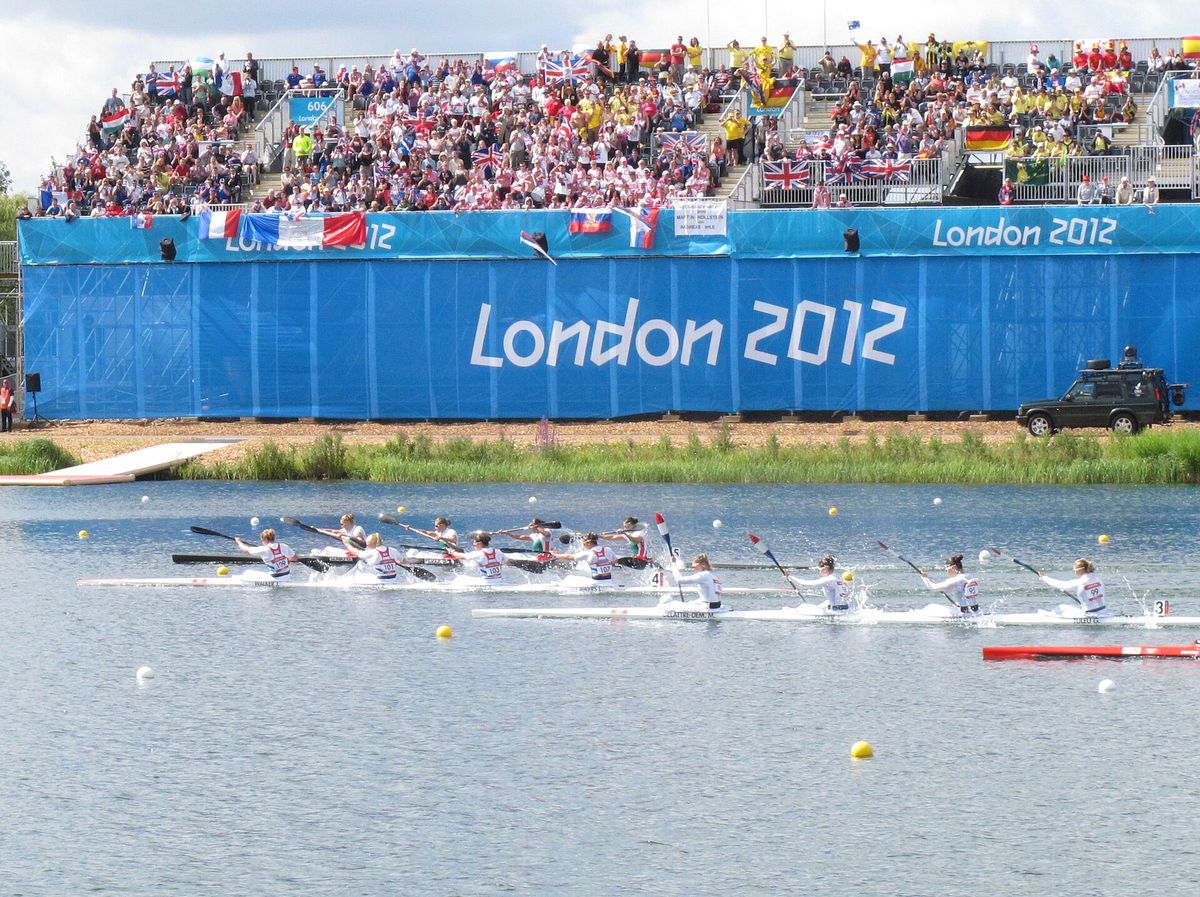
The women's K-4 at Eton Dorney during the London 2012 Olympics.
Sprint needs flat water and boats a club can own, which is why its map is so much wider than slalom's.
David Hawgood · CC BY-SA 2.0 · Wikimedia Commons
Slalom is narrow: Great Britain, France, Germany, the Czech Republic, Slovakia, Slovenia, Spain, Australia and the United States. It needs whitewater of competitive standard, and increasingly that means an artificial course — which is an expensive engineered facility that a small number of countries have built.
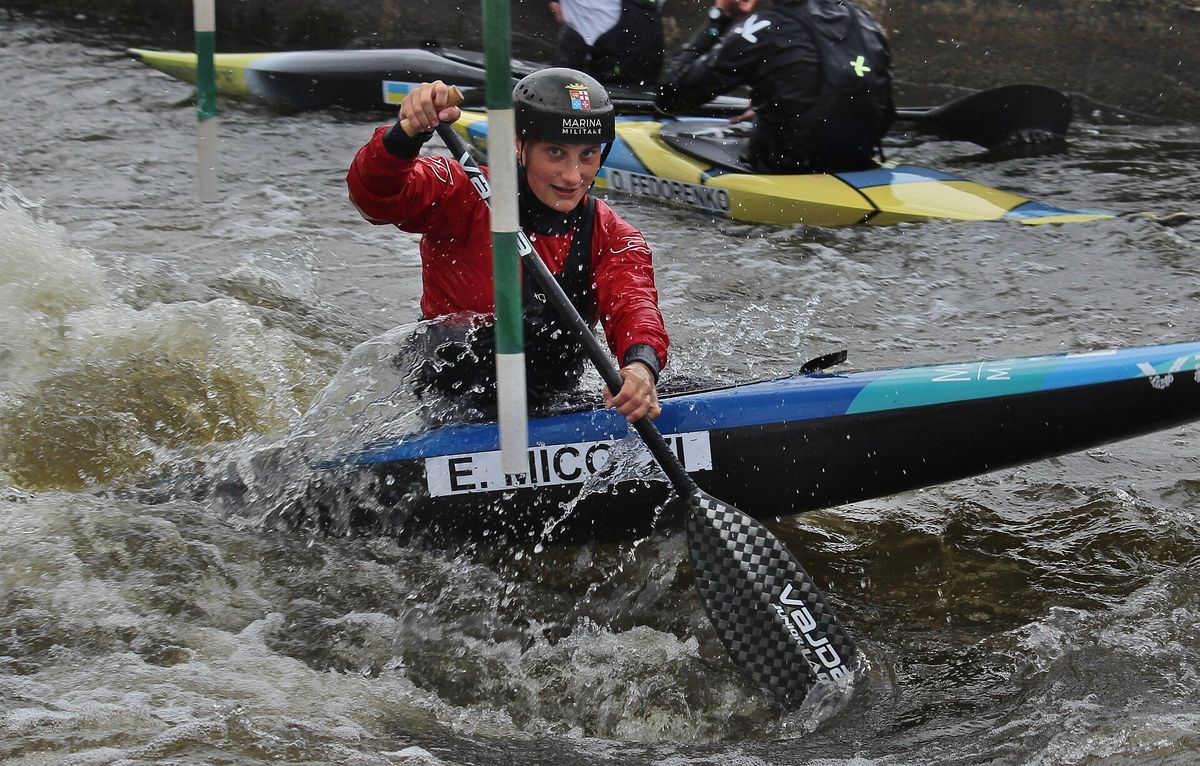
Elena Micozzi at the Canoe Slalom World Cup in Prague, 2023.
The Czech Republic is one of the narrow set of slalom nations, and Prague one of the courses that make it so.
Pavel Hrdlička · CC BY-SA 4.0 · Wikimedia Commons
That is the same dynamic hockey experienced with artificial turf, arriving more slowly and without being mandated. Nobody required slalom to move to engineered channels; it simply became necessary to be competitive, and the map contracted to countries that could build one.
The Indigenous origins of both boats have no presence in the sport's competitive structures, which is a contrast worth drawing with lacrosse, where the Haudenosaunee Nationals compete as a nation. Canoeing took two Indigenous technologies and built a European sport on them, and the peoples who invented the boats are absent from it.
Women's canoe events, absent from the Games until 2021, have a shorter competitive history and a map still forming.
05Learning curve
Two very different learning curves under one federation. A kayak on flat water is among the easier boats on this site to become competent in; a canoe kneeling with a single blade, or any boat in whitewater, is not.
Editorial — the site’s reading, not a sourced claim
Barrier to entry
How hard is it to get to a real game?
A club, a boat and water. The kayak is forgiving; the canoe is not.
Flat-water kayaking is learnable quickly — a double-bladed paddle is intuitive and a stable club boat forgives a beginner. Most people can paddle usefully within a session.
A racing kayak is a different object entirely, narrow enough that a novice capsizes repeatedly, and a canoe — kneeling on one knee, single blade, no rudder — requires holding a straight line by paddle technique alone, which takes months.
Slalom adds whitewater, which cannot be practised gradually in the way flat water can, and requires a course. Artificial courses are expensive facilities and there are not many of them.
Access is the binding constraint throughout: a club, a boat you cannot afford alone, and water of the right kind.
Evidence
- FacilityWaterobserved
- Kit to startA club boatobserved
- KayakSeatedobservedThe forgiving entry point.
- CanoeKneelingobservedHolding a line is the skill.
- Time to paddle competentlyWeeks in a kayakestimate
Barrier to the top
How hard is it to be good at?
Fifty seconds for a missed gate, and a discipline that only added women's events in 2021.
Sprint is a pure physiological contest at 200 m and an endurance one at 1000 m, with the technical demand of holding a racing boat at speed. Its times are best times rather than records, because wind and water are not standardised — the same position rowing takes.
Slalom's ceiling has an unusual shape. A missed gate costs fifty seconds, which is more than the spread of an entire elite field, so the sport punishes a single error more severely than almost anything else here. A run is a sustained sequence of decisions in which one mistake is terminal.
And the sport's own history is part of any honest account of its ceiling. Women could not contest Olympic canoe events at all until 2021. Athletes who spent careers in canoe classes had no Olympic pathway, which is a ceiling imposed by rule rather than by ability.
Evidence
- Women's canoeOlympic only from 2021ruleThe latest correction of a single-sex exclusion on this site.2021 — the rule this rests on
- Missed gate50 sruleMore than the spread of an elite field. One error ends a run.1990 — the rule this rests on
- Kayak crossAdded 2024ruleContact permitted, and a required roll — a different sport inside the discipline.2024 — the rule this rests on
- Typical peak age25–32estimate
Why the two differ
Canoeing sits at moderate to very high and its interest here is that it contains two sports with different problems.
Sprint has rowing's problem — a standardised distance on unstandardised water — and takes rowing's answer, recognising best times rather than records. Slalom has surfing's problem in a controllable form: a course that is different every time, which the sport has solved by building artificial channels rather than by adjusting what its numbers claim.
Those two responses to the same underlying difficulty, inside one federation, are the reason canoeing is worth having on this board.
The historyhow it got here · sections 6 to 10
06Origin and invention
Canoeing is two Indigenous technologies turned into one European sport.
The canoe is North American — open, paddled kneeling with a single blade, built by First Nations peoples for rivers and lakes. The kayak is Arctic — enclosed, paddled seated with a double blade, built by Inuit and Yupik peoples for hunting at sea, with a spray deck and a roll to recover from capsizing.
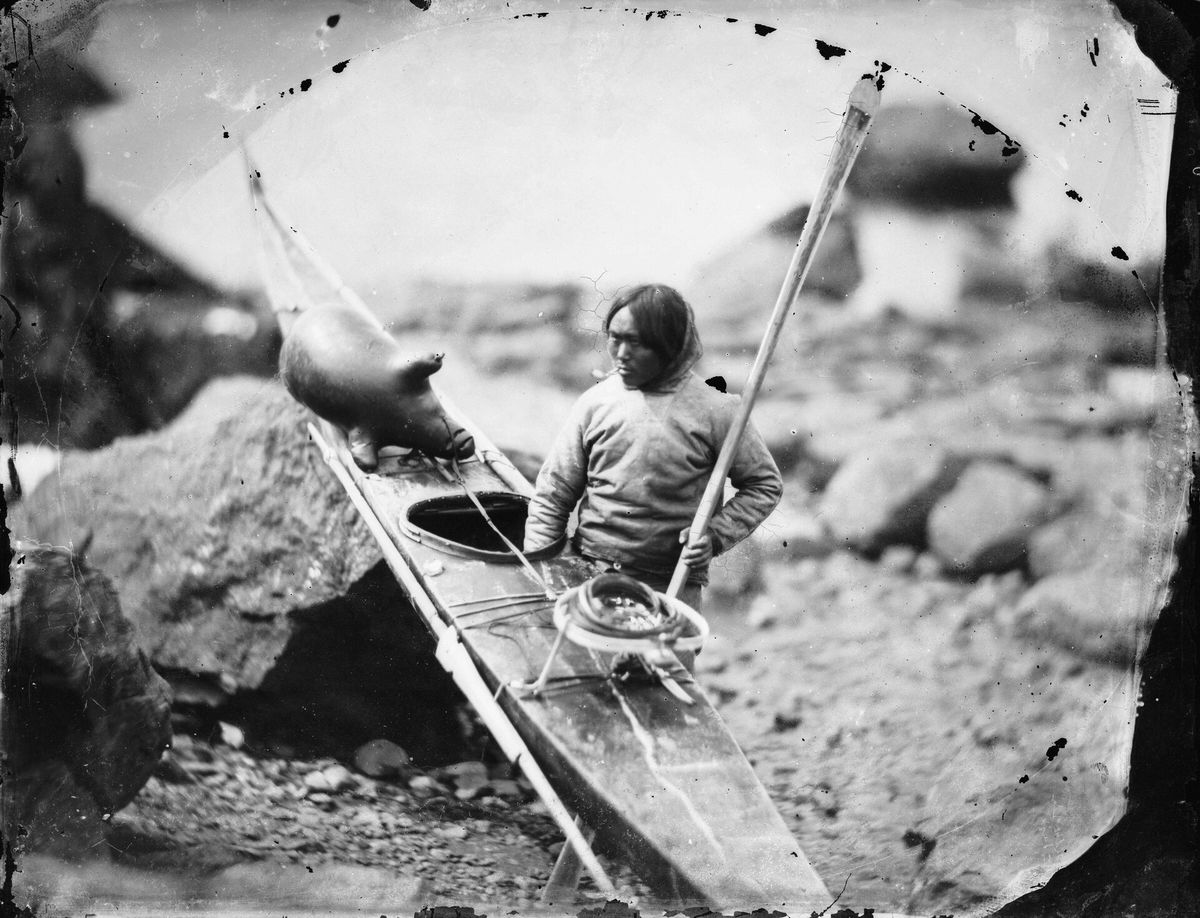
An Inuit man with his kayak and double-bladed paddle, photographed in 1854.
One of the earliest photographs of the boat the sport's kayak classes descend from: enclosed, paddled seated with a double blade, and here with its seal-hunting gear. It was a hunting craft, not a racing one. The man is not named in the record.
Edward Augustus Inglefield · Public domain · Wikimedia Commons
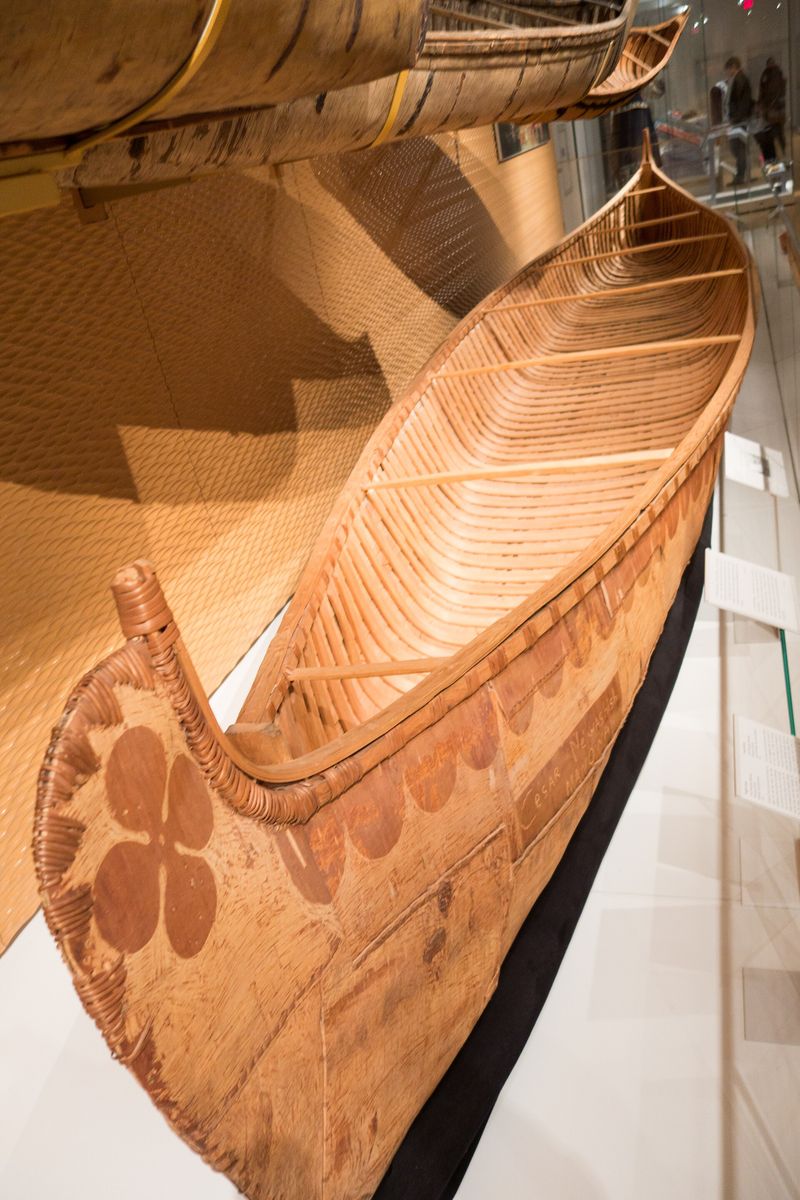
A birchbark canoe in the Royal Ontario Museum, Toronto.
The North American boat: open, built by First Nations peoples for rivers and lakes, and paddled kneeling with a single blade, as the sport's canoe classes still are.
Thomas Quine · CC BY 2.0 · Wikimedia Commons
Neither was designed for racing. Both were transport and work.
The sport came from a Scottish barrister, John MacGregor, who in the 1860s built a decked boat he called the Rob Roy, paddled it across Europe, and wrote books about it that started a recreational canoeing craze. Clubs followed, then racing, then an international federation in 1924.
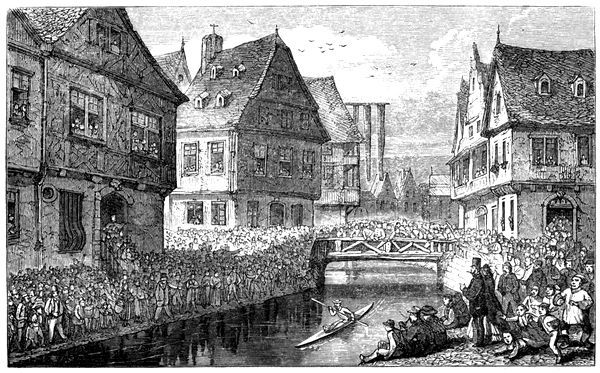
John MacGregor paddling the Rob Roy through Tuttlingen, from his own account of the journey, 1866.
The Scottish barrister whose decked boat and best-selling books started the recreational canoeing craze that turned into clubs, racing and a federation.
John MacGregor · CC0 · Wikimedia Commons
So this sport's equipment is Indigenous and its rules are Victorian, which is the same shape as lacrosse — except that lacrosse's originating peoples still field a team, and canoeing's do not appear in its competitive structures at all.
Sprint entered the Olympic programme in 1936. Slalom appeared in 1972, was dropped, and returned in 1992. Women could compete in Olympic kayak events from 1948 and in canoe events only from 2021.
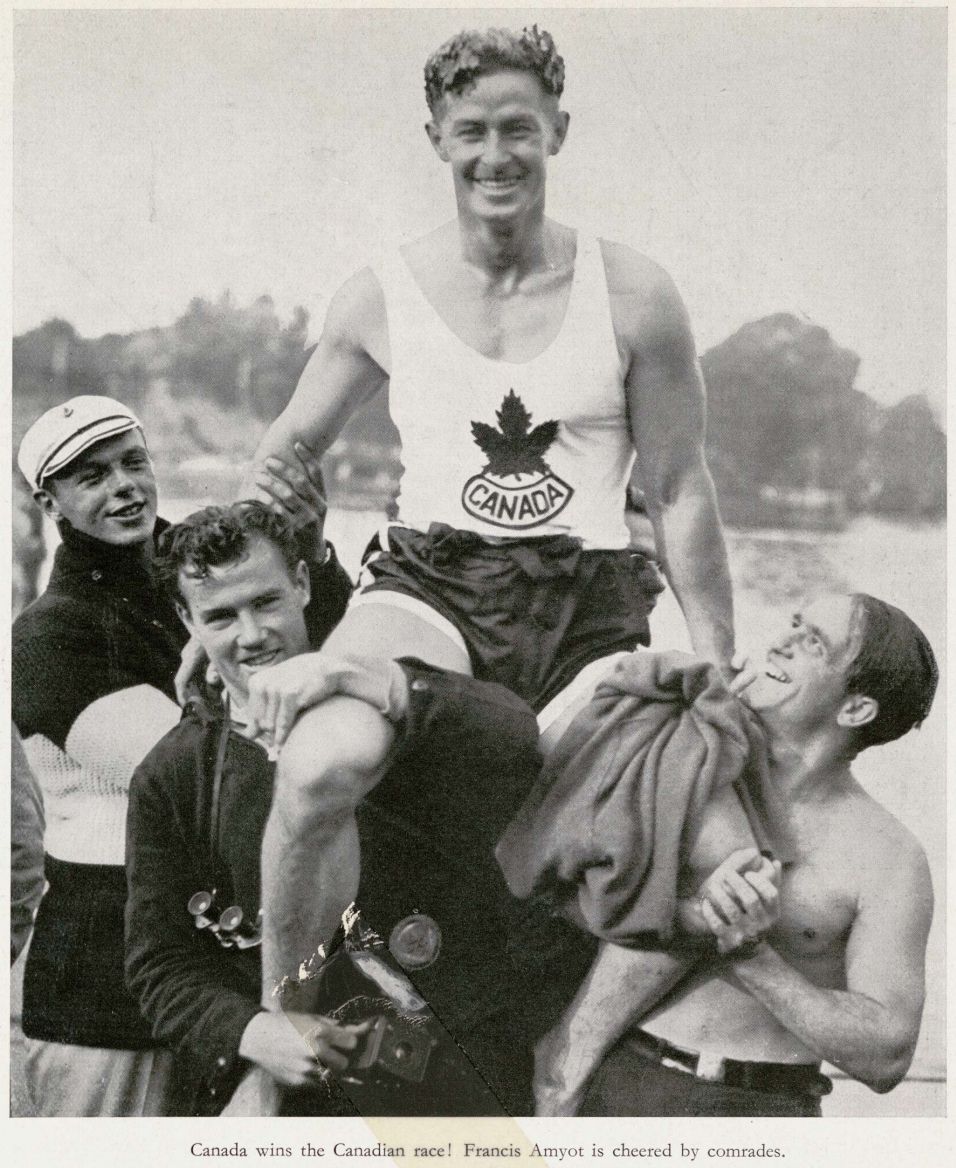
Frank Amyot of Canada carried by teammates after winning the C-1 1,000 m, Berlin 1936.
The Games at which sprint canoeing entered the programme. The source's caption names him "Frances"; he was Francis Amyot. The canoe events he won were closed to women until 2021.
Official report of the 1936 Games · CC0 · Wikimedia Commons
07Rule timeline
The sport’s own lane, expanded. Every entry carries a cause from the closed vocabulary and a citation, and says so where the citation is incomplete.
- 1972Broadcast and pacingadopted 1971
Slalom canoeing was contested at the Olympic Games for the first time, at Munich in 1972, on a purpose-built artificial course. It was then dropped and did not return until 1992. Munich's course was the first artificial whitewater channel built for competition, and it began the sport's transition from natural rivers to engineered ones.
Comparability break · Measurement scale changed
Artificial courses began replacing natural rivers, and every course is different from every other. There has never been a comparable slalom time. See the series
Trigger and citationIncomplete — no confirmed article
Trigger
Natural whitewater is unpredictable, inaccessible to spectators and impossible to schedule. An artificial course puts the sport in one place at a known time with a controllable water flow.
ICF Competition Rules · ICF Canoe Slalom Competition Rules, 1972
- 1990Fairness and eligibilityalso broadcast and pacingadopted 1990
Slalom penalties were simplified to two: two seconds for touching a gate, fifty seconds for missing one. The earlier system had graded penalties for different kinds of touch and different degrees of error. A result is therefore a time plus penalties, which means a fast run with two touches can lose to a slower clean one — and a missed gate ends any realistic chance, because fifty seconds is more than the spread of a whole field.
Comparability break · Measurement scale changed
Graded penalties became two seconds for a touch and fifty for a miss. A result is a time plus a penalty structure, and the structure changed. See the series
Trigger and citationIncomplete — no confirmed article
Trigger
Graded penalties required judges to assess the severity of a touch, which was inconsistent and difficult to explain. Two penalties, both large, are unambiguous.
ICF Competition Rules · ICF Canoe Slalom Competition Rules
- 2000Equipment and technologyalso fairness and eligibilityadopted 2000
Minimum boat lengths and weights were specified by class, and slalom boats in particular were given a minimum width after designs had become progressively narrower and faster through gates.
Trigger and citationIncomplete — no confirmed article
Trigger
Composite construction had let slalom boats become extremely narrow, which made them faster and less stable and pushed the sport towards an equipment race. Setting a minimum width froze the design.
ICF Competition Rules · ICF competition rules, boat specifications
- 2021Participation and accessalso commercialadopted 2017
Women's canoe events — as distinct from kayak — were added to the Olympic programme for the first time, in both sprint and slalom, by removing men's events to make room within the athlete quota. Until then, Olympic women could compete only in kayak. The canoe classes, paddled kneeling with a single-blade paddle, were men's events only.
Trigger and citationIncomplete — no confirmed article
Trigger
The IOC's requirement for gender parity across the programme forced the issue. The federation had run women's canoe world championship events for years without them reaching the Games.
This is the latest single-sex exclusion of any sport on this site to be corrected — later than boxing's admission of women in 2012, and eighty-five years after canoeing entered the programme. The reasons given historically for excluding women from canoe classes did not survive examination.
ICF Competition Rules · ICF competition rules, 2021
- 2024Broadcast and pacingalso commercialadopted 2022
Kayak cross was added to the Olympic programme: four paddlers descending a whitewater course together, starting by dropping from a ramp, with contact permitted and a required roll. It replaces a timed technical descent with a head-to-head race. Slalom is measured; kayak cross is a race in which competitors interfere with each other. They are different kinds of contest inside the same discipline.
Trigger and citationIncomplete — no confirmed article
Trigger
Slalom is a time trial run one boat at a time, so a spectator watching cannot tell who is winning without a scoreboard. Kayak cross puts four boats on the course at once and the winner is the one in front.
ICF Competition Rules · ICF Kayak Cross Competition Rules, 2024
08Equipment evolution
Canoeing's equipment rules are about stopping boats getting narrower, and its most consequential equipment change was not a boat at all.
The boats went from wood and canvas to fibreglass to carbon composite, and each material made them lighter and stiffer. Minimum weights and lengths by class hold that in check. Slalom boats acquired a minimum width after composite construction let them become extremely narrow — narrower is faster through a gate and less stable, and without a limit the sport was heading for an equipment race with a stability cost.
That is the same instrument cycling used in the Lugano Charter: define the shape and stop the arms race, rather than banning a specific design after it appears.
The artificial course is the change that matters most, and it is a venue rather than equipment. Munich built the first purpose-made whitewater channel for the 1972 Games, and slalom has been migrating from rivers to engineered channels ever since.
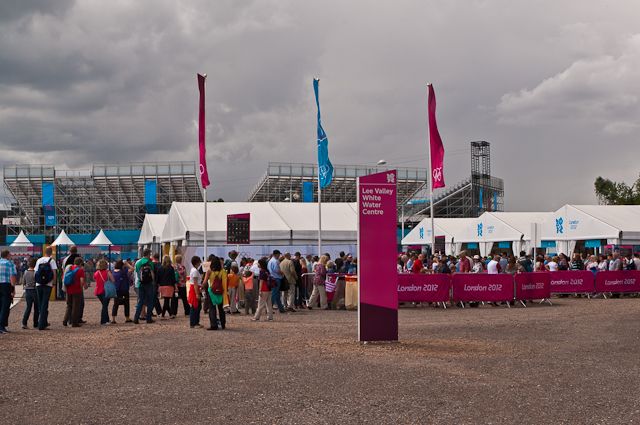
The Lee Valley White Water Centre during the London 2012 Games.
An engineered channel built for the Olympic slalom, and kept afterwards. A country that wants slalom paddlers now needs one of these.
Ian Capper · CC BY-SA 2.0 · Wikimedia Commons
A paddler through the gates at La Seu d'Urgell, Spain, 2019 World Championships.
Another purpose-built course, made for the 1992 Barcelona Games' slalom and still a championship venue.
Antoine Lamielle · CC BY-SA 4.0 · Wikimedia Commons
The effect parallels hockey's move to artificial turf: a controllable, schedulable, spectator-friendly surface replacing a natural one, at a cost. Whitewater courses are expensive facilities, there are not many, and a country without one cannot develop slalom paddlers.
Unlike hockey, canoeing did not mandate the change — it simply became necessary to be competitive, which is the quieter version of the same thing.
Rudders are permitted in sprint kayak and not in canoe, which is why holding a straight line in a canoe is a skill and in a kayak is a fitting.
09Governing body politics
The ICF's defining recent decision was correcting an exclusion it had maintained for eighty-five years.
Until the 2020 Games, Olympic women could compete in kayak events only. The canoe classes — kneeling, single blade — were men's events. Women's canoe world championship events had existed for years without reaching the Games, and the reasons historically offered for the exclusion did not survive examination.
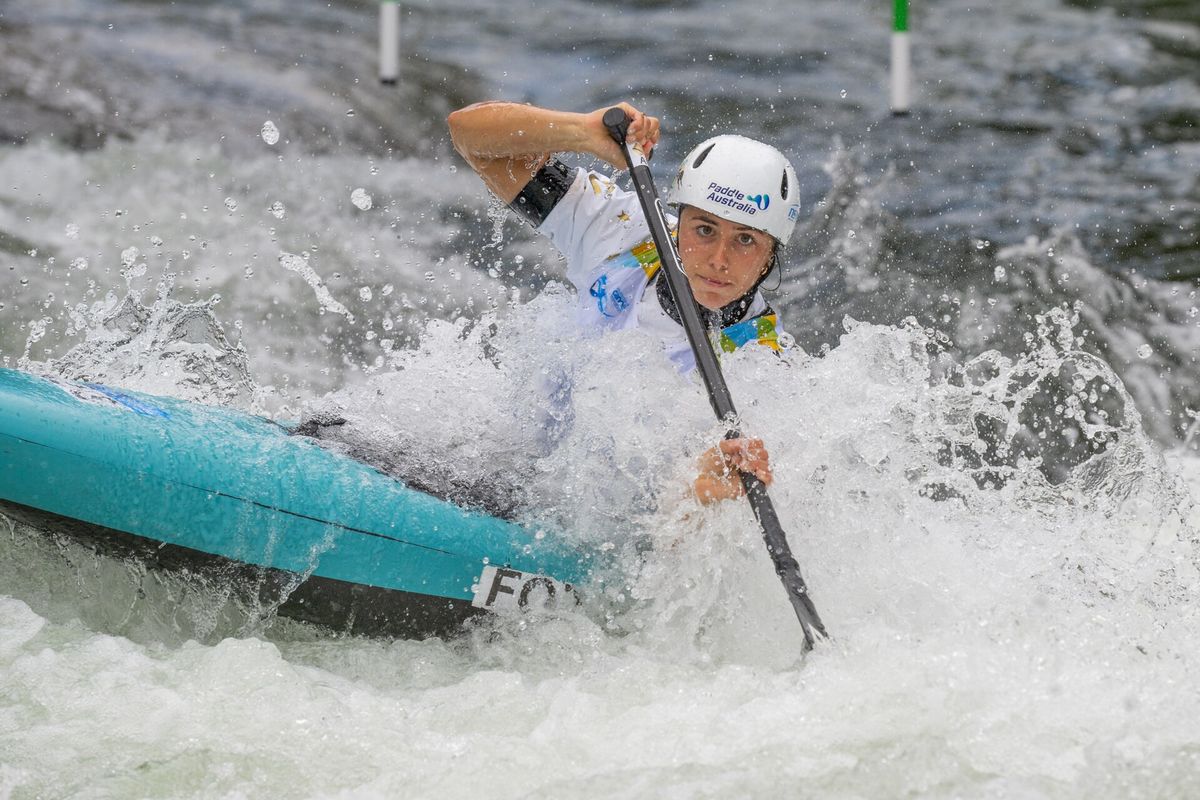
Noemie Fox of Australia in the women's C-1 at the 2022 World Championships, on the Augsburg Eiskanal.
Two of this page's arguments in one frame: the women's canoe class, absent from the Games until 2021, on the channel built for the 1972 slalom, the first of its kind.
Stefan Brending (2eight) · CC BY-SA 3.0 de · Wikimedia Commons
It took the IOC's gender-parity requirement to force it, and because the athlete quota is fixed, women's canoe events arrived by removing men's events. That is the same arithmetic rowing faced when it cut lightweight events and shooting faced when it removed three men's events for mixed teams: parity inside a quota means exchange, and something gets deleted.
This is the latest such correction of any sport on this site. Boxing admitted women in 2012; canoeing's canoe classes waited until 2021.
The federation's other structural problem is that it governs two sports. Sprint's constituency is flat-water clubs; slalom's is whitewater, requires expensive artificial courses, and has a much narrower geography. They compete for the same quota and the same attention, and kayak cross — added for 2024 — is slalom's attempt to become more watchable without becoming sprint.
The artificial course question underlies everything in slalom. A sport that needs a purpose-built engineered channel has a facility barrier it did not choose and cannot easily reverse.
10Controversies that forced rule changes
Women in canoe. The longest-running and least defensible. Olympic women could paddle kayaks from 1948 and could not contest canoe events until 2021 — eighty-five years after the sport entered the programme. The federation ran women's canoe world championships for years while the Olympic classes stayed closed.
The correction, when it came, was forced by the IOC's parity requirement and paid for by deleting men's events. It is the latest such exclusion to be ended of any sport on this site.
The fifty-second gate. Slalom's penalty structure was simplified around 1990 to two values: two seconds for a touch, fifty for a miss. Fifty seconds is larger than the spread of an entire elite field, so a missed gate is not a penalty but an elimination.
That is deliberate and defensible — it makes the sanction unambiguous and removes a judge's assessment of severity — and it means canoe slalom punishes a single error more harshly than almost anything else on this site.
The unwatchable time trial. Slalom sends one boat down at a time against a clock, so a spectator cannot tell who is winning. Kayak cross, added for 2024, is the answer: four boats at once, contact permitted, first down wins.
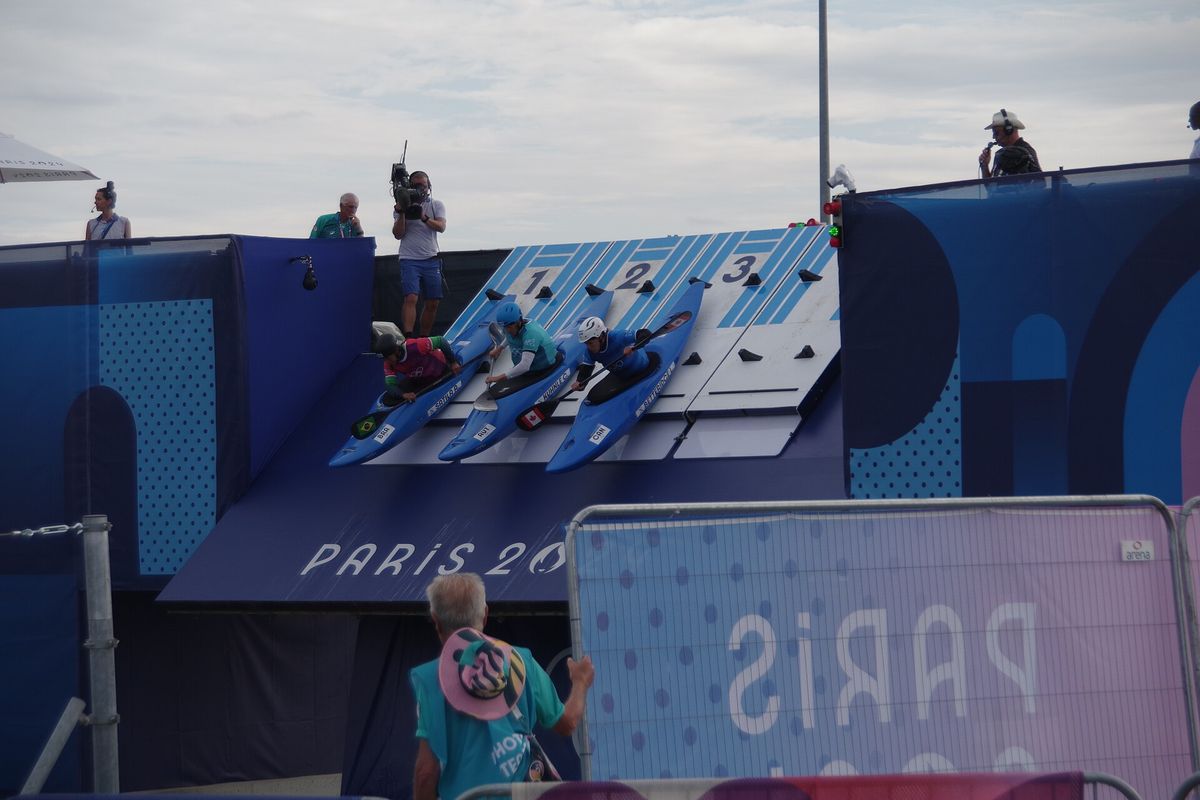
Four kayaks on the start ramp in kayak cross, Paris 2024.
The discipline's answer to an unwatchable time trial: four boats released together, first to the bottom wins.
AlSepPhoenix · CC BY 4.0 · Wikimedia Commons
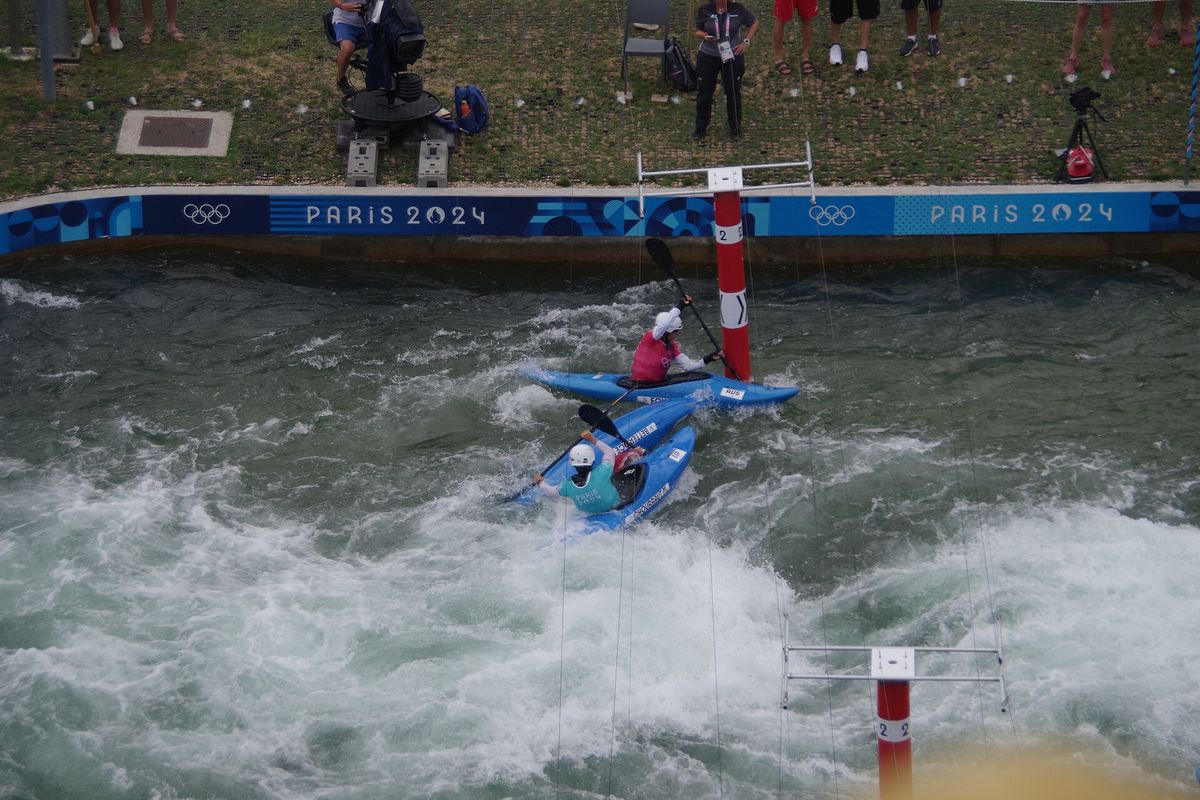
Kayak cross boats together in the water, Paris 2024.
Contact is permitted, which asks officials a question slalom spent a century avoiding: whether the contact was legitimate.
AlSepPhoenix · CC BY 4.0 · Wikimedia Commons
It is a race inside a discipline built on measurement, and whether it belongs in the same sport is exactly the argument climbing has about speed.
The narrowing boat. Composite construction made slalom boats progressively narrower and less stable through the 1990s. A minimum width froze the design before it became an arms race.
Where it standsthe record, and what is still open · sections 11 to 12
11Series
No series can exist
Slalom times
A canoe slalom result is a run time plus penalties, on a course that is different at every event and different again depending on where the gates were hung that morning. Nothing about it is comparable. The water flow varies, the gate positions are set for each competition, and artificial courses differ from each other and from natural rivers. A time from one venue means nothing at another, and the federation has never suggested otherwise. Sprint is the opposite case and belongs in the same entry for contrast. A 1000 m sprint on flat water is closer to rowing's problem: a standardised distance, in lanes, with wind and water that nobody controls. Rowing decided its times were world best times rather than records, and canoeing recognises best times in the same way and for the same reason. So this federation runs one discipline whose times cannot be compared because the course changes, and another whose times cannot be compared because the conditions do — and it has handled both by declining to claim they are a series.
1972Measurement scale changedArtificial courses began replacing natural rivers, and every course is different from every other. There has never been a comparable slalom time.
1990Measurement scale changedGraded penalties became two seconds for a touch and fifty for a miss. A result is a time plus a penalty structure, and the structure changed.
12What is contested now
Recorded as unsettled.
Whether kayak cross belongs. Four boats, contact permitted, first down wins — inside a discipline built on individual timed descents. It makes slalom watchable and it is a different kind of contest. Sport climbing is having exactly this argument about speed, and neither federation has resolved it.
The cost of whitewater. Competitive slalom increasingly requires an artificial course, which is an expensive engineered facility. The sport's geography has contracted to countries that can build one, and no rule change addresses it — the same problem hockey has with turf and swimming has with pools.
Parity paid for by deletion. Women's canoe events arrived in 2021 by removing men's events, because the athlete quota is fixed. That is the correct outcome reached by a mechanism nobody defends, and it will recur every time the programme is rebalanced.
The fifty-second penalty. Unambiguous, and severe enough that a single missed gate ends a run outright. Whether a sport should punish one error that heavily is argued after every major final, and the counter-argument — that any graded alternative reintroduces a judge's assessment of severity — has held so far.
Two sports, one federation. Sprint and slalom share a paddle, a quota and almost nothing else, and every programme decision sets them against each other.