Croquet
Its club became Wimbledon and the tennis players took the lawns; its one Olympic appearance drew a single paying spectator.
- Official
- Croquet
- Game category
- Target
- Adjudication
- Decided by score
- Standing
- Lapsed pre-1940
- rule changes
- 5
- comparability breaks
- 2
- Olympic edition
- 1
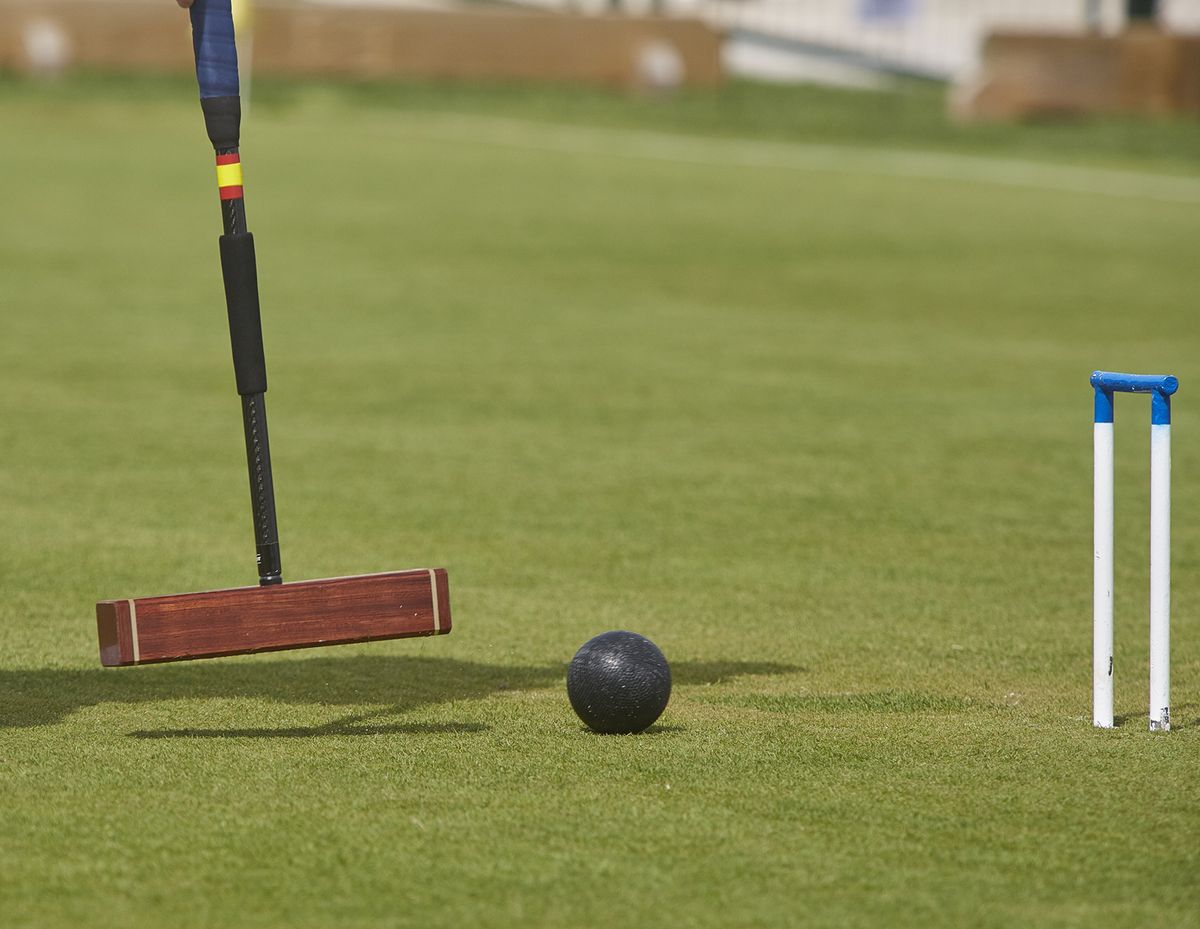
A mallet, a ball and a hoop at a tournament, 2018 · Guillermo Navarro · CC BY-SA 4.0
- Governing body
- World Croquet Federation
- Founded
- Codified in England in the 1860s, with the first championship in 1867 and the All England Croquet Club founded in 1868; the World Croquet Federation was formed in 1986.
- Olympic status
- 1 edition
- not on the 2028 programme
- Also contested at
- No other programme here
Two codes under one name. Association croquet lets a good player run the entire course in a single turn, so the sport's central skill is constructing a break and its central problem is that an opponent may not get to play. Golf croquet removed all of that — one stroke each, all four balls contesting one hoop — and has become the larger game. Contested at one Olympic Games, in 1900, with women among the competitors.
The gamewhat it is now · sections 1 to 5
01How it is played
Six hoops and a peg on a lawn thirty-five yards by twenty-eight, four balls, two sides. In association croquet a turn can last the whole game; in golf croquet a turn is one stroke.
These figures were entered from the edition named above but have not been checked against its text line by line. Treat them as this site’s reading of the laws, not as a substitute for them.
The object of the game
Association croquet: run both your balls through all six hoops in order, in both directions, and finish by hitting the peg — twenty-six points in all. A turn continues as long as you keep scoring or hitting other balls.
Golf croquet: all four balls contest one hoop at a time, in strict rotation, one stroke each. Whoever runs the hoop wins the point and everybody moves on to the next.
The two share equipment and share almost no tactics.
- Association
- 26 points — 12 hoops each way, plus the peg
- Golf croquet
- One hoop at a time, one stroke per turn
The lawn
Thirty-five yards by twenty-eight of mown grass, with six hoops in a fixed arrangement and a peg in the centre.
The hoops are the precision. At championship level a hoop is only fractionally wider than the ball — a clearance measured in fractions of a millimetre — so running one from any distance is a genuine feat and running one from an angle is close to impossible.
- Lawn
- 35 × 28 yd
- Hoops
- Six, plus a centre peg
- Clearance
- A fraction of a millimetre at championship level
Mallet, balls and hoops
A mallet with a long head, struck with either face. Four balls — blue and black against red and yellow — and each side plays both of its own, choosing which one to play at the start of each turn.
That is worth stating plainly, because it is unusual: a croquet player controls two of the four objects on the field and must manage both, so a singles match involves each player operating a pair.
- Balls
- Four — each side plays two
- Mallet
- Struck with either face
- Choice of ball
- Made at the start of each turn
A mallet, a ball and a hoop at a tournament, 2018.
Everything the rules specify, in one frame.
Guillermo Navarro · CC BY-SA 4.0 · Wikimedia Commons
Players and officials
Singles or doubles. In singles each player controls two balls; in doubles each player controls one.
There is no referee in ordinary play. Players call their own faults and may call a referee to watch a difficult stroke or adjudicate a contested one — a self-officiating structure with an official available on request.
- Singles
- Each player plays two balls
- Officiating
- Self-called, with a referee on request
Time
Association games are played to the full twenty-six points or to a time limit, and a championship game can run for hours. Golf croquet is much faster, played to seven or thirteen hoops.
- Association
- Hours, or to a time limit
- Golf croquet
- 7 or 13 hoops
Scoring
One point per hoop run, plus the peg in association. Nothing is awarded for the manner of it.
In handicap play, the weaker side receives bisques — free extra turns, taken at a moment of their choosing. A bisque is spent when a break has broken down, which is when an extra turn is worth most, so the handicap does not merely add strokes but hands the recipient the right to undo their worst moment.
- Bisque
- A free turn, taken when the recipient chooses
This clause reads this way because of
The turn
A turn is one stroke, extended by success. Running a hoop earns one extra stroke. Roqueting another ball earns two: a croquet stroke, taken with your ball placed against the one you hit so that both move, and then a continuation.
Each ball may be roqueted once per turn, and the count resets when a hoop is run — which is the mechanism that makes a long break possible and also what ends one.
- Run a hoop
- One extra stroke
- Roquet
- Two strokes, the first a croquet stroke
- Reset
- Roquets refresh when a hoop is run
This clause reads this way because of
Faults
Pushing or pulling the ball rather than striking it cleanly. Striking with anything but a mallet face. Touching a ball with the body. Playing a wrong ball. Failing to move both balls in a croquet stroke, or sending the croqueted ball off the lawn.
Almost all of these are called by the player who committed them, because almost all are visible only to them.
Deciding the winner
Twenty-six points, or the higher score at a time limit, or the majority of hoops in golf croquet. In association play a game can end with the loser having had very few turns, which is the reason the handicap exists.
Everything above is current law. Everything below is how Croquet got here.
02Disciplines and events
Contested at one Olympic Games, in 1900, and never again. The World Croquet Federation runs world championships in both codes, and the simpler of the two is now the larger sport.
- Disciplines
- 2
- Olympic medal events
- 0
- Men’s and women’s counted separately.
- Contested elsewhere
- 9
- world championship, federation only, lapsed.
- Listed for context
- 2
- Not counted as this sport.
Association croquet4
The championship code, built on the break. Twenty-six points.
- World championship singlesWorld championship
- World championship doublesWorld championship
- MacRobertson ShieldWorld championshipA quadrennial team contest between Australia, England, New Zealand and the United States — the oldest and most prestigious event in the code.
Golf croquet4
One stroke per turn, all four balls contesting one hoop. Simpler, faster, and now the larger game worldwide.
- World championship singlesWorld championship
- World championship doublesWorld championship
Its Olympic record1
- Croquet, Paris 1900LapsedContested once, almost entirely by French entrants, with women among the competitors — and reportedly one paying spectator.
Games in the same family3
- RoqueLapsedAn American hard-court variant with a raised border, contested at the 1904 Olympics and effectively extinct.
- GateballFederation onlyA Japanese team derivative from the 1940s, played five a side on a much smaller court to a strict clock, with a very large participation base in East Asia.
- Ricochet and other national codesFederation onlyAustralian variants played domestically.
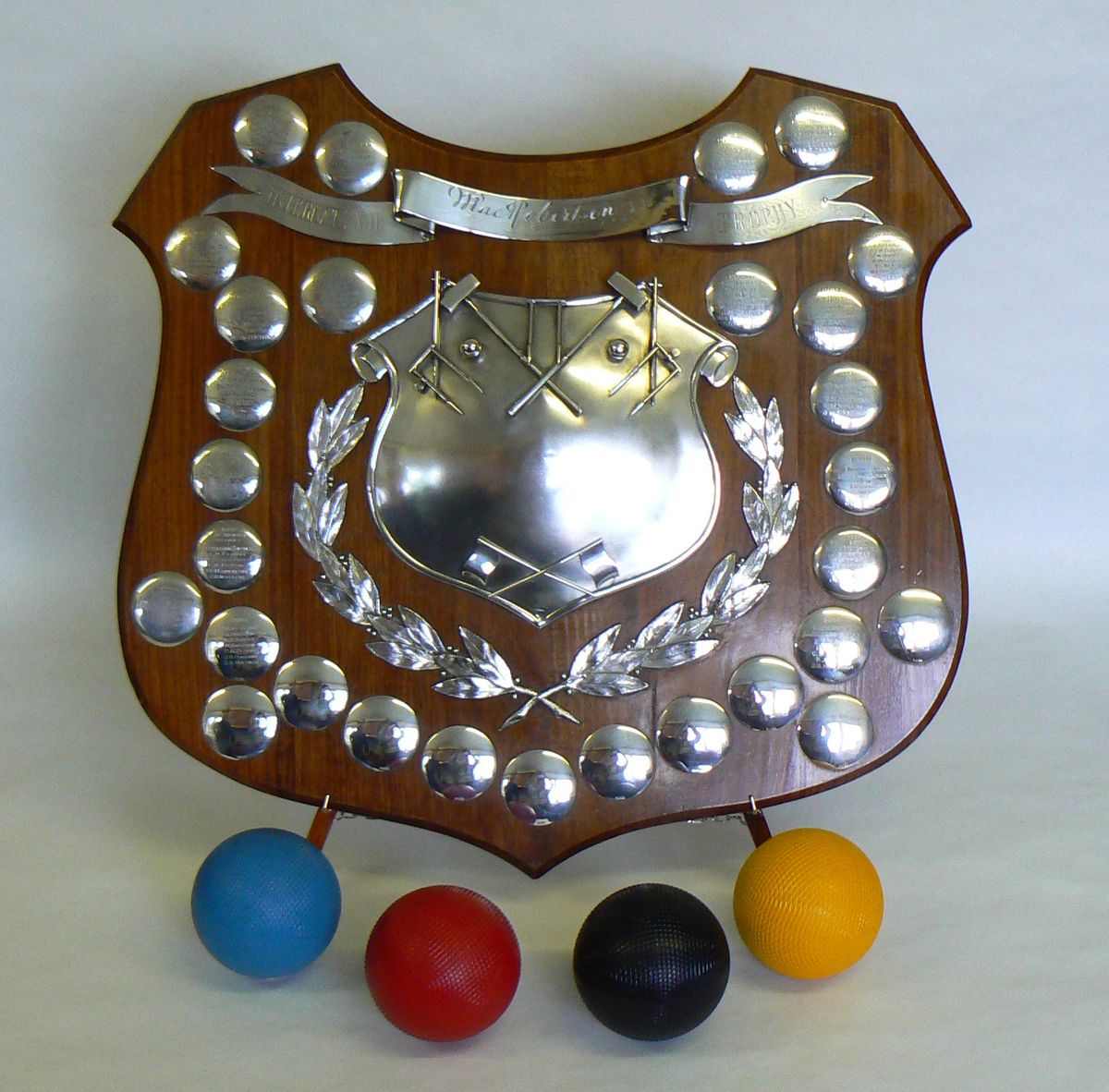
The MacRobertson Shield, with the four balls of association croquet.
The oldest and most prestigious team contest in the code, played between Australia, England, New Zealand and the United States.
Christine Irwin · CC BY 3.0 · Wikimedia Commons
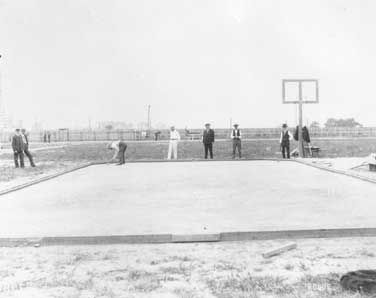
Roque at the 1904 St. Louis Games.
The American hard-court variant with a raised border, contested at the Olympics once and now effectively extinct.
Photographer unknown · Public domain · Wikimedia Commons
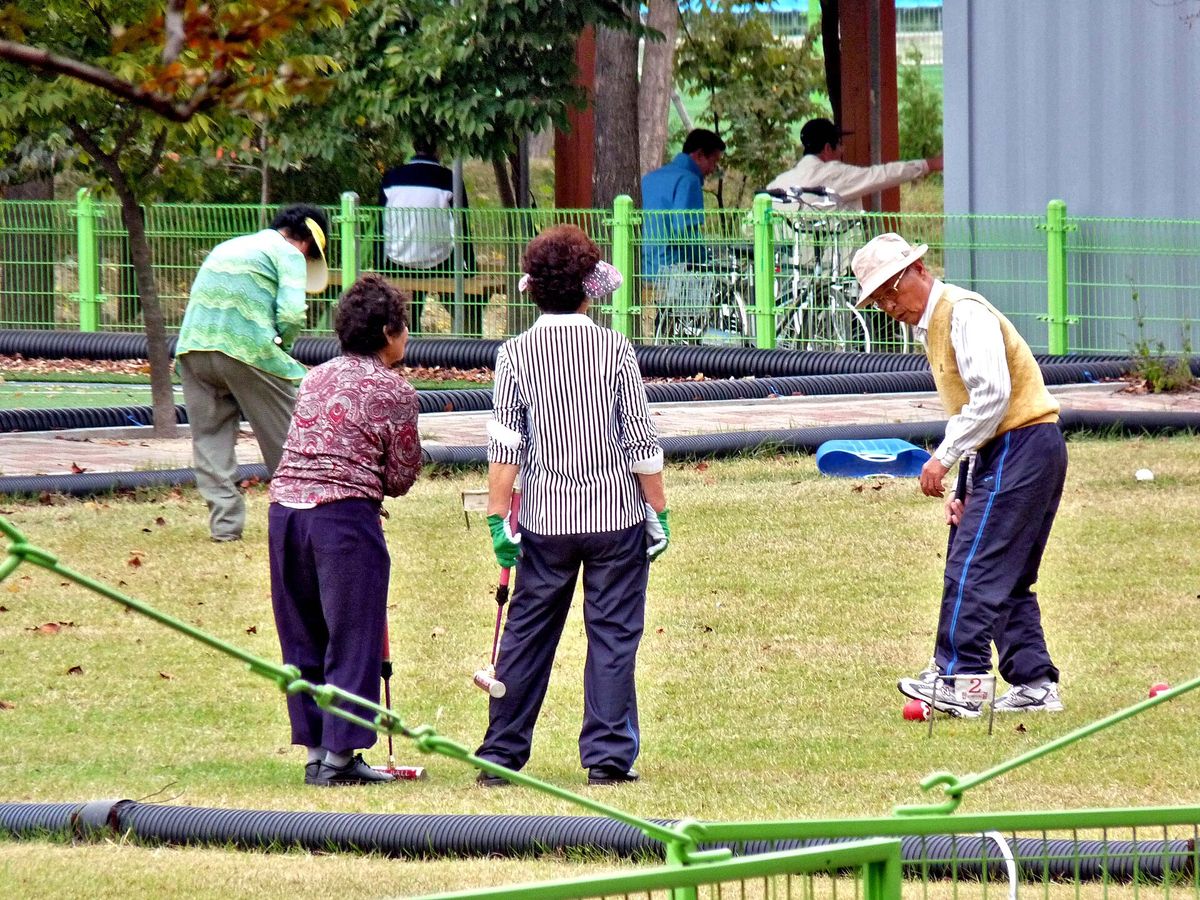
Gateball at a citizens' festival in Gyeongju, South Korea, 2008.
The Japanese team derivative from the 1940s, played to a clock on a small court, with a participation base across East Asia far larger than croquet's.
Grete Howard · CC BY 3.0 · Wikimedia Commons
03Officiating
Players call their own faults, and call an official over when they would rather not.
Croquet is self-officiated in ordinary play, and the reason is practical: most faults are visible only to the person committing them. Whether a mallet pushed rather than struck the ball, whether contact was momentary or sustained, whether both balls moved in a croquet stroke — these happen at the striker's feet and nobody else can see them.
So the laws place the obligation on the striker, and croquet's culture around that is strict. Calling a fault against yourself in a match you are winning is expected rather than admirable.
Referees exist and are requested. A player may call one to watch a difficult stroke before playing it — a hampered shot near a hoop, or a croquet stroke where a fault is likely — which is an unusual arrangement: the official is summoned in advance to observe a specific act, rather than positioned to watch everything.
Contested strokes and questions of law go to a referee or, in tournaments, to a tournament referee whose ruling stands.
That structure puts croquet alongside ultimate, orienteering and boules on this site: sports where the competitor is trusted with the adjudication, for different reasons. Ultimate made it a principle, orienteering replaced it with an electronic record, boules can settle its central question with a ruler, and croquet does it because nobody else has the angle.
04Where it is played
The old English-speaking clubs, and Egypt.
England, Australia, New Zealand and the United States are croquet's historic competitive nations, and the MacRobertson Shield — contested between those four — remains the most prestigious event in association croquet. Club structures in all four are long-established, well organised and, in most places, ageing.
Egypt is the outlier and the most interesting thing in the sport's modern geography. Egyptian players dominate golf croquet at world level, from a deep domestic structure centred on Cairo clubs, and they arrived in the code the traditional powers had regarded as the simpler one. It is the same shape of story this site records for Colombia in ultimate, finswimming and roller speed skating: a country concentrating on a sport nobody else was funding, and winning it.
Beyond those, croquet is played in Ireland, Scotland, Wales, Canada, South Africa, Japan, Spain, Italy and Latvia, generally in small club numbers.
The constraint is the lawn. Croquet needs level, closely mown grass maintained to a consistent speed, which is a groundskeeping commitment rather than a purchase — so the sport exists where a club owns and maintains ground, and almost nowhere else.
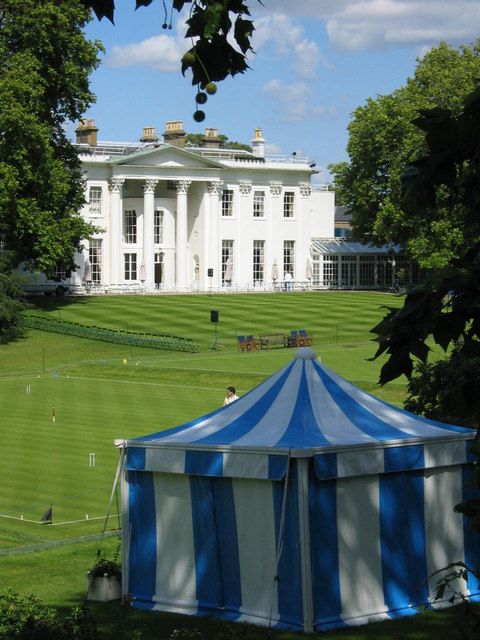
Hurlingham House and its croquet lawns, London, 2007.
Level grass, closely mown and kept at a consistent speed, owned by a club: the requirement that confines croquet to where clubs already exist.
Carol · CC BY-SA 2.0 · Wikimedia Commons
Gateball, the Japanese team derivative from the 1940s, has a participation base across East Asia far larger than croquet's worldwide, and is governed entirely separately.
05Learning curve
Golf croquet is understood in one turn and association croquet takes years — and the handicap means a beginner can play a competitive match against a champion in either, which almost nothing else on this site can offer.
Editorial — the site’s reading, not a sourced claim
Barrier to entry
How hard is it to get to a real game?
A club with a lawn. Golf croquet is playable properly within an hour, and bisques make you competitive at once.
Golf croquet is the easiest competitive entry on this site after pétanque. One stroke per turn, all four balls contesting the same hoop, no roquets and no breaks — the rules take two minutes and a beginner is playing the real game immediately, not a simplified version of it.
Association croquet is much harder to begin, because the break is the game and a beginner cannot construct one. That is precisely what the bisque is for: free turns spent when your break collapses, which is every turn at first.
Between them, croquet is unusually good at letting a novice compete honestly against an expert. The barrier is the lawn — mown, level, and belonging to a club — which is a real facility requirement and the reason the sport lives where clubs exist.
Evidence
- Golf croquetPlayable properly in an hourrule1996 — the rule this rests on
- BisquesFree turnsrule1868 — the rule this rests on
- Kit to startProvided by the clubobserved
- FacilityA mownobserved
- Physical demandVery low; playable at any ageestimate
Barrier to the top
How hard is it to be good at?
Running the whole course in one turn, through hoops barely wider than the ball, using three balls you did not choose the position of.
Association croquet's ceiling is one of the least visible on this site. A top player wins by taking a break — using the other three balls as stepping stones, croqueting each into the position it will be needed in several strokes later, and running hoop after hoop without the opponent playing.
That requires planning a sequence many strokes ahead while executing croquet strokes that must send two balls to two different places with one swing. The elite version, the triple peel, involves knocking your partner ball through its remaining hoops during your own break so that the game can be finished before an opponent gets in.
The precision is unforgiving: championship hoops are set with a clearance over the ball measured in fractions of a millimetre, so a hoop that would be a formality at club level is a genuine shot.
Golf croquet's ceiling is different and not lower — with no breaks, every stroke is a tactical decision made against three other balls, and elite golf croquet is a positional game of extreme accuracy over distance.
Evidence
- The breakA turn can last the whole gameruleA skilled player wins without the opponent taking a meaningful turn.1868 — the rule this rests on
- Hoop clearanceFractions of a millimetreobservedChampionship hoops are barely wider than the ball.
- Two balls eachIn singlesobservedA player manages a pair, not a ball.
- Typical peak age30–55estimateAmong the longest competitive spans covered here.
Why the two differ
Low to very high — and croquet's handicap makes the gap unusually *crossable* rather than unusually narrow.
This site has now found three deliberate comparability solutions: golf's stroke handicap, polo's awarded goals, and croquet's bisques. All three come from sports played across enormous ability ranges in club settings, and croquet's is the most powerful of the three, because the recipient chooses when to spend it. Golf adjusts your score afterwards and polo adds goals before play; a bisque lets you undo the moment your game fell apart.
The other thing croquet demonstrates is what happens when a sport's central mechanism is also its barrier. The break is the reason association croquet is beautiful and the reason it is hard to take up, and the federation's answer was not to change it but to run a second code without it. Golf croquet is now the larger game.
The historyhow it got here · sections 6 to 10
06Origin and invention
Croquet's founding club became Wimbledon, and tennis took the lawns.
The game arrived in England in the 1850s, probably from Ireland, and spread with extraordinary speed — a lawn game that could be played by men and women together, in ordinary clothes, on a garden lawn, at a moment when very little else could. Manufacturers sold sets by the hundred thousand.
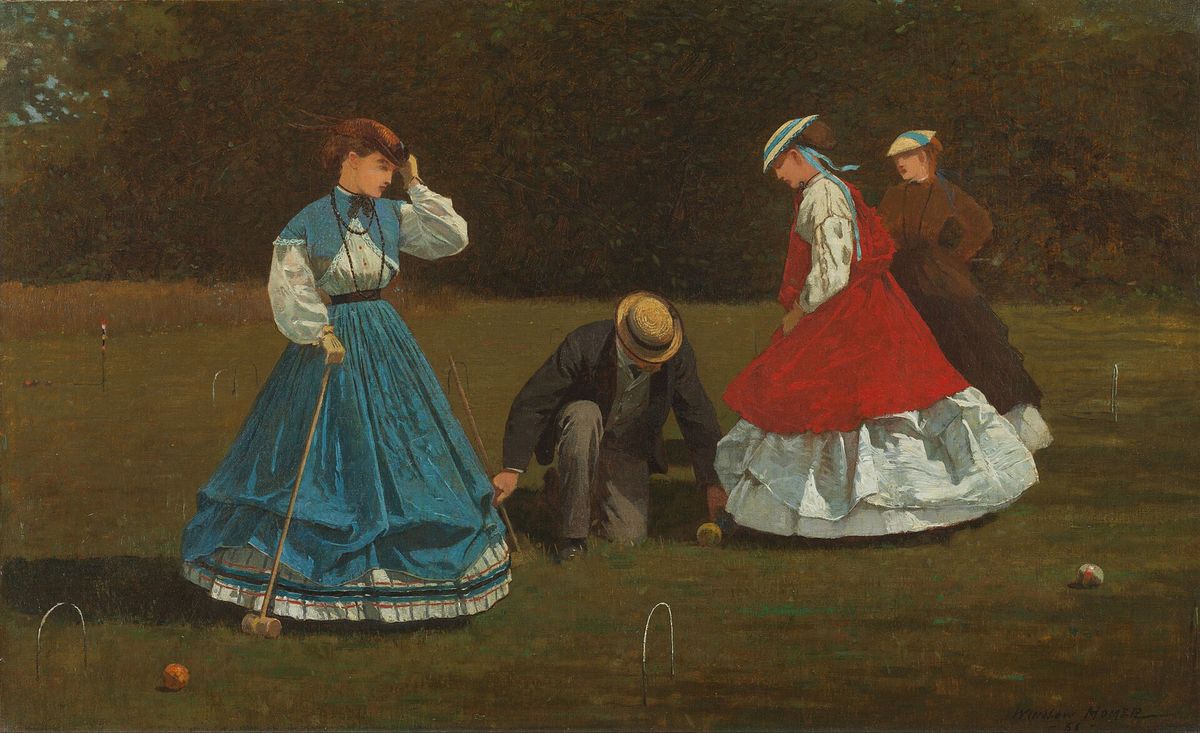
Winslow Homer, Croquet Scene, 1866.
Painted in the years of the craze: men and women playing together, in ordinary clothes, on a lawn. Very few games of the period allowed any of that.
Winslow Homer · Public domain · Wikimedia Commons
Competition followed quickly. The first championship was held at Moreton-in-Marsh in 1867, and the All England Croquet Club was founded in 1868 at Wimbledon to run the sport properly.
Nine years later that club added lawn tennis to its name and held the first Wimbledon championship on its croquet lawns. Tennis was faster, more physical and more appealing to the club's younger members, and it displaced croquet so completely that the club dropped croquet from its title within a few years — later restoring it as a courtesy. The most famous tennis venue in the world is a croquet club that was taken over by a sport it let in.
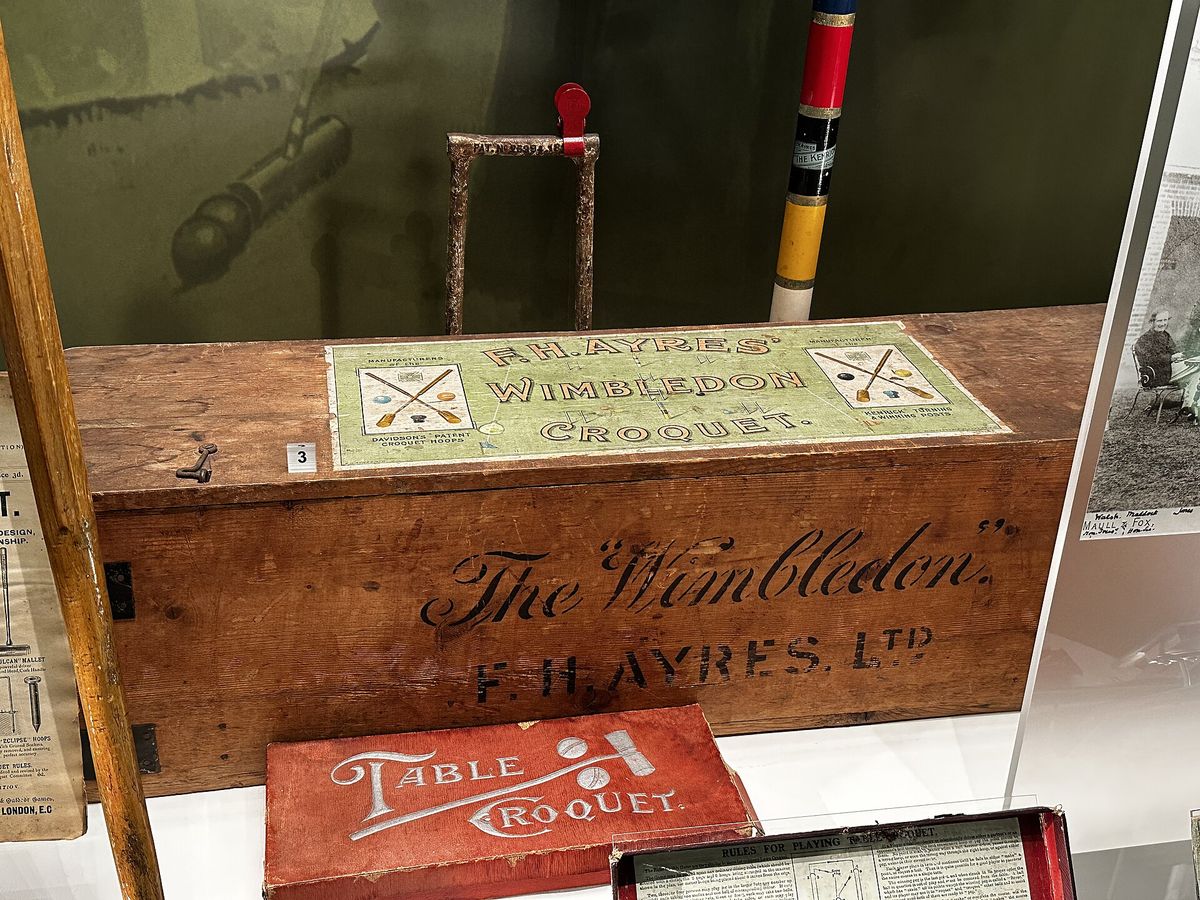
An F. H. Ayres "Wimbledon" croquet set, in the Wimbledon Lawn Tennis Museum.
The club the sport founded, remembered by the sport that took it over: croquet's equipment kept in a tennis museum.
Matt Brown · CC BY 4.0 · Wikimedia Commons
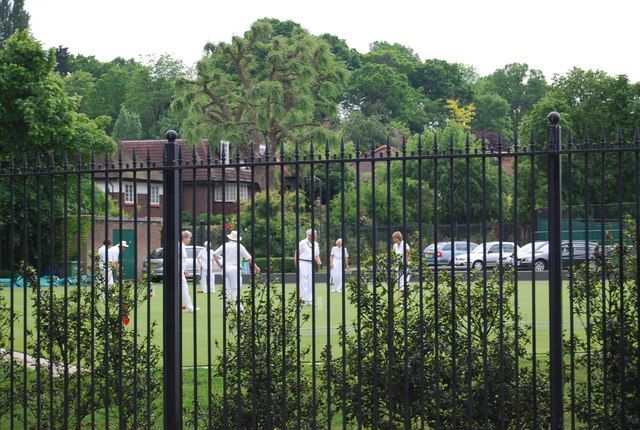
Croquet on the lawns of the All England Lawn Tennis and Croquet Club, 2011.
The game is still played at Wimbledon, behind the fence, in the club whose name restored it as a courtesy.
N Chadwick · CC BY-SA 2.0 · Wikimedia Commons
Croquet was contested at the 1900 Paris Olympics, almost entirely by French entrants, with women among the competitors — it is one of the first Olympic sports in which women took part. It has never been contested since, and the tournament is best remembered for having reportedly drawn a single paying spectator.
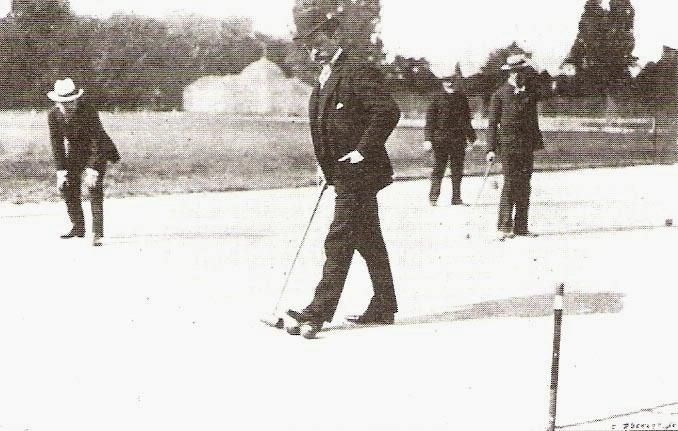
A croquet match at the 1900 Paris Games.
The sport's only Olympic tournament, contested almost entirely by French entrants and reportedly watched by one paying spectator.
Photographer unknown · Public domain · Wikimedia Commons
The World Croquet Federation was formed in 1986, and in 1996 established a world championship for golf croquet — a code that removes the break entirely, and which has since become the larger game.
07Rule timeline
The sport’s own lane, expanded. Every entry carries a cause from the closed vocabulary and a citation, and says so where the citation is incomplete.
- 1868Fairness and eligibilityadopted 1868
Croquet was codified around the rule that defines it: striking another ball — a roquet — earns two further strokes, the first of which is taken with your ball placed in contact with the one you hit. That is what creates the break. A player who can roquet, croquet a ball into a useful position, run a hoop and roquet again can continue indefinitely, using the other three balls as tools to carry themselves round the course. A strong player may run the entire game in one turn. Nothing else on this site gives a competitor an unbounded turn purchased by skill. Snooker's break is the closest, and a snooker player cannot move the other balls to wherever they need them next.
Trigger and citationIncomplete — no confirmed article
Trigger
Croquet spread rapidly as a lawn game in the 1850s and 1860s with rules varying by household, and competition required one code.
WCF Laws of Association Croquet and Rules of Golf Croquet · WCF Laws of Association Croquet
- 1868Participation and accessalso fairness and eligibilityadopted 1868
The bisque: a weaker player receives a number of free extra turns, taken whenever they choose, calculated from the difference between the two players' handicaps. It is croquet's answer to the problem the break creates. Without a handicap, a player who can construct breaks beats one who cannot without the loser ever taking a meaningful turn, and there is no contest at all. A bisque is more powerful than golf's stroke allowance or polo's awarded goals, because the recipient decides *when* to spend it — at the moment their break has broken down, which is exactly when it is worth most.
Comparability break · Scoped to one competition
Handicap results depend on bisques and on a handicap that is revised as a player improves. See the series
Trigger and citationIncomplete — no confirmed article
Trigger
A game in which one player can complete the course without the other playing is unplayable between people of different standards, which is most games of croquet.
WCF Laws of Association Croquet and Rules of Golf Croquet · WCF Laws, handicap play
- 1877Commercialalso participation and accessadopted 1877
The All England Croquet Club, founded in 1868 for croquet, added lawn tennis to its name in 1877 and held the first Wimbledon championship on its croquet lawns that year. Tennis displaced croquet so completely that the club dropped croquet from its title within a few years and later restored it as a courtesy. The world's most famous tennis venue is a croquet club that was taken over by the sport it had let in. This site records it as a rule change because it is one: the lawns, the club and the constituency that had made croquet a competitive sport in England were reallocated within a decade, and croquet never recovered the ground.
Trigger and citationIncomplete — no confirmed article
Trigger
Lawn tennis was faster, more physically appealing to a young membership, and could be played on the same grass. The club that had been built for croquet found its members preferred it.
WCF Laws of Association Croquet and Rules of Golf Croquet · All England Club history
- 1900Participation and accessAdopted, then rescinded before it was ever enforcedadopted 1900
Croquet was contested at the Paris Games in 1900 and never again. The entrants were almost entirely French, and women competed — croquet is among the first Olympic sports in which they did. The tournament is also the standing example of Olympic obscurity: it is reported to have drawn a single paying spectator, an Englishman who travelled from Nice.
Trigger and citationIncomplete — no confirmed article
Trigger
The 1900 Games were run alongside the Paris Exposition with a sprawling and loosely defined programme, into which croquet fitted as an established French and English lawn game.
Olympedia · Olympedia, croquet 1900
- 1996Participation and accessalso broadcast and pacingadopted 1996
A world championship was established for golf croquet, the simpler code: one stroke per turn, all four balls contesting the same hoop in order, no roquets, no croquet strokes and no breaks. It has since become the larger game worldwide by participation, and decisively so in Egypt, which is now among the strongest nations in the sport. A federation whose founding code lets one player finish the game alone now governs a second code built by removing that possibility — and the second one is winning.
Comparability break · Scoped to one competition
Two codes, scored differently and contested by different fields. Results belong to a code, not to croquet. See the series
Trigger and citationIncomplete — no confirmed article
Trigger
Association croquet is difficult to learn, slow to become competitive at, and can leave a beginner sitting out while an opponent plays. Golf croquet guarantees both players a stroke and is understood immediately.
WCF Laws of Association Croquet and Rules of Golf Croquet · WCF Rules of Golf Croquet
08Equipment evolution
A mallet, four balls, six hoops and a peg — and the hoops are the part that became a precision instrument.
The hoops are where croquet's difficulty lives. A garden set has hoops comfortably wider than the ball, and running one is a formality. A championship hoop is set with a clearance measured in fractions of a millimetre, firmly in ground prepared so it will not move, and running one from any distance or angle is a genuine shot.
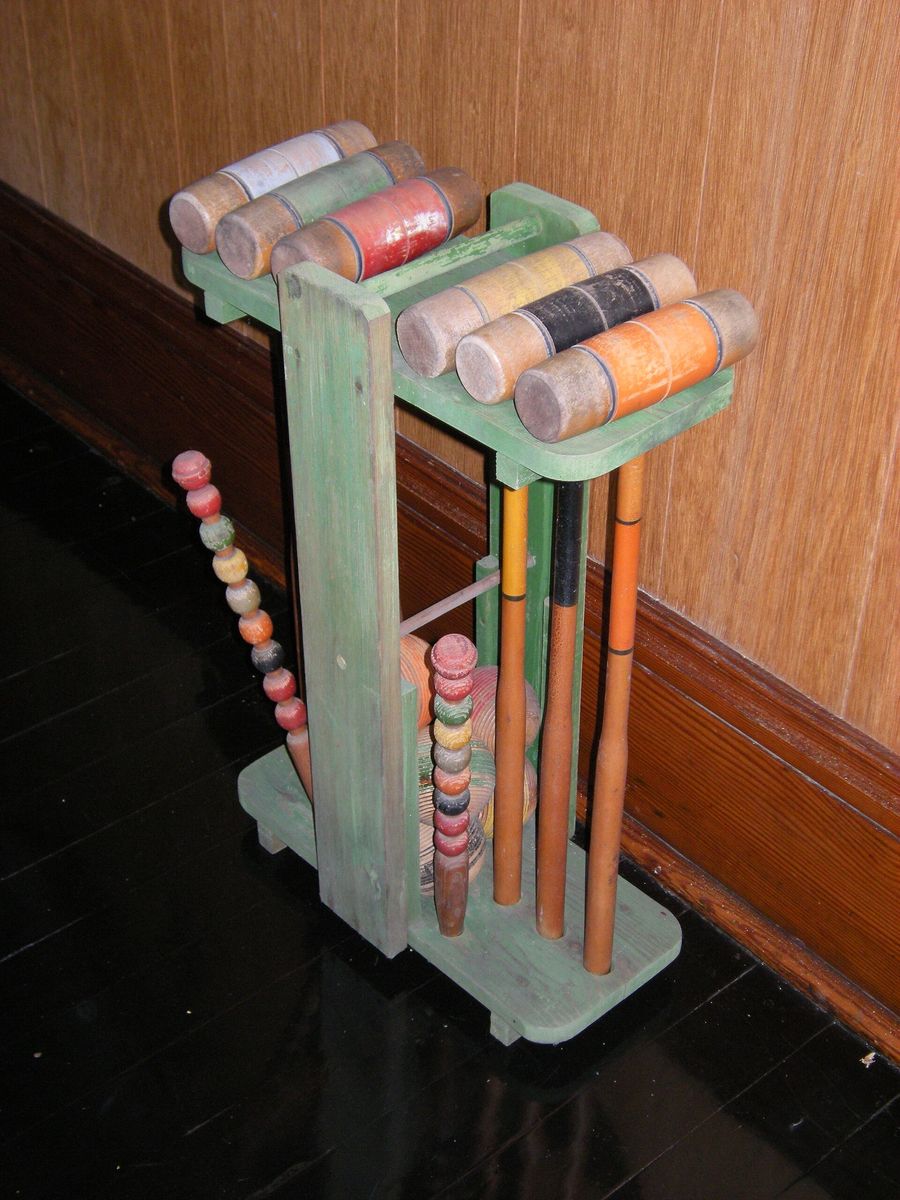
An old garden croquet set in its stand.
Wooden mallets, striped balls and thin wire hoops, far wider than the ball: the game most people have played, in which running a hoop is a formality.
Joe Mabel · CC BY-SA 3.0 · Wikimedia Commons
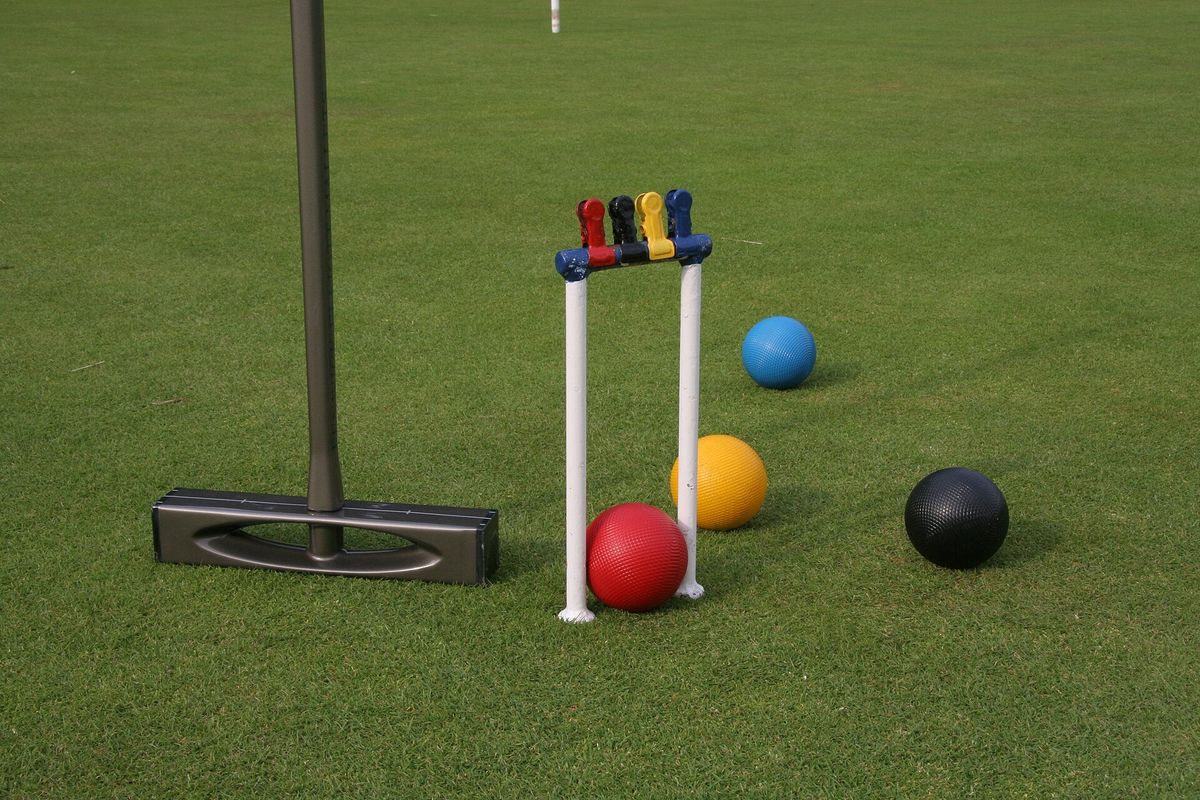
A carbon-fibre mallet, composition balls and a cast-iron championship hoop.
The same four balls and the same hoop, tightened until running one is a real shot: the hoop's clearance over the ball is a fraction of a millimetre.
Winnywinn · CC BY-SA 3.0 · Wikimedia Commons
That single specification is most of the difference between the game people have played at a party and the sport. It is the same relationship this site records between a pub pool table and a competition snooker table, or a recreational bowling lane and a sport oil pattern: the equipment has been tightened until the activity is hard.
The mallet moved from wood to composite shafts with heads of dense materials, and it is struck with either face. Head length, weight and balance are personal in the way a putter is.
The balls are milled and matched, and the sport's regulation of them is about consistency rather than performance: four balls that behave identically matter enormously in a game where you are using three of them as tools.
The lawn is the largest piece of equipment and the real barrier. It must be level and mown to a consistent speed, which is a groundskeeping problem rather than a purchase, and it is why croquet exists where clubs exist and almost nowhere else.
09Governing body politics
A federation formed in 1986 for a sport that had already lost its century, now governing two codes of which the newer one is winning.
The World Croquet Federation exists to hold world championships and to coordinate national associations, principally in England, Australia, New Zealand, the United States and — increasingly and decisively — Egypt. It has no Olympic ambition worth the name; croquet was contested once, in 1900, and nothing about the sport's scale suggests a route back.
Its interesting institutional question is internal. Association croquet is the historic championship code and it is difficult: the break means a good player can finish the game without the opponent playing, which is thrilling to watch if you understand it and dispiriting to be on the wrong end of. Golf croquet removed the break and guarantees both players a stroke, and it has grown into the larger game worldwide.
Egypt is the clearest evidence. Egyptian players dominate golf croquet at world level, from a national structure with real depth, and their strength is in the code the English clubs regarded as the lesser one.
So the federation is in the position several bodies on this site occupy: the form it was built around is not the form that is growing. Roller sports had it with skateboarding, water ski with cable riding, and croquet has it with a code that succeeded by subtracting the sport's most distinctive feature.
There is no professional structure in either code anywhere in the world.
10Controversies that forced rule changes
The break, and what it does to the opponent. Croquet's founding problem. Once a player can construct a break, the other player may sit out most of the game, and the sport becomes an exhibition rather than a contest. Every structural response croquet has made comes from this — the bisque handicap, the time limit, and eventually a whole second code.
The bisque. The handicap answer, and unusually powerful because the recipient chooses when to spend it. It is the reason croquet clubs can run competitive tournaments across enormous ability ranges, and it means a handicap result and a level result are different kinds of statement.
Losing the lawns. Not a rule change and the most consequential thing that ever happened to the sport. The club founded for croquet at Wimbledon took up lawn tennis in 1877 and was taken over by it, and croquet's competitive constituency in England went with the grass.
Golf croquet. A code created by removing the break, given a world championship in 1996, and now larger than the code it was derived from. Whether that is croquet's salvation or its dilution is argued in club bars and settled by participation numbers.
Hoop tolerance. Championship hoops are set with a clearance over the ball measured in fractions of a millimetre, and exactly how tight they should be is a recurring dispute — tighter hoops reward precision and lengthen games, looser ones do the reverse.
Where it standsthe record, and what is still open · sections 11 to 12
11Series
No series can exist
A comparable score
Croquet's scores are bounded and its competitions are handicapped, and between them there is nothing to chart. An association game is won at twenty-six points and cannot exceed it. A scoreline of 26–14 and one of 26–8 are both wins, and the losing figure reflects how many turns the loser got rather than how well they played — in a game decided by breaks, a strong player may win 26–0 without the result meaning they played better than in a closer one. Handicap play removes what remains. Bisques are free turns taken at a moment of the recipient's choosing, so a handicap result depends on when they were spent as much as on the play. And handicaps are recalculated as players improve, so a given player's results are measured against a moving entitlement. The two codes rule out the rest. Association croquet and golf croquet share a lawn, hoops and balls, and are scored differently, played differently and contested by increasingly different people. A number from one says nothing about the other. What could be measured — the proportion of games won from a completed triple peel, say — is recorded by enthusiasts and has never been assembled into anything cited.
1868Scoped to one competitionHandicap results depend on bisques and on a handicap that is revised as a player improves.
1996Scoped to one competitionTwo codes, scored differently and contested by different fields. Results belong to a code, not to croquet.
12What is contested now
Recorded as unsettled.
Which code is croquet. Association croquet is the historic championship game and golf croquet is the larger one. The federation runs both, the growth is in the simpler code, and the traditional powers are strongest in the harder one while Egypt dominates the other. Nobody proposes choosing, and the question keeps answering itself.
Whether the break is a feature. It is what makes association croquet distinctive and what makes it hard to watch, hard to learn and dispiriting to lose to. The sport's entire structural apparatus — bisques, time limits, a second code — exists because of it.
Hoop tolerance. How tight a championship hoop should be is argued continually, and it directly sets how long games last and how much precision beats tactics.
An ageing membership. Club croquet's participation is old in most of its strongholds, and golf croquet is the main recruitment tool precisely because it is immediately playable.
Self-officiation under pressure. The laws depend on players calling faults only they can see. It works, and it works because the sport is small and amateur, and nobody has tested what would happen if there were money in it.
The lawns. Croquet needs maintained grass and clubs that own it. Where a club folds the sport does not relocate, because there is nowhere to relocate to.