DanceSport
Its federation got breaking into the Olympics in 2024. Ballroom, the thing it actually governs, has never been on the programme.
- Official
- DanceSport
- Game category
- Outside this taxonomy
- Adjudication
- Judged
- Standing
- Never Olympic
- rule changes
- 4
- comparability break
- 1
- Olympic editions
- 0
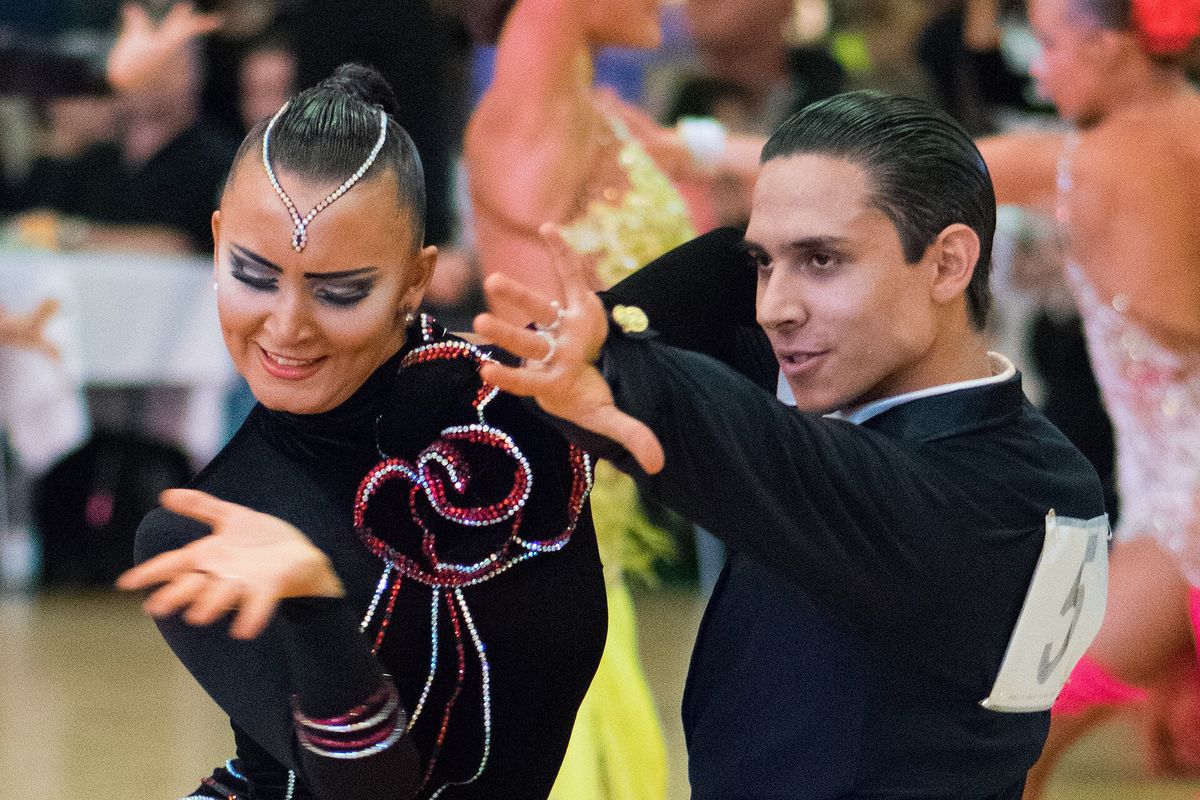
A Latin couple at the Blaues Band der Spree competition, Berlin, 2016, with other couples dancing behind them · Thomas Quine · CC BY 2.0
- Governing body
- World DanceSport Federation
- Founded
- Governed internationally since 1957, as the International Council of Amateur Dancers, renamed the International DanceSport Federation in 1990 and the World DanceSport Federation in 2011.
- Olympic status
- Not on the Olympic programme
- Also contested at
- World Games
Competitive ballroom and Latin dancing, contested by couples, and judged in a way nothing else on this site is: six or more couples dance at the same time on the same floor while a panel compares them directly. It spent decades seeking Olympic inclusion, was given governance of breaking, and watched its newest discipline reach the 2024 Games and be dropped for 2028 while ballroom itself never got there at all.
The gamewhat it is now · sections 1 to 5
01How it is played
Couples dance five dances in a programme — Standard or Latin — and are judged on technical quality, movement to music, partnering skill and choreography. Several couples are on the floor at once, and the panel compares them directly.
These figures were entered from the edition named above but have not been checked against its text line by line. Treat them as this site’s reading of the laws, not as a substitute for them.
The object of the game
Be marked higher than the other couples across all five dances of the programme. A couple's result is an aggregate: excellence in one dance does not carry a round, and a weak dance cannot be hidden.
What makes the sport unusual is the comparison. In gymnastics, diving and figure skating a competitor performs alone and is scored against a standard. Here, six or more couples perform simultaneously and the judges are watching all of them.
- Dances per programme
- 5
- On the floor at once
- Six or more couples
The floor
A sprung competition floor, with the panel positioned around it. There are no lanes, no marked zones and no assigned space — couples travel around the floor, and in the Standard programme they travel continuously in a counter-clockwise line of dance.
Navigating a crowded floor without collision is therefore part of the competition, and a couple that is repeatedly blocked will be seen less by the judges.
- Floor
- Sprung, unmarked
- Line of dance
- Counter-clockwise, in Standard
- Assigned space
- None
Costume and shoes
Shoes are functional equipment — suede-soled, with a heel height and construction matched to the programme — and costume is regulated by rule rather than left to taste, with detailed provisions on what may be worn in each age and level category.
Costume regulation exists because appearance is part of what is being judged, so the federation has to draw a line between presentation as a component of performance and expenditure as a competitive advantage. It is the same problem equestrian and gymnastics have, in a sharper form.
- Shoes
- Suede-soled, heel by programme
- Costume
- Regulated by category
Competitors and officials
A couple is the competitive unit and is indivisible: partners are registered together, ranked together, and a partnership that splits starts again.
A panel of judges marks the field. Under the WDSF's absolute system each judge awards marks against defined components; under the older ordinal method still used elsewhere in the sport, judges place couples against each other rather than scoring them.
- Competitive unit
- The couple
- Judging
- Component marks, in WDSF competition
This clause reads this way because of
Time
Each dance runs to a fixed length of music — roughly a minute and a half to two minutes — and a round is five of them in succession with short breaks. A championship runs through qualifying rounds to a final of six couples.
- Each dance
- About 1.5 to 2 min
- Final
- Six couples
Scoring
In WDSF competition, marks against four components: technical quality, movement to music, partnering skill, and choreography and presentation. Marks across the five dances are aggregated into a placing.
The older method — used for decades and still used in parts of the sport — asked judges to place couples rather than score them, and resolved the placements by a counting rule. A result under that system was a statement about a field rather than about a performance, and could not say how far apart two couples were.
This clause reads this way because of
Rounds
Couples are called on in heats, dance the programme, and are recalled to the next round. There is no restart within a dance: a fall, a collision or a musical error is danced through, and the judges saw it.
Infringements
Lifts are prohibited in the standard competitive programmes — a partner's feet leaving the floor with assistance is an offence, which separates competitive ballroom from show dance, where lifts are the point.
Also: costume outside the category's regulations, wrong dance for the music, and deliberate interference with another couple on the floor.
Deciding the winner
The couple with the best aggregate across the programme. Because six couples dance a final simultaneously and are marked by a full panel, the result rests on many judges' comparative readings of the same crowded floor.
Everything above is current law. Everything below is how DanceSport got here.
02Disciplines and events
No Olympic events for ballroom or Latin. DanceSport is on the World Games programme and holds world championships across both programmes — and the same federation governed breaking at the 2024 Olympics, which is not on the 2028 programme either.
- Disciplines
- 2
- Olympic medal events
- 0
- Men’s and women’s counted separately.
- Contested elsewhere
- 8
- world games, world championship, federation only, lapsed.
- Listed for context
- 2
- Not counted as this sport.
Standard2
Waltz, tango, Viennese waltz, slow foxtrot, quickstep.
- Standard, couplesWorld GamesWorld championship
- Standard formationWorld championshipTeams of eight couples dancing a choreographed routine together.
Latin2
Samba, cha-cha-cha, rumba, paso doble, jive.
- Latin, couplesWorld GamesWorld championship
- Latin formationWorld championship
Breaking1
Governed by the WDSF since 2017, and the only discipline under this federation to have reached an Olympic Games. Covered on this site as its own sport.
- BreakingLapsedContested at Paris 2024 and not on the 2028 programme. The federation's newest discipline got the place its oldest ones never have.
Danced competitively, governed elsewhere3
Competitive dance is institutionally divided, by style and by amateur-professional status, more than almost anything on this site.
- Professional ballroom and LatinFederation onlyGoverned by the World Dance Council, a separate body; the professional side of the same dances.
- Rock'n'roll and boogie-woogieWorld GamesFederation onlyGoverned by the World Rock'n'Roll Confederation.
- Show dance and other stylesWorld championshipContested under WDSF rules with lifts permitted, unlike the standard programmes.
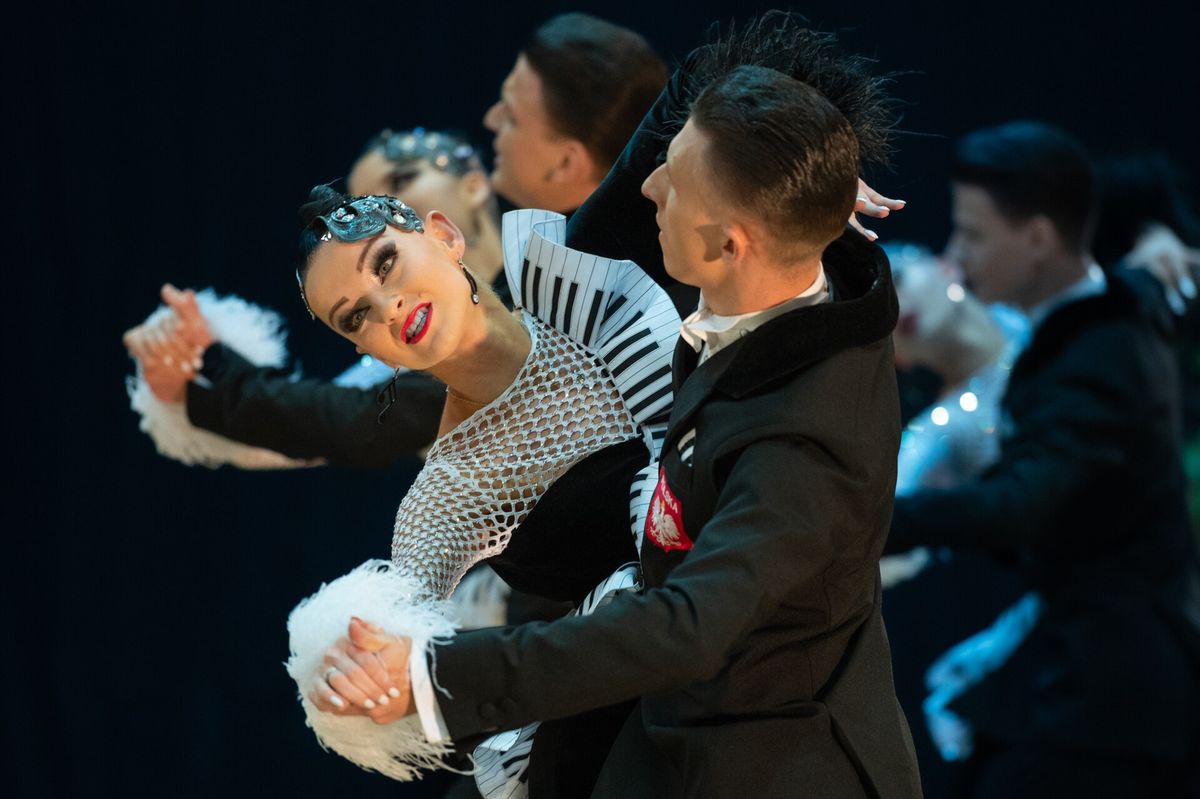
Jantar Elbląg of Poland at the 2022 WDSF European Formation Standard Championship.
Standard formation: teams of eight couples dancing one choreographed routine together.
Stefan Brending (2eight) · CC BY-SA 3.0 de · Wikimedia Commons
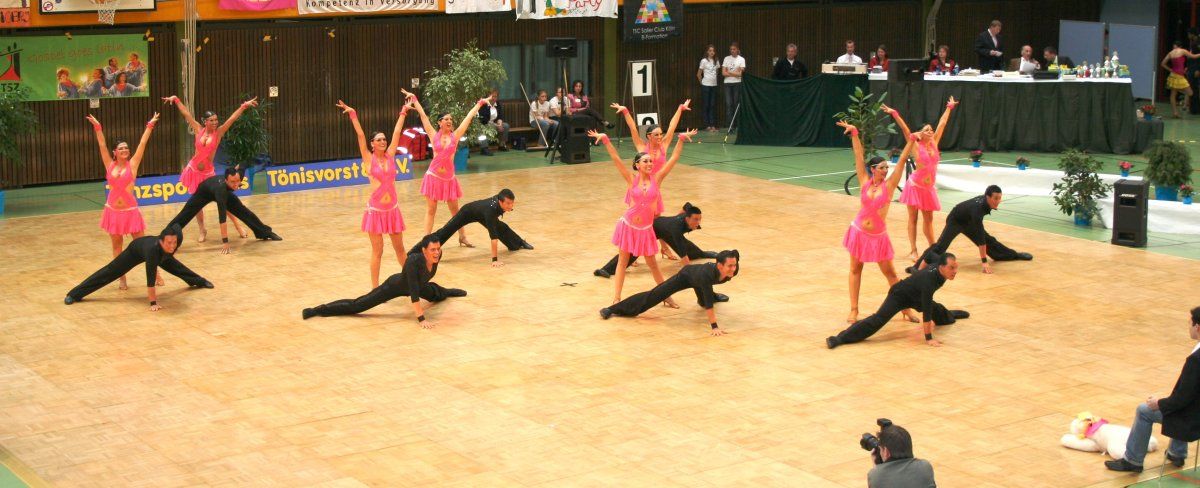
The Latin formation team of ATSC Blau-Silber Aachen, 2007.
The Latin equivalent: eight couples, one routine, judged as a team.
Thornard · CC BY-SA 3.0 · Wikimedia Commons
03Officiating
DanceSport's judges do something no other panel on this site is asked to do: watch six performances at once and compare them.
In gymnastics, diving, figure skating and skateboarding, a competitor performs alone and the panel gives that performance a score against a standard. In dancesport, six or more couples dance the same dance simultaneously on the same floor, travelling, and the judges mark all of them in the same ninety seconds.
Two things follow.
Being seen is part of competing. A couple blocked in a corner, or repeatedly cut off, is marked on less evidence. Floorcraft — navigating a crowded moving floor at speed without collision while dancing full out — is a genuine competitive skill and is largely invisible to spectators.
The judgement is comparative by construction. Under the old ordinal system this was explicit: a judge ranked the couples rather than scoring them. The WDSF's component marking makes each mark absolute in form, but a judge is still physically comparing six couples in real time.
The components — technical quality, movement to music, partnering skill, choreography and presentation — are the sport's attempt to say what is being marked, and they carry the same difficulty every judged sport on this site has: they name the categories without making the judgement mechanical.
There is no instrumentation. Nothing in dancesport is measured, sensed or reviewed on video in the way taekwondo, fencing and shooting have adopted. Given that one of the judged components is how a couple moves to music, it is difficult to see what could be.
04Where it is played
An English codification, a European competitive heartland, and an Asian growth story that has changed the results.
Britain wrote the technique and holds the sport's most historically significant competitions; the Blackpool Dance Festival remains the event that matters most to many competitors regardless of which federation sanctions it. Italy, Germany, Russia, Ukraine, Poland, Moldova, Lithuania and Slovenia form a deep European competitive belt, and Russian and Ukrainian couples have dominated large parts of the sport for decades.
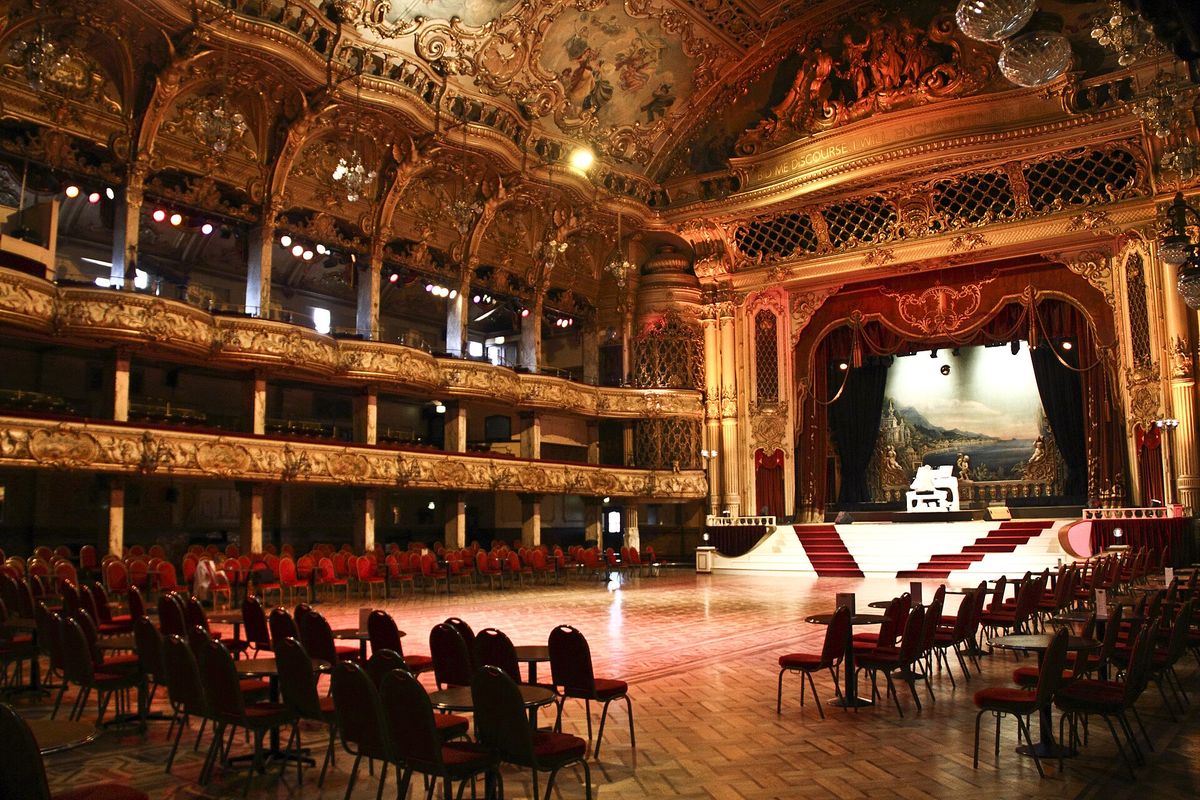
The Tower Ballroom, Blackpool.
The Blackpool Dance Festival, held at the Winter Gardens a short walk away, is still the event that matters most to many couples whichever federation sanctions it; the Tower Ballroom is the town's dancing landmark.
Michael Beckwith · CC BY 2.0 · Wikimedia Commons
Asia is where the sport has grown most. China has invested heavily and produces couples at the highest level, Japan has a long-established competitive culture, and Chinese Taipei, South Korea and Hong Kong all compete. Chinese formation and couple results have shifted the sport's balance in a way few federations have managed anywhere.
The United States has a large social and studio-based dancing culture and a comparatively small international competitive presence, which is close to the inverse of the picture in most sports on this site.
The participation base is enormous and mostly invisible to the competitive structure. Social ballroom and Latin classes run in almost every country, and the overwhelming majority of people who dance these dances will never enter a competition or know which federation would sanction it — a gap between participation and sport that only disc golf, elsewhere on this site, matches.
05Learning curve
A social class in any town gets you started, and a competitive career depends on finding one specific other person and staying with them — which is a constraint no other sport on this site puts on an athlete.
Editorial — the site’s reading, not a sourced claim
Barrier to entry
How hard is it to get to a real game?
Ballroom classes exist nearly everywhere, and they are the sport's actual entry level.
Dancesport has the broadest amateur base of any sport covered here that isn't played with a ball. Social ballroom and Latin classes run in community halls, universities and studios across most of the world, teach the same dances the sport contests, and welcome complete beginners of any age.
The equipment is shoes. The facility is a room with a floor. There is no contact risk, no fitness prerequisite to start, and the first competitive levels are graded so that beginners compete against beginners.
What holds it at low rather than very low is the partner. You cannot start competing alone, and finding someone at a compatible level who wants the same commitment is a real barrier that has nothing to do with dancing.
Evidence
- Competitive unitA coupleruleYou cannot enter alone.1957 — the rule this rests on
- Kit to startShoesobserved
- FacilityA hall with a floorobserved
- ClassesWidely available worldwideobserved
- Time to a first competitionMonthsestimate
Barrier to the top
How hard is it to be good at?
Five dances at championship standard, in a partnership that must survive years.
A finalist must be excellent in five distinct dances with different rhythms, postures and technical demands, in one programme, on the same evening. Nothing else on this site asks for five disciplines at once except the combined events in athletics and modern pentathlon.
The judged component is unusually hard to train against because of how the sport is watched. Six couples are on the floor simultaneously, so being seen is part of performing — floorcraft, the skill of navigating a crowded floor at speed without collision while dancing full out, is real and largely invisible to a spectator.
And there is the partnership. A couple is the competitive unit, ranked together, and building one takes years of shared training. When a partnership ends, both athletes effectively restart. No other sport covered here makes an athlete's career contingent on one other person's continued availability in quite this way — equestrian's rider and horse is the closest parallel, and a horse does not leave.
Costume, grooming and presentation are also judged components, which adds a cost dimension to the ceiling that the rules can constrain but not remove.
Evidence
- Five dances per programmeStandard or LatinruleA weak dance cannot be hidden by a strong one.1957 — the rule this rests on
- Judged on componentsSince the WDSF's absolute systemruleReplaced ordinal placement, which scored a field rather than a performance.2013 — the rule this rests on
- Couples on the floor at onceSix or moreobservedBeing seen is part of performing.
- Typical peak age25–35estimate
Why the two differ
Low to very high, and the distinctive feature is that the ceiling is partly social rather than physical.
Every other sport here asks an athlete to develop capacities in themselves. This one asks that too, and then makes the result depend on a second person's technique, commitment, availability and willingness to keep going. Partnerships end for reasons that have nothing to do with dancing, and when they do, two careers reset at once.
The sport is also the site's clearest case of the "is it a sport" question being institutionally consequential rather than merely rhetorical. The federation renamed itself around the word, restructured its governance to look like an Olympic federation, and replaced a judging system that produced results a spectator could not read — all in pursuit of a place it has still not been given.
The historyhow it got here · sections 6 to 10
06Origin and invention
Competitive ballroom is the codification of a social activity, and the codifying was done in Britain between the wars.
Social partner dancing existed everywhere; what did not exist was an agreed technique. In the 1920s British teaching bodies standardised the figures, footwork, timing and holds of the ballroom dances, producing a written technique that could be taught identically and — crucially — judged. That work turned dancing into something with a right answer, which is the precondition for a competition.
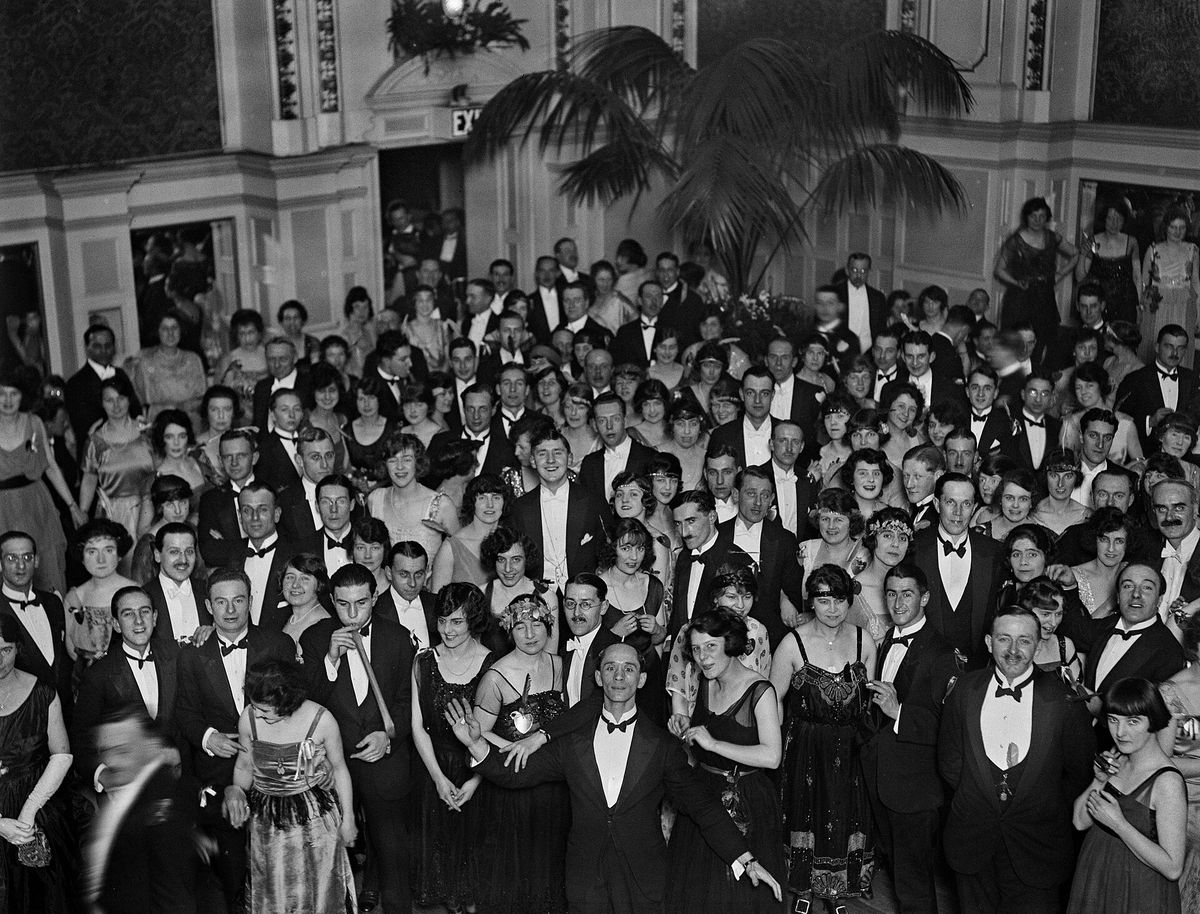
A St. Valentine's dance and ballroom competition at the Royal Palace Hotel, Kensington, February 1921.
The decade the British teaching bodies standardised the technique. The man at the front is Santos Casani, a dancing teacher. The photograph is better known now as the one retouched for the ending of The Shining.
Morey, for the Topical Press Agency · Public domain · Wikimedia Commons
The competitive programmes settled into two lists of five. Standard: waltz, tango, Viennese waltz, slow foxtrot, quickstep. Latin: samba, cha-cha-cha, rumba, paso doble, jive. Both are danced in sequence and a couple's result is an aggregate across all five.
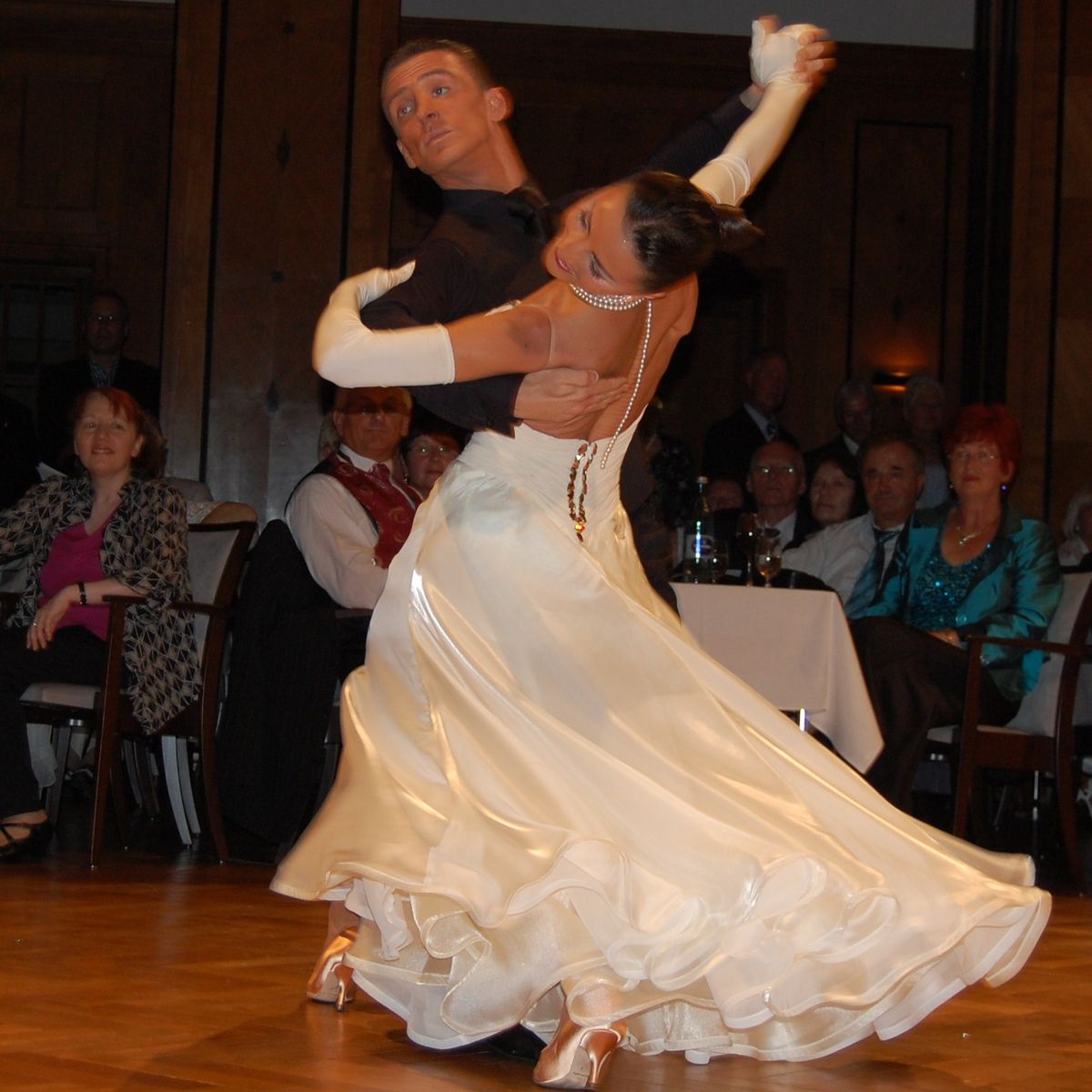
Benedetto Ferruggia and Claudia Köhler, German, European and world amateur Standard champions, 2010.
The Standard programme: closed hold, the man's tails, the woman's gown, travelling counter-clockwise round the floor.
Sigismund von Dobschütz · CC BY-SA 3.0 · Wikimedia Commons
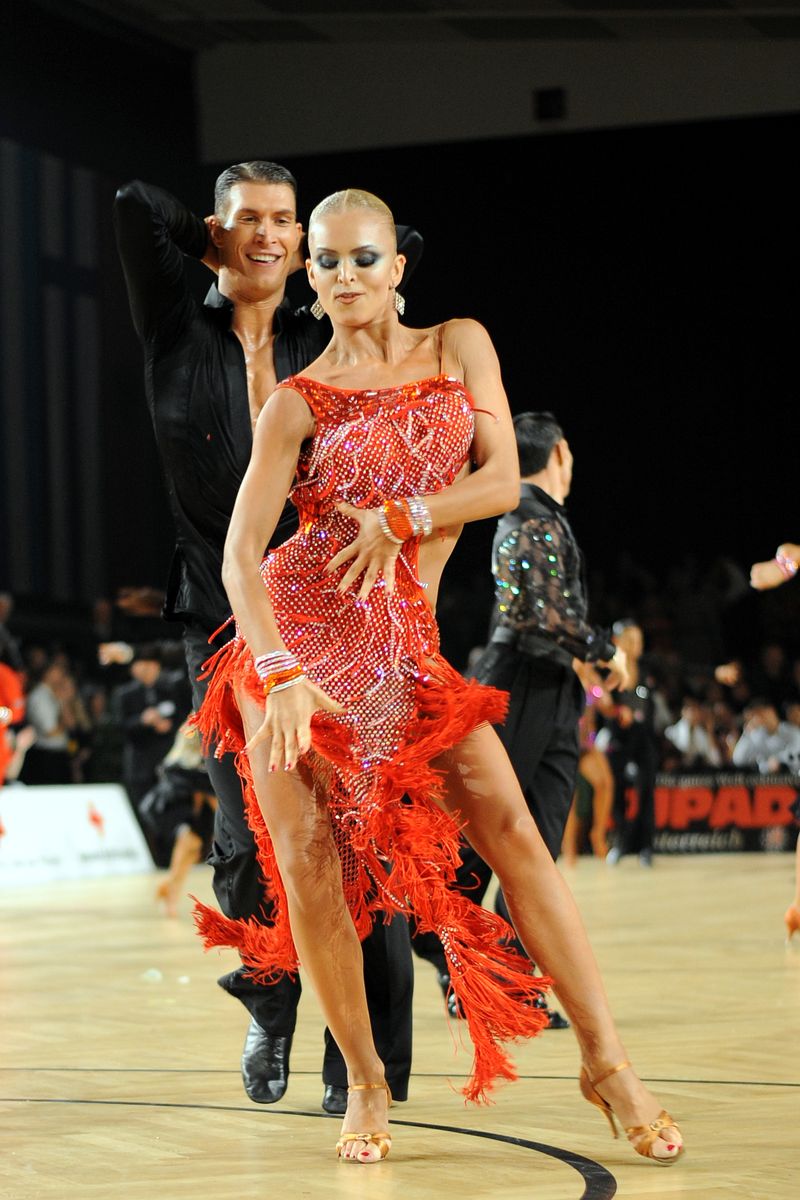
Miha Vodičar and Nadiya Bychkova of Slovenia dancing the cha-cha-cha at the 2012 WDSF World Latin Championships, Vienna.
The Latin programme: open holds, no travelling line, and costume designed to show the lines of the body.
Ailura · CC BY-SA 3.0 · Wikimedia Commons
International governance came in 1957 with the International Council of Amateur Dancers, which became the International DanceSport Federation in 1990 and the World DanceSport Federation in 2011. The renaming was not cosmetic: the word "sport" was doing institutional work, and the federation reorganised itself around Olympic criteria — anti-doping compliance, eligibility rules, a recognisable governance structure — through the 1990s.
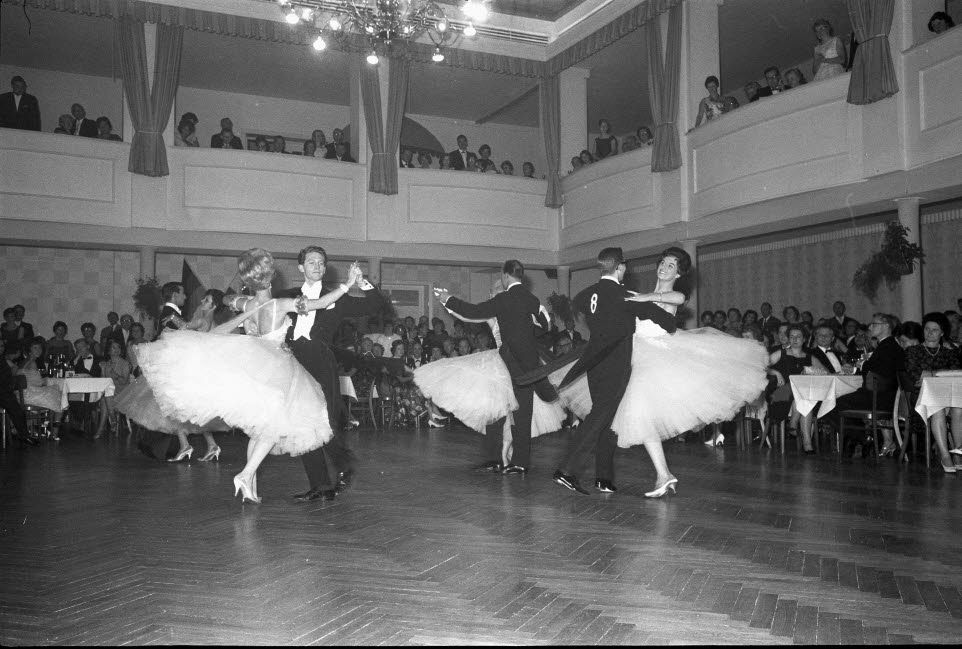
An international amateur dance tournament at Kieler Woche, Kiel, 1963.
Couples in the Standard programme sharing one floor, a few years after the amateur international council was founded in 1957.
Friedrich Magnussen · CC BY-SA 3.0 de · Wikimedia Commons
IOC recognition arrived in 1997 and has now been held for nearly three decades without producing a place on the programme.
What did arrive was breaking, in 2024, under this federation's governance, because the WDSF had the recognition breaking needed and breaking had the audience the IOC wanted. It was dropped for 2028. The federation's newest discipline reached the Games and its founding ones never have.
07Rule timeline
The sport’s own lane, expanded. Every entry carries a cause from the closed vocabulary and a citation, and says so where the citation is incomplete.
- 1957Fairness and eligibilityadopted 1957
An international federation was formed for amateur competitive dancing, fixing the two competitive programmes the sport still contests: Standard — waltz, tango, Viennese waltz, slow foxtrot and quickstep — and Latin — samba, cha-cha-cha, rumba, paso doble and jive. Five dances in each, danced in sequence, with a couple's placing determined across all five rather than in any one. That structure is the sport, and it has been stable ever since.
Trigger and citationIncomplete — no confirmed article
Trigger
Competitive ballroom had developed in Britain and spread across Europe with national bodies using different dance lists and different judging conventions.
WDSF Competition Rules · WDSF Competition Rules
- 1997Commercialalso participation and accessadopted 1997
The federation received IOC recognition, which is the step before candidacy, and it renamed itself around the word "sport" — DanceSport — as part of the same effort. Recognition has now been held for nearly three decades without producing an Olympic place for the sport that sought it.
Trigger and citationIncomplete — no confirmed article
Trigger
The federation reorganised itself to meet the criteria the Olympic movement applies — anti-doping compliance, athlete eligibility rules, and a governance structure resembling other international federations.
WDSF Competition Rules · IOC recognition, 1997
- 2013Fairness and eligibilityalso broadcast and pacingadopted 2013
The WDSF introduced an absolute judging system, in which judges award marks against defined components — technical quality, movement to music, partnering skill, and choreography and presentation — replacing, in its own competitions, the ordinal placement method the sport had used for decades. Under the old method, borrowed from figure skating, a judge did not score a couple at all: they placed them against the other couples on the floor, and the placements were resolved by a counting rule. A result was therefore a statement about a field, not about a performance. Moving to component marks changed what a score is, which means results before and after are on incompatible scales. Gymnastics did the same thing in 2006 with the open-ended Code of Points, and this site records both as the same kind of severance.
Comparability break · Measurement scale changed
Ordinal placement replaced by component marks. Before the change there was no scale to compare against, only an order within a field. See the series
Trigger and citationIncomplete — no confirmed article
Trigger
Ordinal placement produced results that were hard to explain to a spectator and that could not express how far apart two couples were. A federation seeking Olympic inclusion needed a scoring system that looked like the ones already on the programme.
WDSF Competition Rules · WDSF Judging System, competition rules
- 2024Commercialalso participation and accessadopted 2020
Breaking was added to the Paris 2024 Olympic programme under the governance of the World DanceSport Federation, and was not included for 2028. The federation's mandate over breaking came from its existing Olympic recognition rather than from any historical connection to the dance: a ballroom body was the available route to admission for a street form it did not create. So the discipline the WDSF had governed for three years reached the Games, and the disciplines it had governed since 1957 did not.
Trigger and citationIncomplete — no confirmed article
Trigger
Paris organisers sought a young, urban, broadcast-friendly addition, and breaking needed a recognised federation to be admitted under. The WDSF had recognition and breaking did not.
Parts of the breaking community disputed whether a ballroom federation should govern the form at all. That argument is recorded on this site's breaking pages; from dancesport's side, the fact worth recording is that its recognition was the asset that mattered, and it did not convert into a place for its own disciplines.
WDSF Competition Rules · IOC Session decisions, 2020 and 2023
08Equipment evolution
Shoes, and a costume rulebook that exists because appearance is being judged.
Shoes are functional. Suede soles give a controlled slide on a sprung floor — enough to pivot, not enough to lose the foot — and heel height and construction differ between the Standard and Latin programmes because the posture and weight placement differ. They are the only piece of equipment in the sport that affects what the body can do.
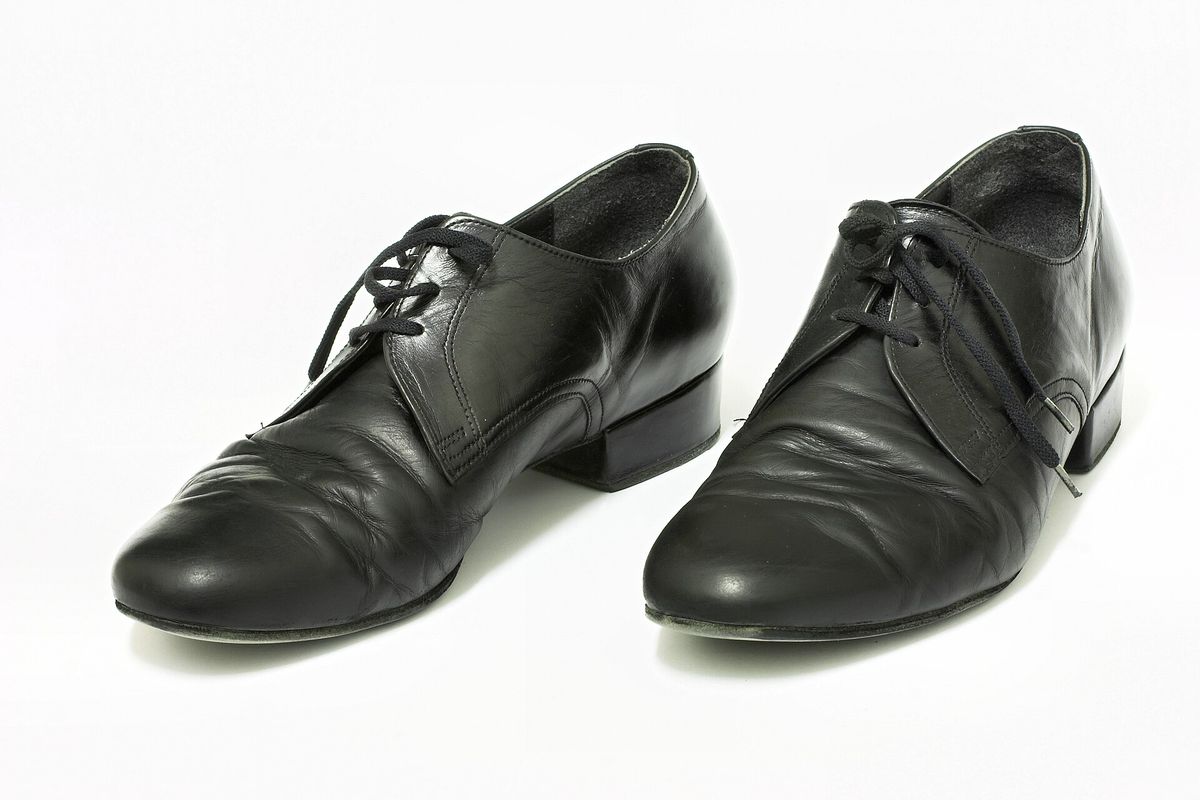
Men's ballroom shoes.
Suede soles for a controlled slide on a sprung floor, and a low heel for the Standard posture.
Martin Kozák · Public domain · Wikimedia Commons
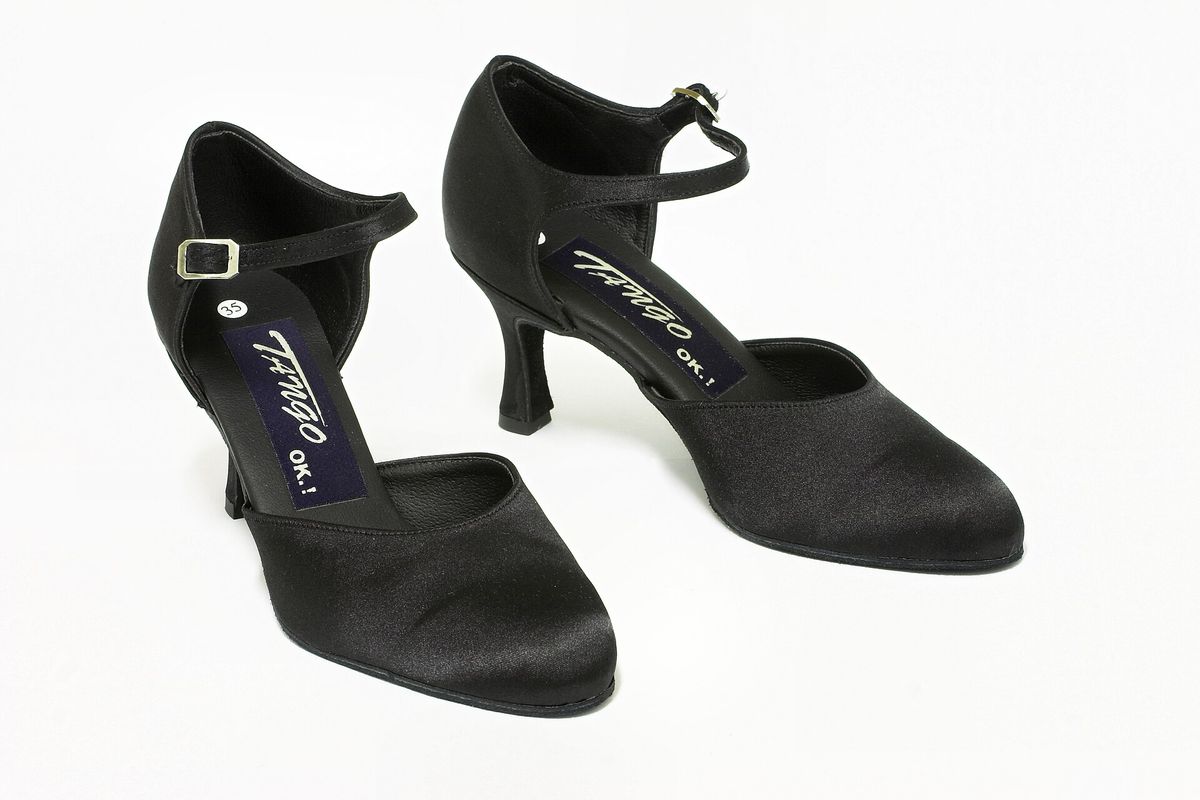
Women's ballroom shoes.
The heel height differs between programmes because the posture and weight placement do.
Martin Kozák · Public domain · Wikimedia Commons
The floor is the other piece of hardware. Sprung, unmarked, and shared: there are no lanes and no assigned space, so the floor is a contested resource during a heat rather than a neutral surface.
A Latin couple at the Blaues Band der Spree competition, Berlin, 2016, with other couples dancing behind them.
No lanes and no assigned space: the floor is shared, and a couple blocked or cut off is marked on less evidence.
Thomas Quine · CC BY 2.0 · Wikimedia Commons
Costume is where this sport has a problem most of the others do not. Presentation is an explicit judged component, so what a couple wears is part of the performance being marked — and once that is true, expenditure becomes a competitive variable. Gowns, tailoring, stoning and grooming can cost more than a season's travel.
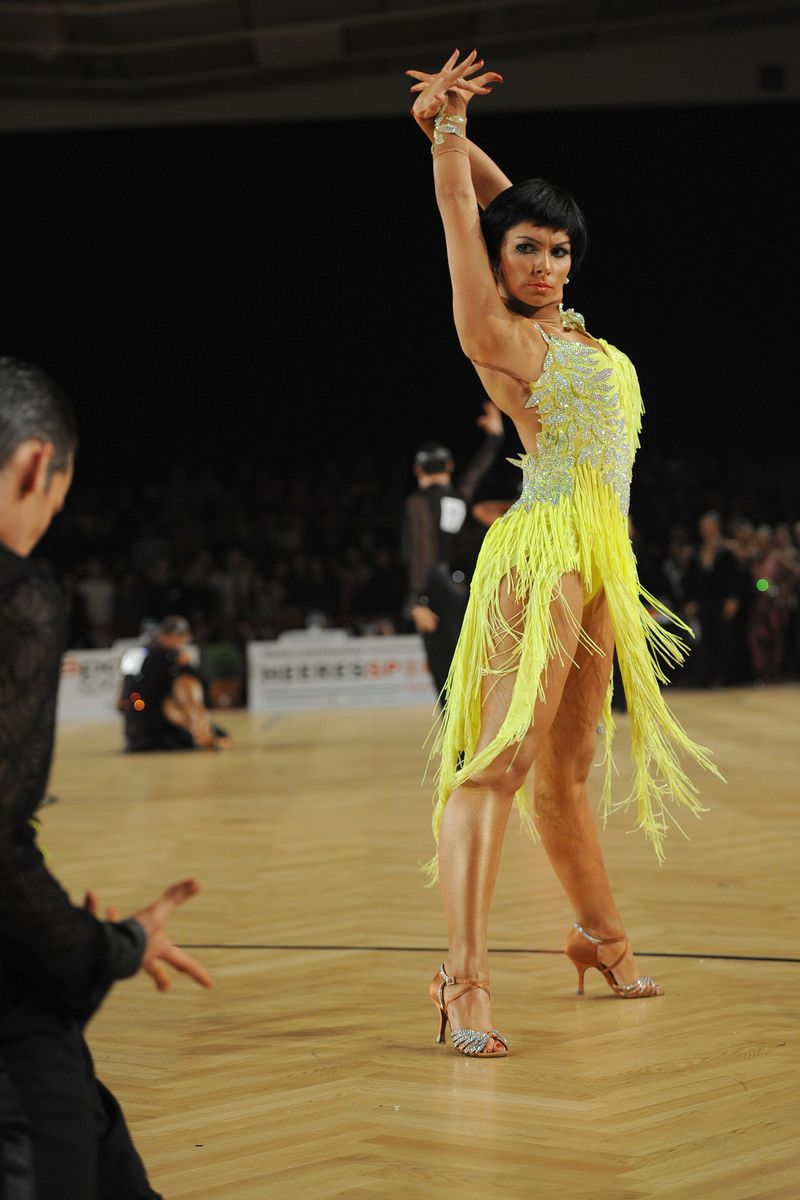
Kristina Raczova of Slovakia in the paso doble, 2012 WDSF World Latin Championships.
A fringed, stoned competition costume. Presentation is one of the things judged, so what a couple wears is part of the performance and its cost a competitive variable.
Ailura · CC BY-SA 3.0 · Wikimedia Commons
The federation's answer is detailed costume regulation by age and level: what may be worn, what may not, and at which grade restrictions relax. Junior categories are the most tightly constrained, precisely to keep the cost of entry down for the people least able to bear it.
It is the same structural problem this site records for equestrian and for gymnastics, and it is sharper here because in dancesport the appearance is not incidental to the judged performance — it is one of the things being judged.
09Governing body politics
Two schisms and one long, unsuccessful campaign — and then a strange consolation prize.
The amateur–professional split. Competitive ballroom is governed by more than one body. The WDSF is the amateur-side, IOC-recognised federation; the World Dance Council governs the professional side of the same dances. Couples, adjudicators and events are distributed between them, and the two have a long history of mutual non-recognition. It is the same shape of problem this site records in powerlifting and, differently, in sumo: a sport whose best competitors and whose Olympic-facing federation are not necessarily in the same place.
The Olympic campaign. The WDSF has held IOC recognition since 1997 and restructured itself thoroughly in pursuit of inclusion — the rename around "sport", anti-doping compliance, governance reform, and a new judging system designed to produce results a spectator could read. None of it worked. Dancesport has never been on an Olympic programme.
Breaking. In 2017 the WDSF took on governance of breaking, which had no recognised federation of its own. Breaking was then contested at the 2024 Olympics and dropped for 2028. The federation's asset in that transaction was its recognition — the thing thirty years of campaigning had produced — and it converted into a place for a discipline the federation did not create and had governed for three years, rather than for the ones it had governed since 1957.
Parts of the breaking community disputed whether a ballroom body should govern the form at all; that argument is recorded on this site's breaking pages. From dancesport's side, the notable fact is that its recognition turned out to be worth something to somebody else.
10Controversies that forced rule changes
How to score a comparison. For most of the sport's history judges did not score couples; they placed them against each other and a counting rule resolved the placements. That worked internally and produced results that could not be explained to an audience or compared between events. The WDSF's absolute judging system — marks against technical quality, movement to music, partnering skill, and choreography and presentation — was the answer, and it severed the sport's own results history in the process.
Judging integrity. A sport marked by a panel, with national blocs, a small adjudicator pool, and long-standing relationships between judges, coaches and couples, has the structural conditions for bias that this site records for gymnastics, boxing and figure skating. Component marking, published marks and adjudicator rotation are responses to it. It has not gone away.
Costume cost. Presentation is judged, so appearance is a competitive variable, so money is. Costume regulation by age and level is a genuine attempt to cap that in the categories where it does most damage.
Amateur and professional. The split between governing bodies has produced eligibility disputes, competing world championships and couples having to choose a side. It is a governance controversy that shapes what any world title means.
Breaking's governance. Awarding a street form to a ballroom federation was disputed by dancers within that form. Recorded here because it is the most consequential thing to happen to this federation, and it happened to a discipline that is not ballroom.
Where it standsthe record, and what is still open · sections 11 to 12
11Series
No series can exist
Competition scores
DanceSport's scores cannot form a series, and the reason is the same one this site records for gymnastics — arrived at from a stranger starting point. For most of the sport's history, judges did not score couples at all. They placed them, one against another, and the placements were resolved by a counting rule borrowed from figure skating. A result under that system was a statement about a particular field on a particular floor: it could say a couple was third, and could not say by how much, or how they would compare with a couple in another final. The WDSF's absolute judging system replaced this in its own competitions with marks against defined components. That is a scale change in the strictest sense — before it, there was no scale, only an order — so nothing on either side of it can be placed on one axis. Gymnastics moved from a closed ten-point scale to an open-ended one in 2006 and severed its own history. DanceSport moved from no scale at all to a scale, which is the same severance with even less on the earlier side of it. There is a third obstacle. Judging remains split between federations, so two couples of comparable standing may be marked under different systems by different bodies in the same season.
2013Measurement scale changedOrdinal placement replaced by component marks. Before the change there was no scale to compare against, only an order within a field.
12What is contested now
Recorded as unsettled.
Whether the Olympic campaign has a future. Thirty years of recognition, a rename, a governance overhaul and a new judging system have not produced a place. The federation's recognition did produce one — for breaking, briefly. Whether to keep pursuing inclusion for ballroom and Latin, having watched that happen, is the sport's live strategic question.
Judging. The absolute system was introduced to make results legible and comparable. Whether component marks genuinely constrain a judge, or simply express the same comparative instinct in numbers, is argued inside the sport, as the equivalent question is in gymnastics and figure skating.
The federation split. Amateur and professional bodies governing the same dances, with competing events and mutual non-recognition, means no world title is uncontested. Nobody has a mechanism for resolving it.
Costume cost. Presentation is judged and therefore money is a competitive variable. Category regulations cap it and do not remove it.
Breaking. The WDSF governs a form that a substantial part of its community did not want governed by a ballroom federation, that reached one Games and was dropped. What the federation's responsibility to breaking is now that the Olympic incentive has gone is an open and largely unexamined question.
Whether it is a sport. The oldest argument, and the one that has shaped the federation's every institutional decision — including its name. Nothing about the answer has been settled by three decades of behaving as though it were.