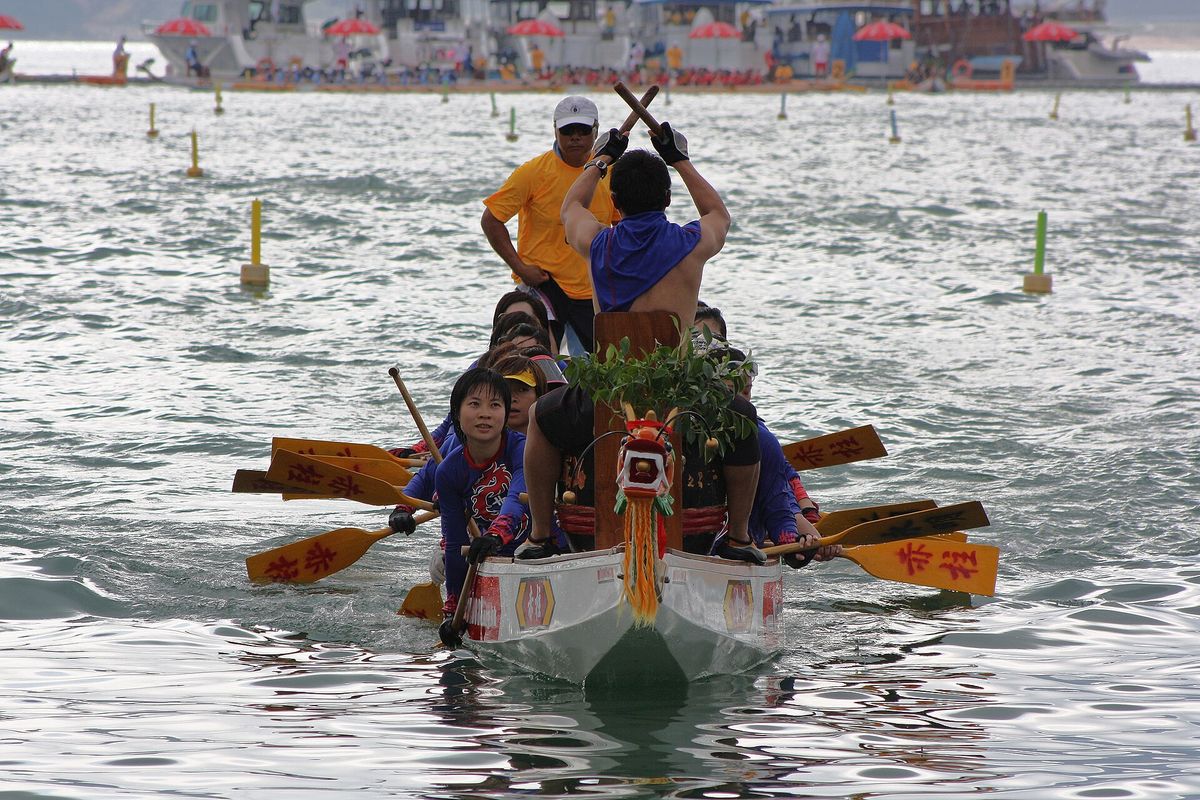
Dragon boat
Twenty-two people in the boat, two of whom are not paddling: a drummer beating time at the bow and a steerer at the stern.
- Official
- Dragon boat
- Game category
- Performance
- Adjudication
- Measured
- Standing
- Never Olympic
- rule changes
- 4
- comparability break
- 1
- Olympic editions
- 0
A crew at the Stanley International Dragon Boat Championships, Hong Kong, 2011 · istolethetv · CC BY 2.0
- Governing body
- International Dragon Boat Federation
- Founded
- A Chinese festival tradition more than two thousand years old, raced competitively in Hong Kong from 1976; the International Dragon Boat Federation was formed in 1991.
- Olympic status
- Not on the Olympic programme
- Also contested at
- Asian Games
Twenty paddlers on ten benches, a drummer facing them at the bow, and a steerer standing at the stern. The drummer is a competitor whose entire function is rhythm — no other racing sport covered here carries someone whose job is to keep time. It is also the only sport on this site with a medical-rehabilitation constituency written into its world championships.
The gamewhat it is now · sections 1 to 5
01How it is played
Twenty paddlers on ten benches, a drummer at the bow and a steerer at the stern, racing in lanes over 200, 500 or 2000 metres. Small boats carry ten paddlers instead of twenty.
These figures were entered from the edition named above but have not been checked against its text line by line. Treat them as this site’s reading of the laws, not as a substitute for them.
The object of the game
Cross the line first. It is a straightforward lane race, and everything distinctive about the sport is in who is in the boat and what the paddling action is.
- Distances
- 200, 500 and 2000 m
The course
Buoyed lanes on flat water, as in canoe sprint and rowing. The 2000 metre event is raced with turns around marks rather than in straight lanes, which introduces a steering contest the shorter races do not have.
- Water
- Flat, buoyed lanes
- 2000 m
- Raced with turns
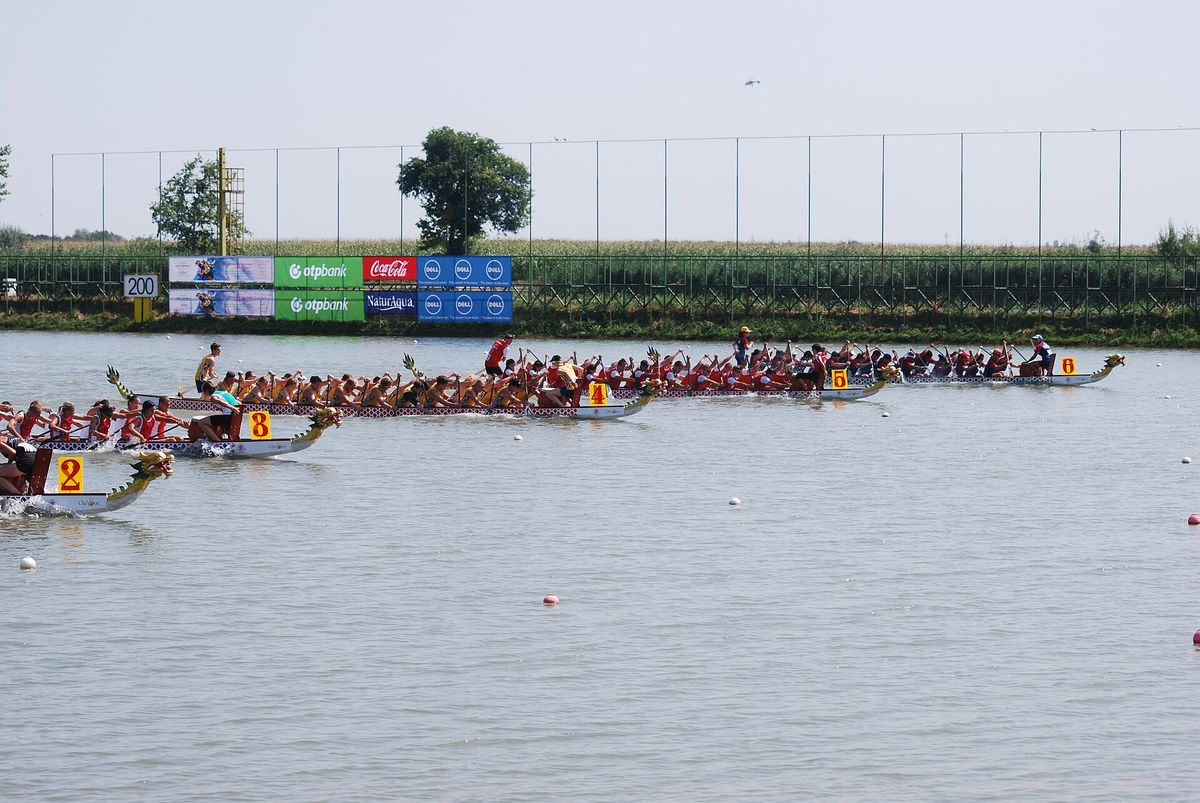
Standard boats in their lanes at the IDBF World Championships, Szeged, 2013.
Flat water and buoyed lanes, with boats usually supplied by the organisers so that no crew races a better hull.
SwedishDragonboat · CC0 · Wikimedia Commons
The boat and the paddle
A long open boat with a dragon head at the bow and a tail at the stern — decorative fittings that are required in competition, which is unusual: a racing craft on this site is otherwise stripped of everything that does not make it faster.
Paddlers use a single-bladed paddle, sitting on fixed benches, facing forwards. That combination separates it from both neighbours: rowing uses oars in oarlocks with the crew facing backwards on sliding seats, and kayaking uses a double blade. Dragon boat paddling is closer to canoe sprint, done sitting rather than kneeling.
The drummer has a drum. The steerer has a long steering oar.
- Paddle
- Single blade, seated, facing forward
- Seats
- Fixed, not sliding
- Dragon head and tail
- Required fittings
- Standard boat
- 20 paddlers
- Small boat
- 10 paddlers
Crew and officials
Twenty paddlers in pairs on ten benches, a drummer at the bow facing them, and a steerer standing at the stern. Twenty-two people, two of whom supply no propulsion.
The drummer's beat sets and holds the stroke rate and calls the crew's pushes. Whether the drum is essential or ceremonial is argued inside the sport, and the rules settle it by requiring the position.
Crews race in open, women's, mixed and — distinctively — breast cancer survivor divisions.
- In the boat
- 22
- Not paddling
- The drummer and the steerer
- Divisions
- Open, women's, mixed, and BCS
Time
Under a minute for a 200, around two minutes for a 500, and roughly ten for a 2000 with turns. Timed to the hundredth, as in canoe sprint.
- 200 m
- Under a minute
- 2000 m
- About ten minutes, with turns
Scoring
Elapsed time, and finishing order in heats and finals. There is no scoring system beyond the clock.
The start
A stationary start with boats held on the line. Because a dragon boat is long, heavy and carries twenty-two people, the acceleration phase is a substantial part of a 200 metre race, and the drummer's role is most visible in it.
Infringements
Leaving your lane and interfering with another crew. Carrying a crew that does not meet the division's composition requirements — the mixed divisions specify the number of each sex in the boat, and the count is checked.
Paddlers must remain seated, and the steerer must remain standing at the stern; substitution during a race is prohibited.
Boats are weighed and inspected, and crews are weighed in divisions where a limit applies.
Deciding the winner
First across the line. Because crews are large and heats are numerous, championship programmes run enormous numbers of races, and a national squad may contest open, women's, mixed and BCS divisions across three distances and two boat sizes.
Everything above is current law. Everything below is how Dragon boat got here.
02Disciplines and events
No Olympic events. Dragon boat has been at the Asian Games since 2010 and holds IDBF world championships — and a second international federation, the canoe body, also claims the sport as one of its disciplines.
- Disciplines
- 3
- Olympic medal events
- 0
- Men’s and women’s counted separately.
- Contested elsewhere
- 8
- asian games, world championship, federation only.
- Listed for context
- 2
- Not counted as this sport.
Standard boat9
Twenty paddlers, a drummer and a steerer.
- 200 mAsian GamesWorld championshipOpen, women's and mixed.
- 500 mAsian GamesWorld championship
- 2000 mWorld championshipRaced with turns around marks.
Small boat6
Ten paddlers, a drummer and a steerer.
- 200 mAsian GamesWorld championship
- 500 mWorld championship
Breast cancer survivor divisions2
Crews of breast cancer survivors, contested at IDBF world championships. The divisions exist because a 1996 clinical study found that the standing advice against strenuous upper-body exercise after surgery was not supported.
- BCS racesWorld championshipA competitive category that began as a medical trial.
The festival it comes from1
Dragon boat racing is a living festival tradition more than two thousand years old, held at the Duanwu Festival and associated with the poet Qu Yuan. Most dragon boat racing in the world is this rather than championship sport.
- Festival racingFederation onlyCommunity and ceremonial racing, in vastly greater numbers than the governed sport.
Claimed by a second federation1
The international canoe federation runs dragon boat as one of its own disciplines, alongside the IDBF's programme. Two bodies govern the same activity.
- Canoe federation dragon boatWorld championshipA parallel structure with its own championships.
03Officiating
Lane racing is easy to officiate and dragon boat's officials spend most of their attention before the race rather than during it.
During the race the calls are the ordinary ones for a lane sport: staying in your water, not interfering with another crew, and — in the 2000 metre event — taking the turns correctly around the marks, which is the only part of the sport where steering is genuinely contested.
Before the race is where the work is:
Crew composition. Divisions specify who may be in the boat. Mixed events set the number of each sex, and the count is verified. Breast cancer survivor divisions have their own eligibility. A boat that does not match its division is not racing in it.
Boat and equipment. Hulls are inspected and weighed, the dragon head and tail must be fitted, buoyancy aids checked. Because boats are commonly supplied by organisers, allocation and rotation between heats are administered so that no crew keeps a better hull.
Seating and positions. Paddlers remain seated, the steerer stands, and nobody swaps during a race.
The drummer is the one position on this site whose performance nobody judges. A drummer can beat well or badly, fast or slow, and no official assesses it — the consequence is simply whether the crew is faster. It is a required role with no governing standard, which is unusual enough to be worth stating.
04Where it is played
A Chinese festival that became a global club sport, with the two layers still visible everywhere.
China is the origin and remains central, with festival racing across the south in particular and a strong competitive programme. Hong Kong codified the modern competition and its international races from 1976 are where the sport's global spread began. Chinese Taipei, Singapore, Malaysia, Indonesia, Thailand, the Philippines, Myanmar and Vietnam all have deep traditions, and Japan and South Korea compete strongly.
Outside Asia the sport travelled first through Chinese diaspora communities and then, unusually, into the mainstream. Canada is a genuine power with a very large club and festival scene, and so are Germany, Hungary, Italy, the Czech Republic, Poland, Great Britain, the United States, Australia and New Zealand.
That spread is more successful than most sports on this site manage, and the reason is the entry structure. A dragon boat crew needs twenty-two people and supplies all the equipment, so corporate teams, community groups, universities and charity crews can form and race within weeks. The sport recruits sideways into populations that were not looking for a sport.
The breast cancer survivor movement is the clearest case of that. It began in Vancouver in 1996 and is now a worldwide network of crews, with international festivals of its own, in countries with no other dragon boat tradition at all.
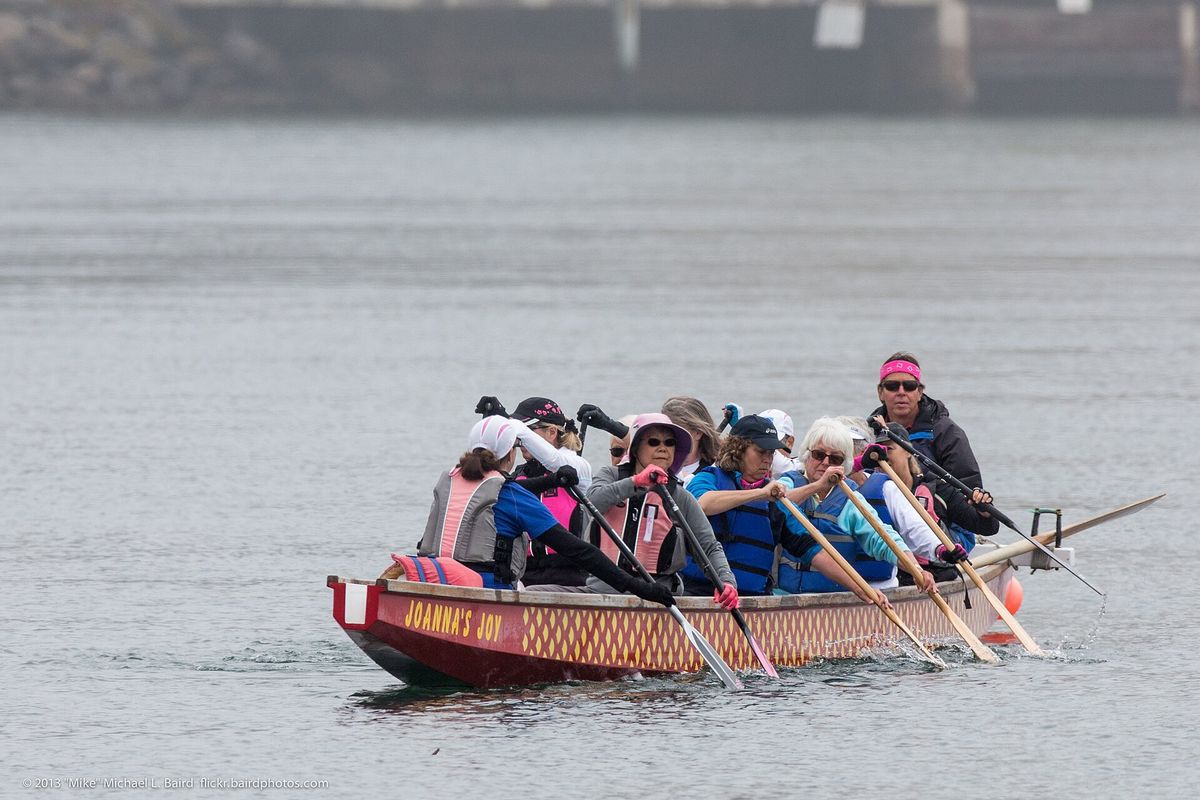
The SurviveOars, a breast cancer survivors' paddling team, at Morro Bay, California.
One of the crews in the worldwide movement that began with a clinical study in Vancouver in 1996.
Mike Baird · CC BY 2.0 · Wikimedia Commons
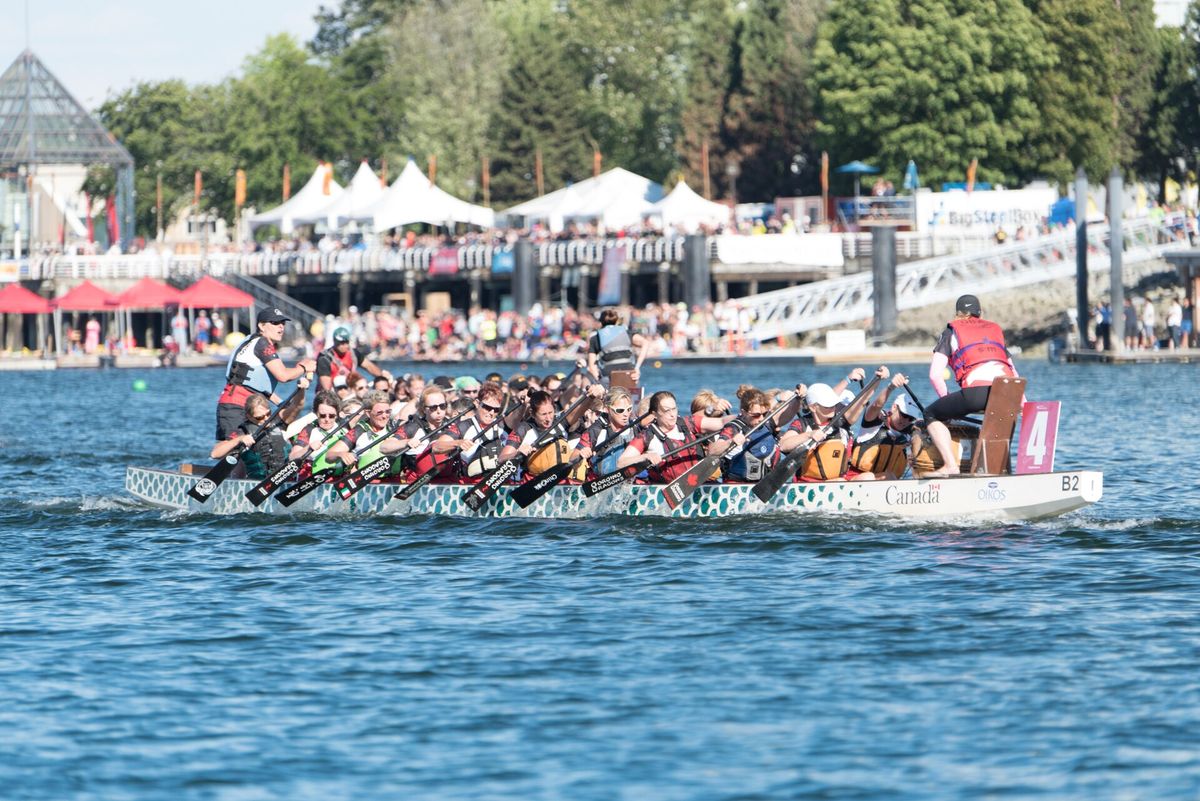
The Concord Pacific Dragon Boat Festival, Vancouver, 2015.
Canada is a genuine power, with a very large club and festival scene; Vancouver is where the survivors' movement began.
Jsdyson · CC BY-SA 4.0 · Wikimedia Commons
05Learning curve
You can be in a racing crew on your first evening, which is true of almost nothing else on this site — and the top of the sport is twenty people being identical, which is harder than it sounds.
Editorial — the site’s reading, not a sourced claim
Barrier to entry
How hard is it to get to a real game?
Turn up at a club, get in the boat, paddle. The club owns everything.
Dragon boat has the gentlest entry of any water sport covered here, and the reason is the boat. It is wide, stable and carries twenty-two people, so a beginner cannot capsize it, does not need to balance, and is never alone with the consequences of a mistake.
Compare canoeing and rowing, where a novice in a single boat spends their first sessions in the water rather than on it. A dragon boat novice is contributing to a crew within minutes.
Clubs own the boats and paddles. Community and corporate crews recruit complete beginners deliberately, and festival racing is full of people who started six weeks earlier.
Evidence
- Kit to startNothing; the club has itobserved
- StabilityVery high — a wide boat with 22 peopleobserved
- PrerequisiteAble to swimestimate
- Crew size22ruleA beginner can be carried by nineteen other paddlers.1991 — the rule this rests on
- Time to a real raceWeeksestimate
Barrier to the top
How hard is it to be good at?
Twenty paddlers producing one stroke, for two minutes, in a boat that punishes any of them being early.
Elite dragon boat is a synchronisation problem before it is a power problem. Twenty paddlers must enter, pull and exit the water together; a paddler out of time does not merely fail to contribute but actively slows the boat by disturbing the run and unsettling the hull. The difference between a good crew and a great one is visible in the water rather than in anyone's physiology.
Because the seats are fixed, the stroke is a whole-body rotation driven from the hips and trunk rather than a leg drive, which is a different action from rowing and closer to canoe sprint. Holding it identical, at rate, in a two-minute maximal effort, is the technical demand.
The 2000 metre event adds turns, which makes steering a competitive skill rather than a lane-keeping one.
The ceiling is capped institutionally: an Asian Games place, no Olympic place, and a sport where the enormous festival and community participation base does not translate into professional structures anywhere.
Evidence
- Synchronisation20 paddlers, one strokeobservedA paddler out of time slows the boat rather than merely not helping.
- Fixed seatsNo sliding seatobservedPower comes from trunk rotation, not a leg drive.
- The drummerSets and holds the rateruleA competitor whose contribution is timing rather than propulsion.1991 — the rule this rests on
- Typical peak age22–34estimate
Why the two differ
Very low to high, and the interesting feature is that the sport is simultaneously one of the most and least accessible things covered here depending on which crew you join.
A community or corporate crew will take anyone, put them in a boat within an hour, and race them at a festival in a month. An elite crew is twenty people who have trained to be indistinguishable from each other. Both are dragon boat, both race under IDBF rules, and there are more people in the first category than in almost any sport on this site.
The breast cancer survivor divisions sit inside that structure and are something no other sport here has: a competitive category that exists because a clinical trial in 1996 found the prevailing medical advice was wrong, and the crews formed for the study did not stop.
The historyhow it got here · sections 6 to 10
06Origin and invention
Dragon boat is the oldest thing on this site that is still, simultaneously, a religious festival and a governed sport.
The tradition is associated with Qu Yuan, a poet and minister of the state of Chu who, in the standard account, drowned himself in the Miluo River in the third century BC, and whose neighbours raced boats out to recover him and beat drums and threw rice into the water to keep the fish away. Whether that is the origin or a story attached later to older dragon-propitiation rites is debated; either way, racing at the Duanwu Festival is attested for a very long time and continues now.
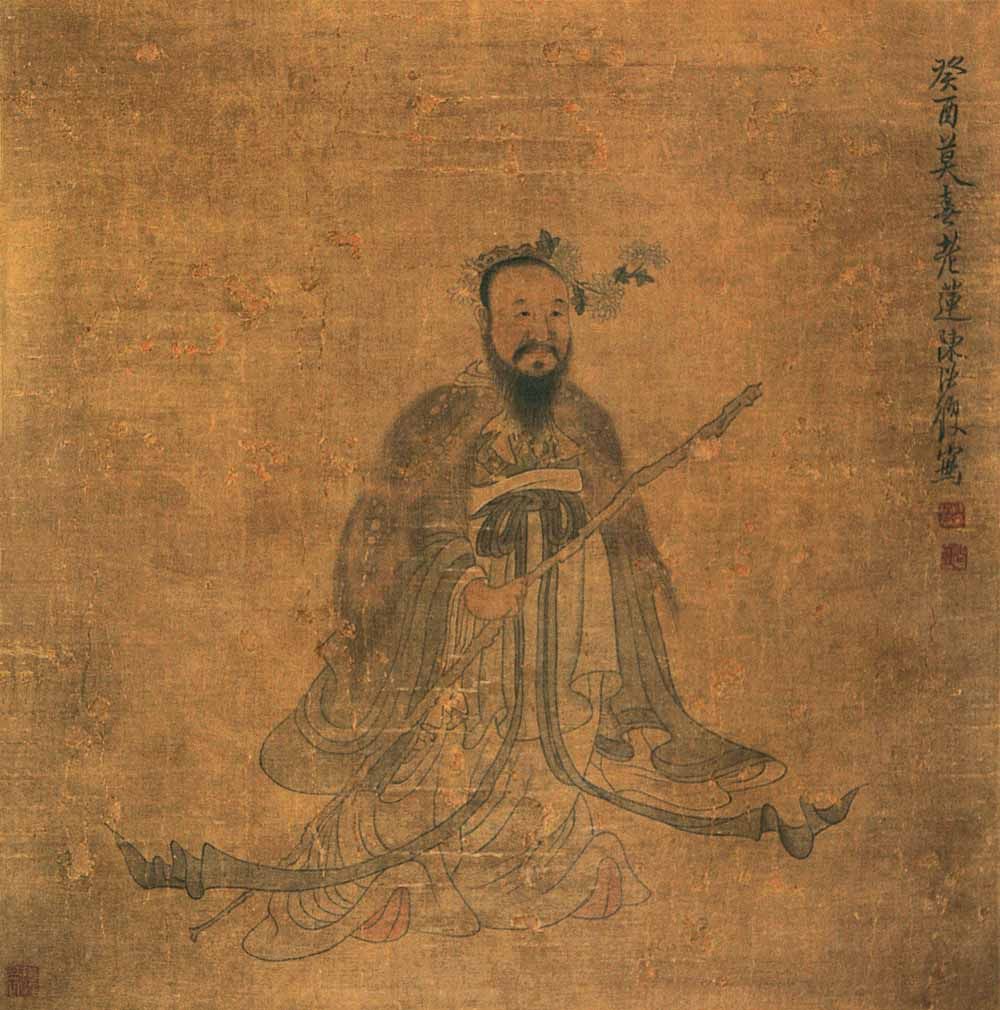
Qu Yuan, by Chen Hongshou, seventeenth century.
The poet and minister of Chu whose drowning, in the standard account, the Duanwu races re-enact. The painting is evidence of the story's standing, not of how the races began.
Chen Hongshou · Public domain · Wikimedia Commons
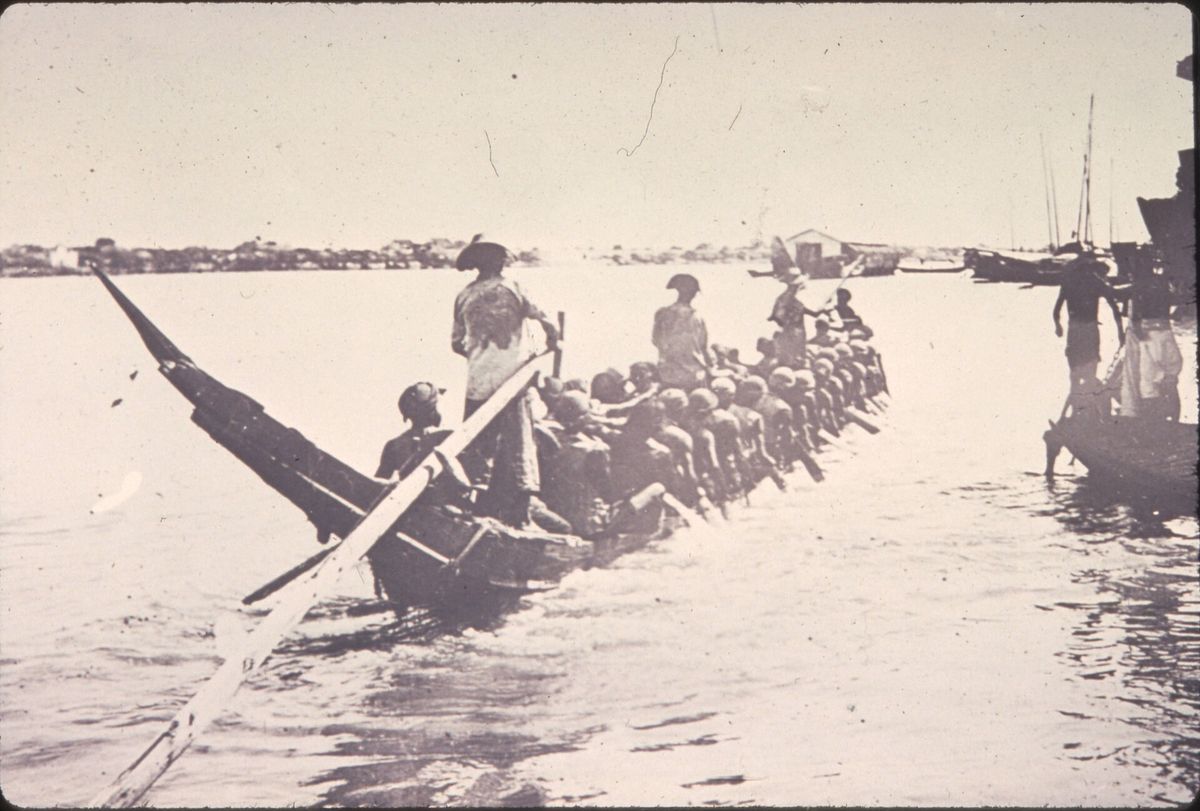
A dragon boat on the river at Changde, Hunan, between 1900 and 1919.
From a missionary's slide, captioned: races were held every year on the river, and rhythm was kept by the drummer. Festival racing, long before any federation.
Photographer unknown · Public domain · Wikimedia Commons
That is not background. Most dragon boat racing in the world today is still festival racing, in enormous numbers, and the governed sport is a small formalised layer on top of a living tradition. Very few sports on this site are in that position — karate's traditional schools and sepak takraw's circle games are the closest comparisons, and neither is on this scale.
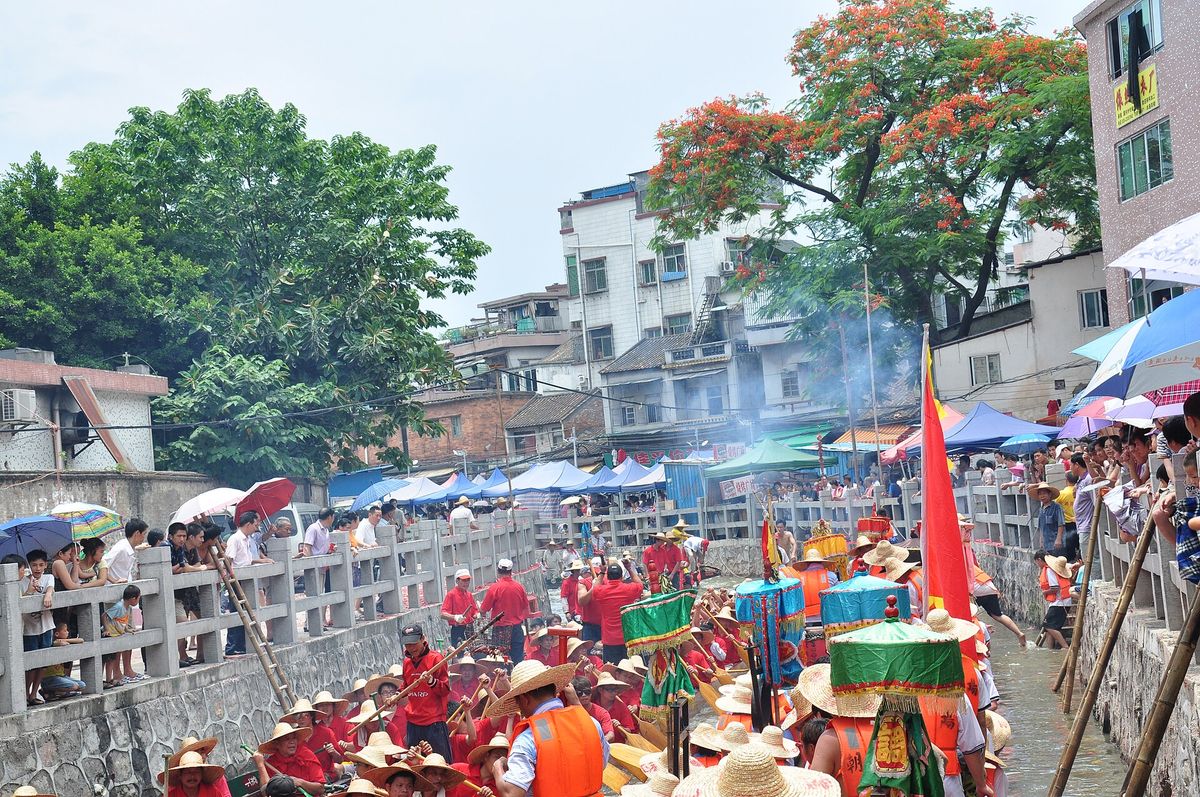
Dragon boats on the canal at Datang, Guangzhou, during the Duanwu Festival, 2011.
Most dragon boat racing in the world still looks like this: a village festival on local water, with crowds on the banks and incense on the boats.
Newnujilb · CC BY-SA 4.0 · Wikimedia Commons
Competitive codification began in Hong Kong in 1976, when an international race was organised as a tourism event and crews came from abroad. From there the sport spread through the 1980s, and the International Dragon Boat Federation was formed in 1991 to fix boat specifications, crew sizes and distances.
A crew at the Stanley International Dragon Boat Championships, Hong Kong, 2011.
Stanley's races are where the international competition began in 1976. The dragon head is fitted at the bow, as the rules require.
istolethetv · CC BY 2.0 · Wikimedia Commons
What the codification kept is the striking part. It could have removed the dragon head and tail as drag, and it could have deleted the drummer as ceremonial. It required both.
07Rule timeline
The sport’s own lane, expanded. Every entry carries a cause from the closed vocabulary and a citation, and says so where the citation is incomplete.
- 1991Fairness and eligibilityalso participation and accessadopted 1991
The standard crew was fixed at twenty paddlers, a drummer and a steerer — twenty-two people, of whom two do not propel the boat. The drummer sits at the bow facing the crew and beats time, setting and holding the stroke rate. They are a registered competitor who contributes no propulsion at all. The steerer stands at the stern with a long oar and keeps the boat in its lane. No other racing sport on this site carries a crew member whose job is rhythm. Rowing's coxswain steers and calls, which is the closest equivalent, and even a cox is not beating a drum.
Comparability break · Scoped to one competition
Standard and small boats, and open, women's, mixed and BCS divisions, race the same distances in different craft with different crews. See the series
Trigger and citationIncomplete — no confirmed article
Trigger
The festival tradition the sport comes from has always carried a drummer, and international codification kept the role rather than treating it as ceremonial.
IDBF Competition Rules · IDBF Competition Rules, crew composition
- 1991Fairness and eligibilityadopted 1991
The IDBF was formed to govern dragon boat racing internationally, fixing boat specifications, crew sizes — standard boats of twenty paddlers and small boats of ten — and the racing distances of 200, 500 and 2000 metres. It codified a sport out of a festival. Racing had been organised competitively in Hong Kong from 1976 and spread internationally from there, and the federation's job was to make a two-thousand-year-old ceremony into something that could be raced in lanes and timed.
Trigger and citationIncomplete — no confirmed article
Trigger
Dragon boat racing had spread worldwide through the 1980s with boats, crew sizes and distances varying by country and by festival.
IDBF Competition Rules · IDBF statutes
- 1996Participation and accessadopted 1996
Dragon boat paddling was studied as rehabilitation after breast cancer surgery, on the hypothesis — contrary to the standing medical advice of the time — that repetitive upper-body exercise would not cause or worsen lymphoedema. The finding supported it, and the crews formed for the study became a movement. Breast cancer survivor crews now race worldwide, and the IDBF contests BCS divisions at its world championships. That is a competitive division created out of a clinical trial, and this site knows of no other sport whose international championship programme contains one.
Trigger and citationIncomplete — no confirmed article
Trigger
A sports medicine researcher in Vancouver recruited breast cancer survivors into a dragon boat crew to test whether the prevailing advice against strenuous upper-body exercise was justified.
IDBF Competition Rules · IDBF Competition Rules, BCS divisions
- 2010Participation and accessalso commercialadopted 2010
Dragon boat was contested at the Asian Games in Guangzhou in 2010 and has appeared at subsequent editions, giving the sport its only multi-sport programme place.
Trigger and citationIncomplete — no confirmed article
Trigger
The Games were held in Guangdong, in the region where the festival racing tradition is strongest, and the host proposed the sport.
Asian Games sport programme listings · Olympic Council of Asia programme listings
08Equipment evolution
A racing boat that is required to carry decoration, which is not a sentence that applies to anything else on this site.
The dragon head and tail are fittings mounted at bow and stern, and competition rules require them. Every other racing craft covered here has been stripped of everything that does not make it faster: a rowing eight, a canoe, a kayak and an Olympic dinghy carry nothing ornamental. Dragon boat kept the ornament and made it a rule, because removing it would have made the boat something else.
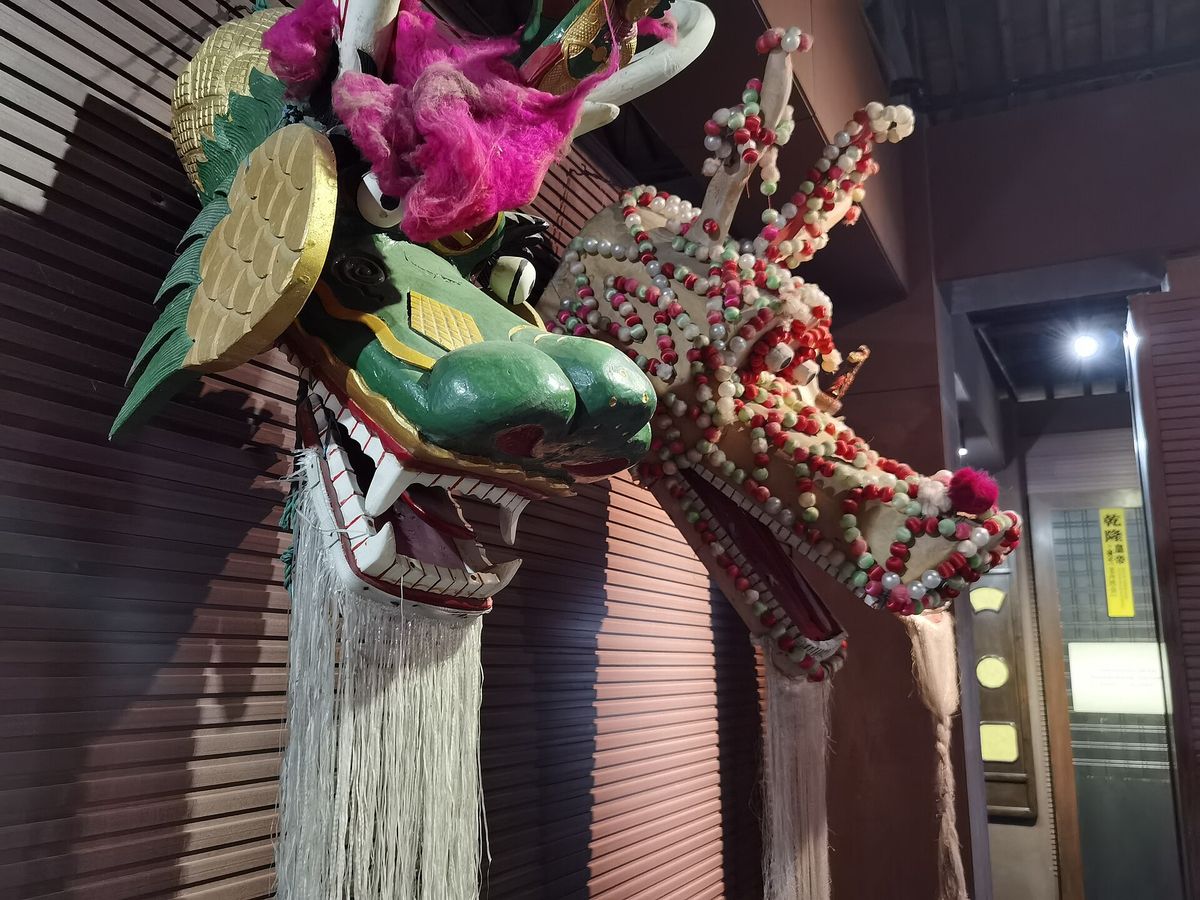
Dragon heads from Wuchang dragon boats, on display.
The head is a required fitting on a racing boat: ornament that the rules kept because removing it would have made the boat something else.
CatOnMars · CC BY-SA 4.0 · Wikimedia Commons
The hull has moved from heavy wooden festival craft to composite racing boats, and this is where the sport's fairness problem sits. Boats are not one-design in the way a sailing class is, and championship organisers usually supply identical boats to remove the variable — which is an admission that otherwise it would decide races.
The paddle is single-bladed and short, used seated, facing forward, from a fixed bench. That combination is the sport's technical signature: no oarlock, so no lever against the hull; no sliding seat, so no leg drive; no double blade, so no alternating stroke. Power comes from trunk rotation, which is why elite dragon boat paddlers look nothing like rowers.
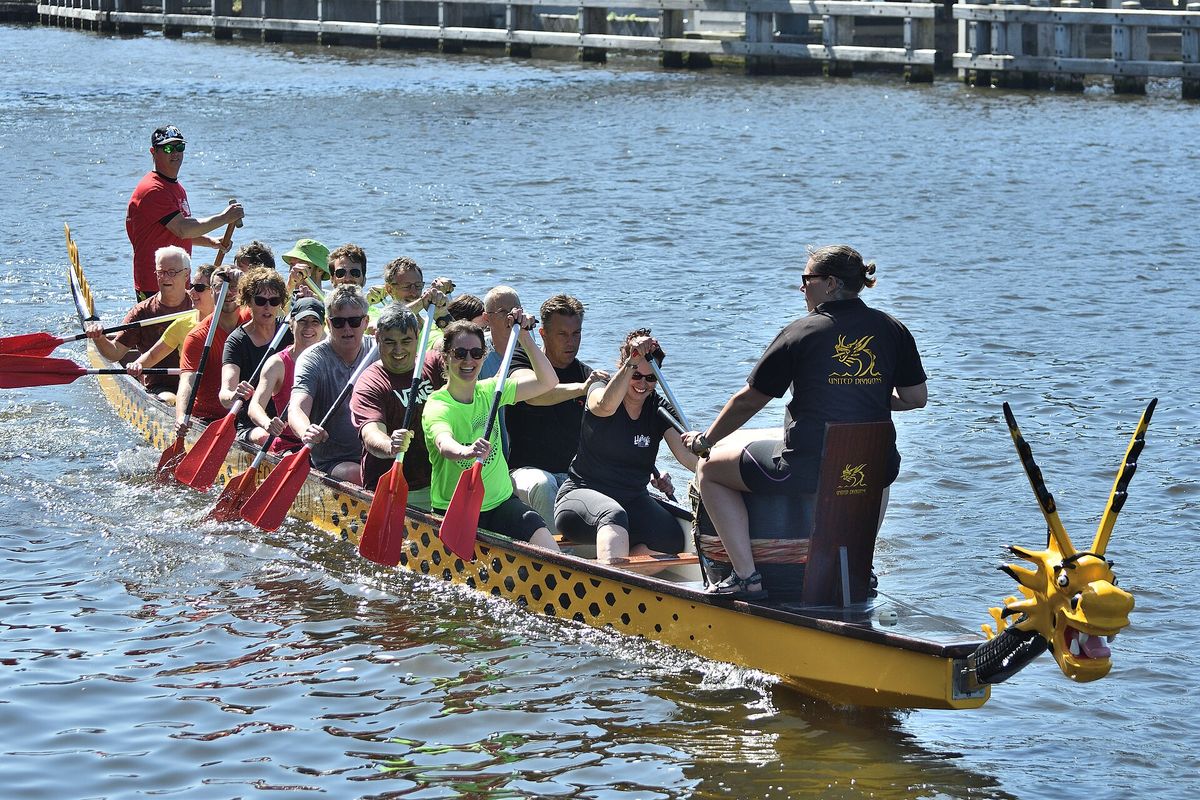
A crew at the Alkmaar dragon boat festival, the Netherlands, 2022.
Paddlers seated two abreast on fixed benches, single blades, the drummer facing them and the steerer standing at the stern with the long sweep.
Rene Cortin · CC BY-SA 4.0 · Wikimedia Commons
The drum is equipment carried for a competitor who supplies no propulsion, and the steering oar is a long sweep worked standing at the stern.
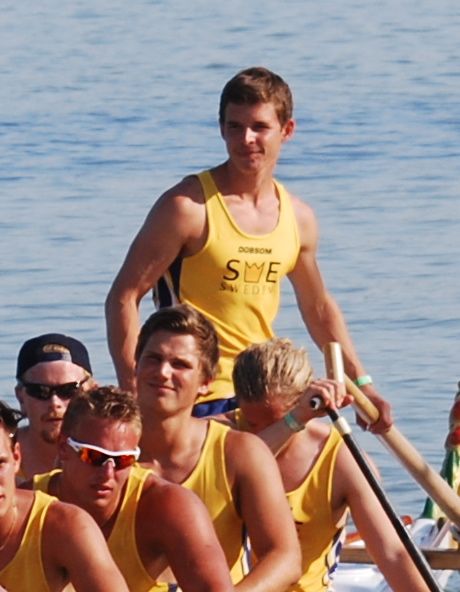
A Swedish steerer at the IDBF World Championships in Szeged, 2013.
The one crew member who stands, working the steering oar at the stern.
SwedishDragonboat · CC0 · Wikimedia Commons
Buoyancy aids are required, boats are weighed, and in some divisions crews are too.
09Governing body politics
Two international federations claim dragon boat, and both run championships.
The International Dragon Boat Federation, formed in 1991, is the body that codified the sport out of the festival tradition and holds its own world championships across standard and small boats, several distances and open, women's, mixed and breast cancer survivor divisions.
The international canoe federation also runs dragon boat as one of its disciplines, with its own competitions. Its claim rests on dragon boat being a paddling sport within its remit; the IDBF's rests on having built the international sport. Neither ratifies the other's results.
This site records the same structure in powerlifting, where federations split over drug testing and never reunified, and the consequence is identical: not a shortage of competition, but the absence of anybody with the standing to say what a world championship is.
For dragon boat the stakes are concrete. The canoe federation is on the Olympic programme. Any route dragon boat has to a Games plausibly runs through it rather than through the body that built the sport, which is a difficult proposition for the IDBF and an obvious one for everybody else.
The Asian Games place, from Guangzhou in 2010, is the sport's only multi-sport platform, and it sits in the region where the festival tradition is strongest.
There is one further political fact worth recording plainly: the sport's largest single act of institutional imagination was not the federation's at all. The breast cancer survivor divisions came out of a clinical study, and the federation adopted them.
10Controversies that forced rule changes
Whether the drummer is a competitor. A crew member who contributes no propulsion, in a sport decided by boat speed, is an obvious target for anyone optimising. The rules require the position, so the argument is settled in the rulebook and not in the sport: whether the beat genuinely helps a trained crew, or whether the drum survives because removing it would make dragon boat a generic paddling event, is discussed by crews constantly.
The boats. Because hulls are not one-design, a crew in a better boat is faster. Championship organisers supply identical boats for exactly this reason, which is a fairness solution that concedes the problem.
The medical advice that was wrong. In 1996 a Vancouver study put breast cancer survivors into a dragon boat crew to test the standing advice against strenuous repetitive upper-body exercise after surgery. The advice did not survive the test. The crews did — and BCS divisions are now contested at world championships. This site records it as a rule change caused by clinical evidence, which is a category it has otherwise only met in lifesaving.
Two federations. Dragon boat is governed in parallel by the IDBF and by the international canoe federation. Athletes, crews and national bodies have to choose, and no mechanism reconciles the results.
Festival and sport. The overwhelming majority of dragon boat racing is community and ceremonial. How much a governing body should regulate it, and whether championship rules should apply to a festival, is a live question in several countries.
Where it standsthe record, and what is still open · sections 11 to 12
11Series
No series can exist
Race times
Dragon boat times cannot form a progression, for the reason rowing gives and refuses to call its marks records: the water decides too much. A 500 metre time depends on the course, the current, the wind, the water temperature and the boat. Dragon boats are not one-design in the way an Olympic class dinghy is, and a heavy festival boat and a modern racing hull are different craft. A time set on one lake says very little about a time set on another. Crew composition compounds it. Standard and small boats, open, women's, mixed and BCS divisions all race the same distances, and the sport's mixed divisions specify the number of each sex aboard — so a mixed time is a function of a rule about who is in the boat. There is a governance obstacle as well. Two international federations run dragon boat competition in parallel, and neither ratifies the other's results, which puts the sport in the same position as powerlifting: not short of numbers, short of an authority to say what they mean. What the sport has instead is finishing order, which is all it claims.
1991Scoped to one competitionStandard and small boats, and open, women's, mixed and BCS divisions, race the same distances in different craft with different crews.
12What is contested now
Recorded as unsettled.
Which federation governs. The IDBF built the international sport; the canoe federation runs dragon boat as one of its disciplines and is on the Olympic programme. Both hold competitions, neither recognises the other's results, and any Olympic route plausibly runs through the body that did not build the sport.
The drummer. Required by rule, contributing no propulsion, and assessed by nobody. Whether the position is a competitive asset or a preserved ceremony is argued by crews, and the rulebook prevents the experiment that would settle it.
Boats. Not one-design, so championship organisers supply them. That works and it means a national programme cannot develop equipment, which most water sports treat as part of the discipline.
Festival and championship. Most dragon boat racing in the world is ceremonial and community racing that predates every federation involved. How much governance it should attract, and whether championship rules belong there, is contested in several countries and is not really a sporting question.
The BCS divisions. A competitive category that came out of a clinical study and now spans the world. Whether it should be integrated further into championship programmes, kept as its own festival circuit, or extended to other conditions, is discussed within the movement rather than by the federation.
Olympic prospects. An Asian Games place, an enormous participation base, no Olympic place, and a governance dispute standing directly in the path.