Duathlon
Triathlon with the swim taken out — which removes the sport's entry barrier and adds a second run on legs that have already run.
- Official
- Duathlon
- Game category
- Performance
- Adjudication
- Measured
- Standing
- Never Olympic
- rule changes
- 3
- comparability break
- 1
- Olympic editions
- 0
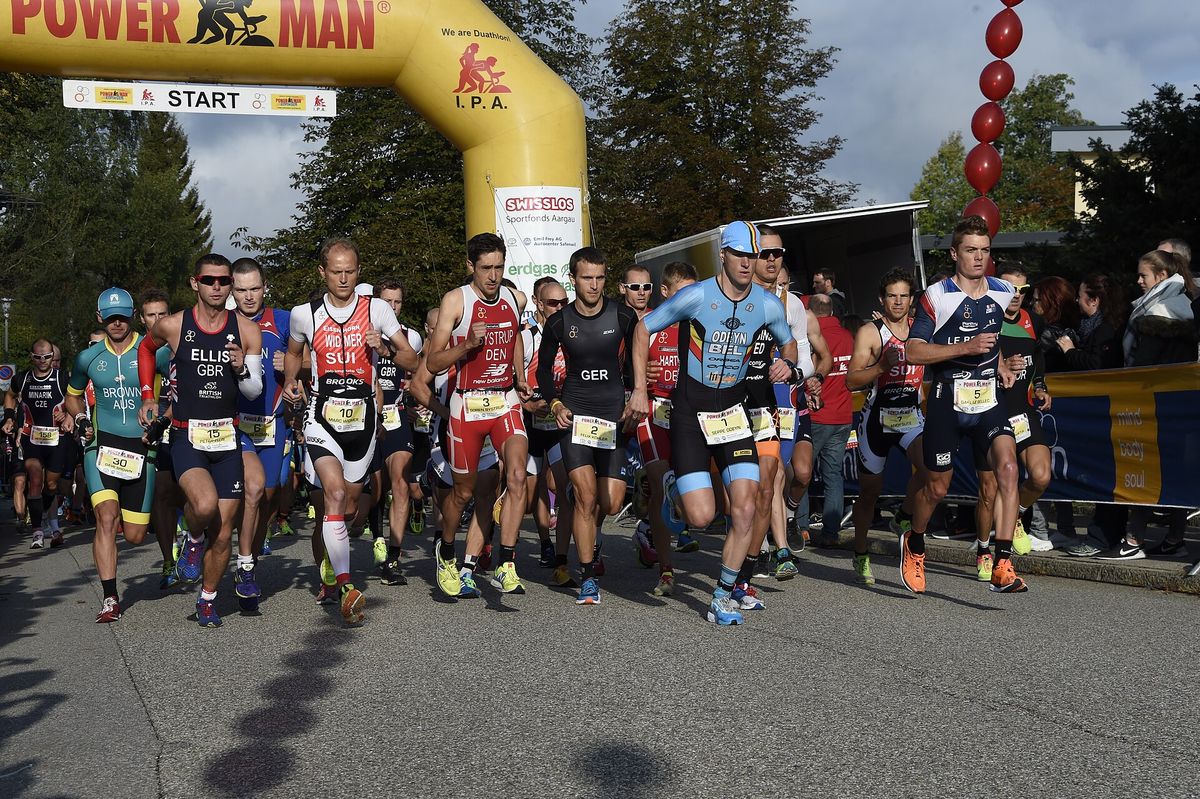
The men's start at Powerman Zofingen, Switzerland, 2017 · Ozzymate · CC BY-SA 4.0
- Governing body
- World Triathlon
- Founded
- Emerged in the 1980s from the triathlon boom as a format for athletes and venues without open water; world championships have been held since 1990, under the federation founded in 1989.
- Olympic status
- Not on the Olympic programme
- Also contested at
- World Games
Run, bike, run. Removing the swim from triathlon takes away the discipline that keeps most people out of the sport — open-water swimming is the barrier, not the cycling — and puts something back that triathlon does not have: a final run begun on legs that have already run hard. It is governed by a federation named after the sport it is not, and has no Olympic prospect for the same reason.
The gamewhat it is now · sections 1 to 5
01How it is played
Run, bike, run, against the clock, with the transitions timed as part of the race. Elite short-course racing permits drafting on the bike; most other racing does not, and the two are effectively different sports.
These figures were entered from the edition named above but have not been checked against its text line by line. Treat them as this site’s reading of the laws, not as a substitute for them.
The object of the game
Complete the course fastest. The clock runs from the start of the first run to the end of the second and does not stop — the transitions between disciplines are inside the race time, so changing shoes and racking a bike are timed activities.
- Sequence
- Run, bike, run
- Clock
- Continuous, transitions included
The course
Roads and paths, with a transition area where bikes are racked. Standard distances vary by format — a common championship configuration is roughly 10 km, 40 km and 5 km — and sprint, standard and long-course versions all exist.
Cross duathlon is run on trails and mountain bikes, which is a different event again.
- Standard
- About 10 km run, 40 km bike, 5 km run
- Transition area
- Inside the race time
Equipment
Running shoes, a bicycle and a helmet. The bike specification depends entirely on the format: draft-legal racing uses road bikes with restrictions on aerodynamic extensions, because a bunch riding at speed in close proximity on time-trial bars is dangerous. Non-drafting racing permits full time-trial equipment.
So the same athlete needs different bicycles for the two versions of the sport, which is the clearest practical evidence that they are not one thing.
- Draft-legal
- Road bikes, aerobar restrictions
- Non-drafting
- Time-trial equipment permitted
- Helmet
- Compulsory, fastened before touching the bike
This clause reads this way because of
Competitors and officials
Individual racing, with relay formats at championship level. Officials police the transition area, drafting where it is prohibited, and conduct on course, issuing time penalties served in a penalty box.
- Format
- Individual, with relays
- Penalties
- Served in a penalty box, during the race
Time
Roughly two hours for a standard-distance championship race; sprint formats around an hour; long course considerably more.
- Standard distance
- About 2 hours
Scoring
Elapsed time, and finishing order. There is nothing else — no points, no bonuses, no adjustment for conditions.
Transitions
The two transitions are part of the race and are governed in detail: the bike must be racked in the assigned position, the helmet fastened before the bike is touched and unfastened only after it is racked, and nobody may ride inside the transition area.
A rider who mounts before the line or dismounts after it takes a penalty. These are among the few rules on this site that regulate the act of changing equipment.
Infringements
Drafting, where the format prohibits it — riding within a defined distance behind or beside another competitor without completing an overtake in the allowed time.
Blocking, outside assistance, discarding equipment outside designated zones, and helmet offences in transition.
Penalties are time penalties served during the race rather than disqualifications, which keeps a competitor in the event and makes the penalty box a visible part of the racing.
This clause reads this way because of
Deciding the winner
First across the line. In draft-legal racing that is almost always decided on the second run, because the bike leg compresses the field; in non-drafting racing the bike can decide it outright.
Everything above is current law. Everything below is how Duathlon got here.
02Disciplines and events
No Olympic events. Duathlon is contested at the World Games and holds world championships across several distances — governed by the federation whose Olympic place belongs to triathlon.
- Disciplines
- 3
- Olympic medal events
- 0
- Men’s and women’s counted separately.
- Contested elsewhere
- 9
- world games, world championship.
- Listed for context
- 1
- Not counted as this sport.
Standard and sprint5
Road racing, run–bike–run. Draft-legal at elite short course.
- Men's standard and sprintWorld GamesWorld championship
- Women's standard and sprintWorld GamesWorld championship
- Mixed relayWorld championship
Long course2
Non-drafting, over considerably longer distances.
- Men's long distanceWorld championship
- Women's long distanceWorld championship
Cross duathlon2
On trails and mountain bikes.
- Cross duathlonWorld championship
The federation's other multisport formats4
World Triathlon governs a family of combinations, of which only one is Olympic.
- TriathlonSwim, bike, run — Olympic since 2000, and covered on this site as its own sport.
- AquathlonWorld championshipSwim and run, with no bike.
- AquabikeWorld championshipSwim and bike, with no run.
- Winter triathlonWorld championshipRun, mountain bike and cross-country ski.
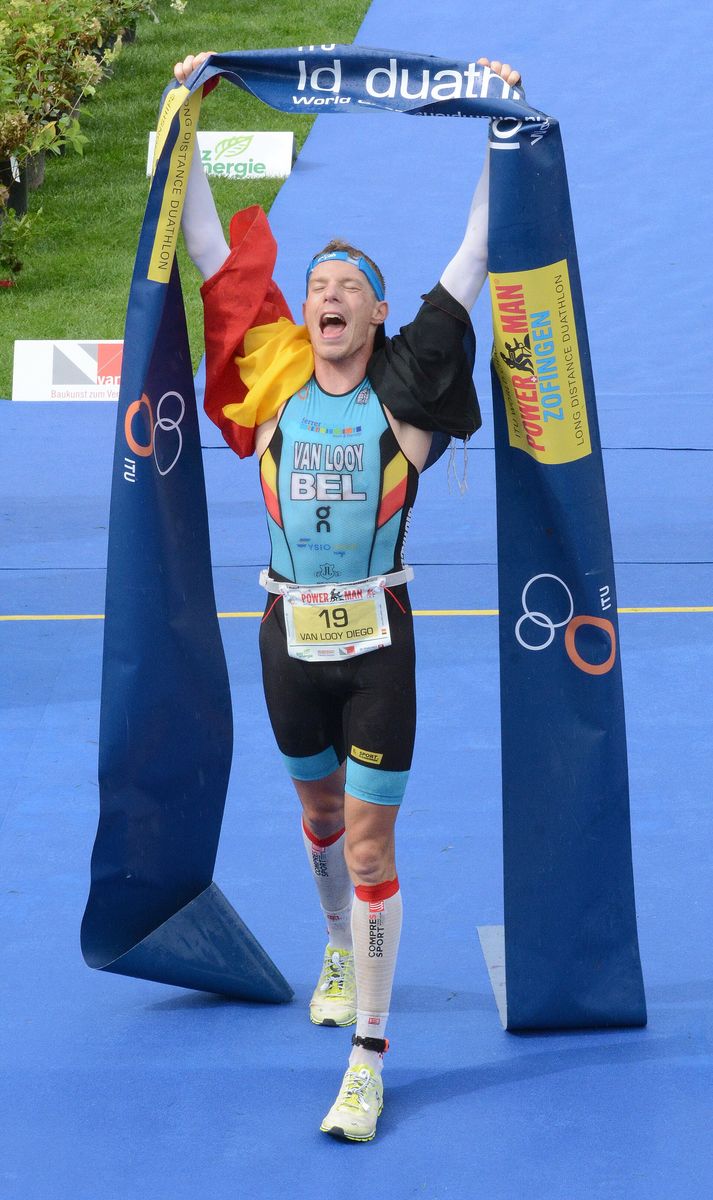
Diego Van Looy of Belgium winning the long-distance world championship at Powerman Zofingen, 2019.
Belgium has a depth in duathlon out of proportion to its size.
Kronsmans · CC BY-SA 4.0 · Wikimedia Commons
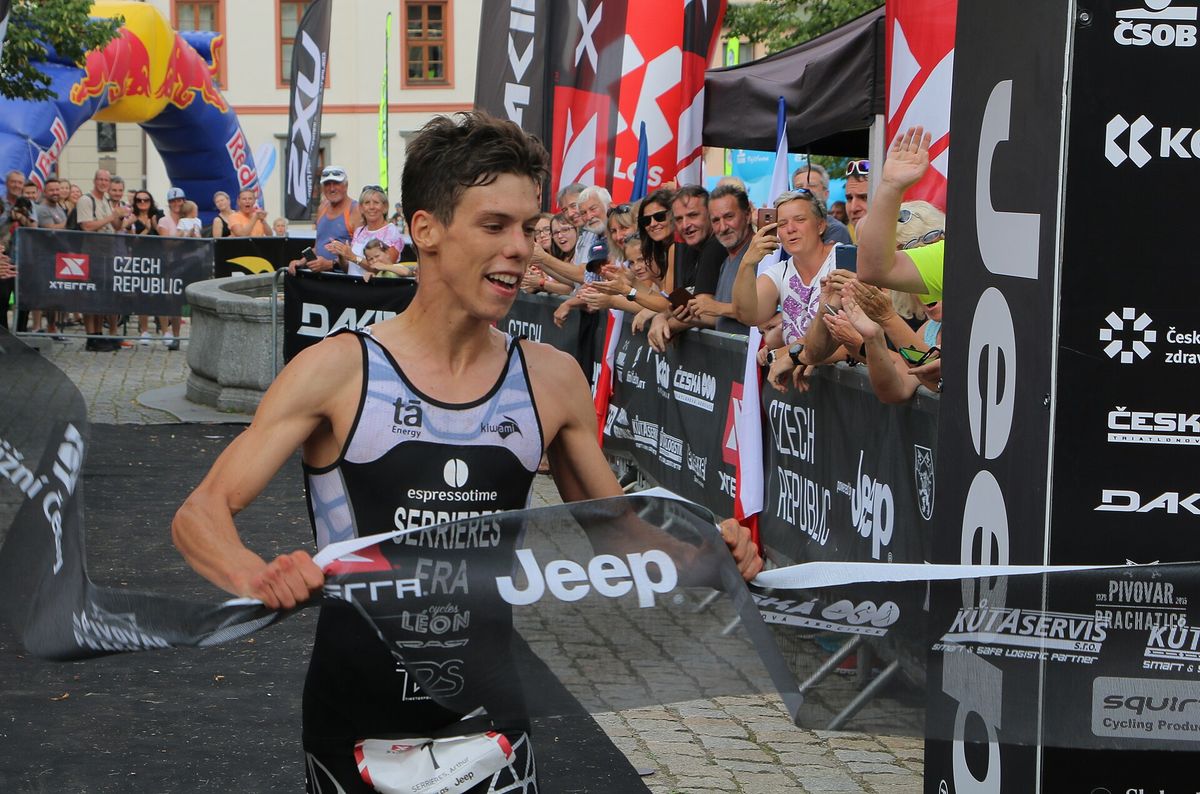
Arthur Serrières winning the Xterra cross triathlon at Prachatice, Czech Republic, 2020.
Cross triathlon, off-road on a mountain bike, here in the commercial Xterra series. The federation runs cross championships of its own alongside duathlon.
Jan Beránek · CC BY-SA 3.0 · Wikimedia Commons
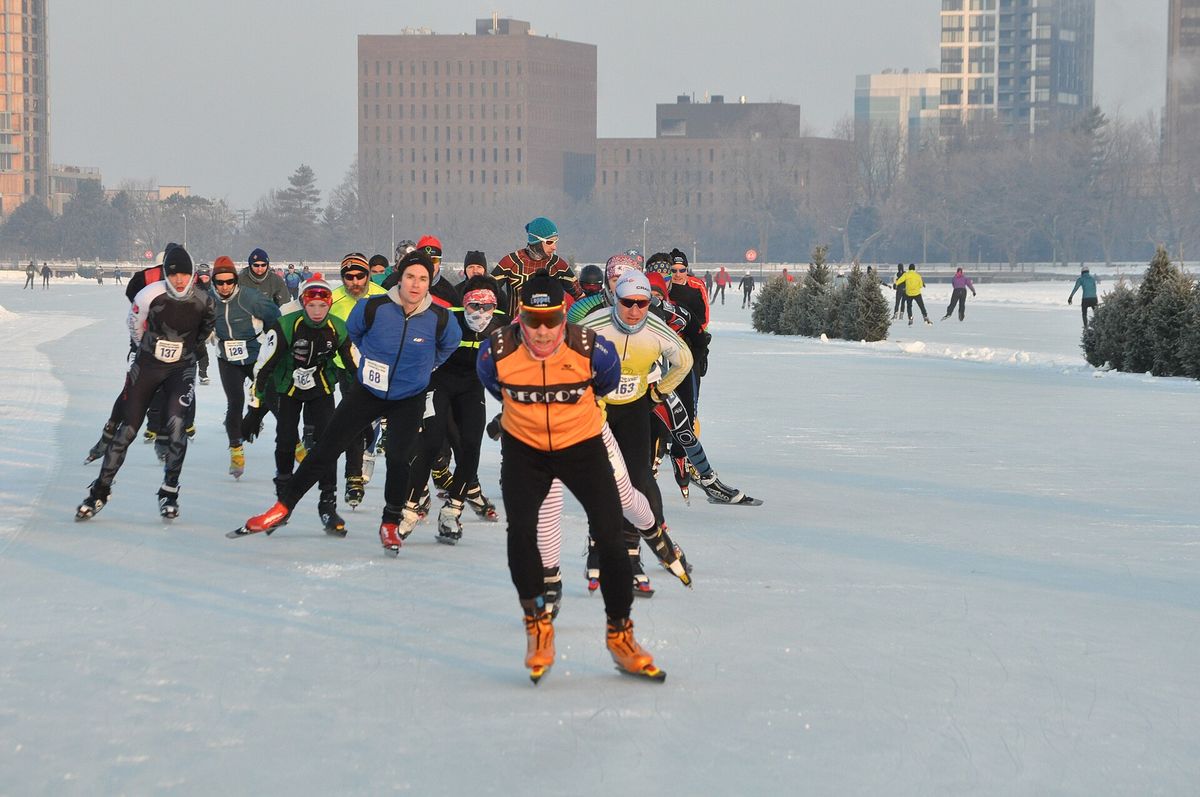
Skaters in the Winterlude Triathlon on Dow's Lake, Ottawa, 2020.
A local winter race in which one leg is skated. The federation's own winter triathlon is run, mountain bike and cross-country ski; this is the same idea on a frozen lake.
TomasNotThomas · CC BY-SA 4.0 · Wikimedia Commons
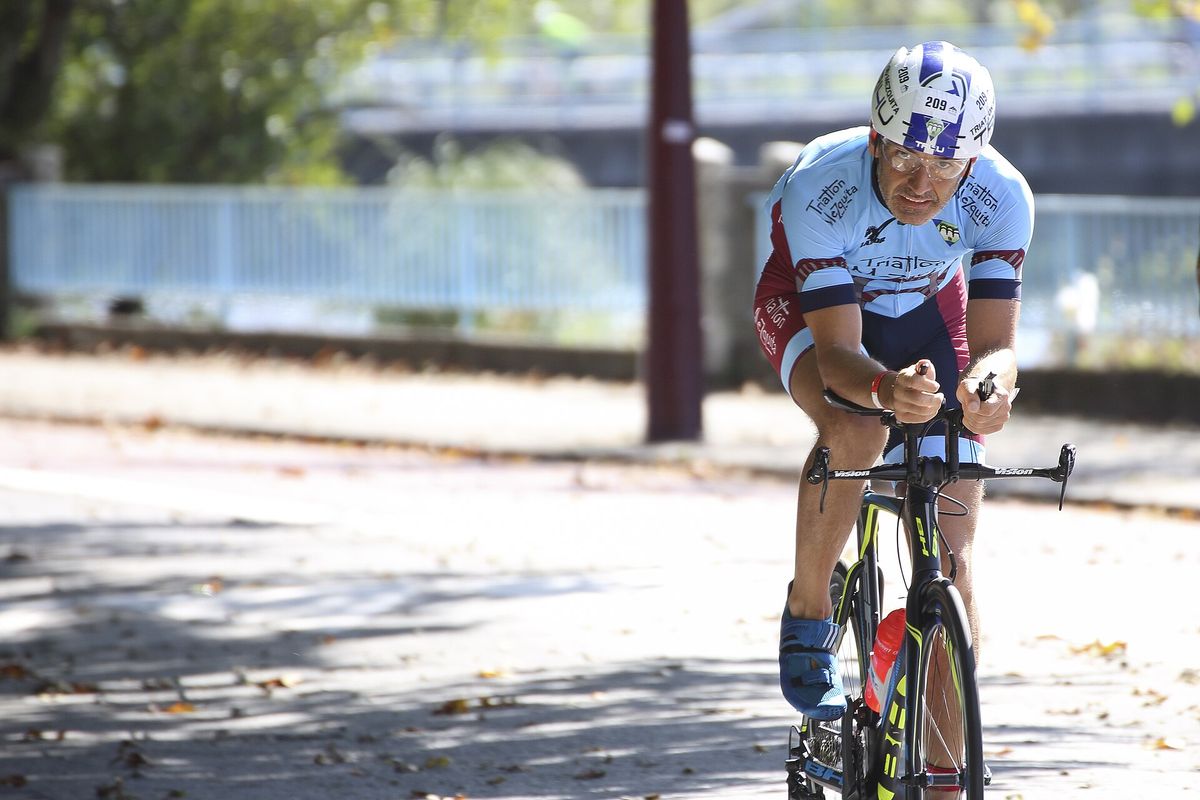
A competitor at the Spanish long-distance triathlon and aquabike championships, Pontevedra, 2018.
Aquabike removes the run: swim and bike only.
Harpagornis · CC BY-SA 4.0 · Wikimedia Commons
03Officiating
Most of duathlon needs no officiating at all, and the part that does is extremely difficult.
The clock decides the race and is not in dispute. Chip timing records the start, the transitions and the finish, and the result is a fact.
Drafting is where the officials are, and only in the formats that prohibit it. Motorcycle-mounted officials judge whether a rider is within a defined distance of the competitor in front and, if so, whether they are completing an overtake inside the allowed time. That is a judgement about distance and elapsed seconds, made from a moving motorcycle, on open roads, in a field of riders who are all trying to sit as close to legal as possible.
It is the single most contested call in the sport, and no technology has replaced it — proposals for automated proximity detection recur and none is in general use.
The transition area is the other officiated space. Helmet fastened before the bike is touched and unfastened after it is racked; the bike racked in its assigned position; no riding inside the area; mounting and dismounting on the correct side of the line. These are bright-line rules, easily seen, and frequently broken by athletes in a hurry.
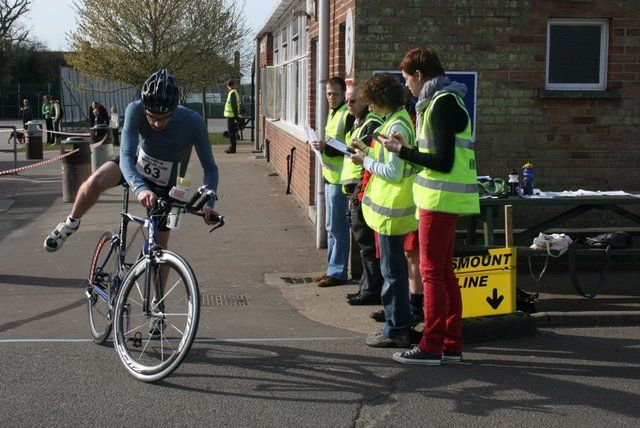
A competitor at the dismount line of the Diss Duathlon, Norfolk, 2009.
Marshals at a painted line: mounting and dismounting on the correct side of it is one of the bright-line rules of the transition area.
Katy Walters · CC BY-SA 2.0 · Wikimedia Commons
Penalties are time penalties served in a box during the race rather than disqualifications, which is unusual: the competitor stays in the event, the sanction is visible to spectators, and the race carries on.
04Where it is played
Europe, decisively, and a much wider amateur base than the elite results suggest.
Belgium, the Netherlands, Spain, France, Great Britain, Germany, Italy and Switzerland carry most of duathlon's elite competition, and Belgium and the Netherlands in particular have a depth in the sport out of proportion to their size — a product of dense cycling culture, flat road racing terrain and strong club structures.
Powerman long-course racing, centred on Switzerland, is the discipline's best-established professional circuit and has been for decades.
The men's start at Powerman Zofingen, Switzerland, 2017.
The long-course circuit's best-known race, and host of the long-distance world championships.
Ozzymate · CC BY-SA 4.0 · Wikimedia Commons
Beyond Europe, the United States, Australia, Canada, Japan, South Africa and increasingly Latin America compete, and duathlon's age-group world championships draw genuinely international fields.
The interesting pattern is where duathlon is strong relative to triathlon. It does disproportionately well in countries with serious road cycling cultures and less open-water swimming tradition, and in inland regions with no accessible safe water. That is exactly what the format was invented for, and the map still shows it.
At amateur level the sport's footprint is far larger than its elite profile, because it is the multisport event that people who cannot swim can enter. A great deal of duathlon happens in club races that no federation counts.
05Learning curve
Substantially easier to enter than triathlon, because the discipline that stops people is the one that has been removed — and a top end that is harder in one specific way, since the last run starts on legs that have already run.
Editorial — the site’s reading, not a sourced claim
Barrier to entry
How hard is it to get to a real game?
If you can run and ride a bike, you can enter one. No open water, no swim technique.
Triathlon's barrier is swimming, and specifically open-water swimming. Adult beginners can learn to run and to ride a bicycle without instruction; learning to swim well enough to race in a crowded open-water start is a different order of commitment, and it is where most prospective triathletes stop.
Duathlon removes it. What remains — running and cycling — are the two endurance activities with the largest existing participation base in the world, so a very large number of people are already halfway trained for it without knowing.
The equipment is running shoes, a bike and a helmet, and entry-level events are short and untimed at the sharp end.
It sits at low rather than very low because a bicycle is a real purchase and events need organising on roads.
Evidence
- No swimThe barrier removedruleOpen-water swimming is what keeps people out of triathlon.1990 — the rule this rests on
- Kit to startShoesobserved
- Existing skillsRunning and cyclingestimate
- FacilityRoads and a transition areaobserved
- Time to a first raceWeeksestimate
Barrier to the top
How hard is it to be good at?
A final run started on running-fatigued legs, in a sport with no Olympic destination.
The physiological demand is genuinely distinct from triathlon's, and this is the thing the sport is not given credit for. A triathlete's run comes off a swim and a bike — different muscle recruitment, different loading. A duathlete's second run comes after a hard first run *and* a bike leg, so the running muscles have been loaded twice with an interval that does not restore them. Elite duathletes describe the second run as a different activity from the first, and the split times show it.
Pacing is correspondingly harder. The first run has to be fast enough to stay in the race and slow enough to leave a second one, and misjudging it is unrecoverable in a way a triathlon swim rarely is.
Then the ceiling. Duathlon's elite structure is a world championship, a World Games place and a modest circuit, because the federation that governs it already has an Olympic sport and it is not this one. An athlete good enough to reach the top of duathlon is generally good enough to make a living in triathlon or in running, and many do.
Evidence
- The second runOn legs that have already runruleA loading pattern triathlon does not produce.1990 — the rule this rests on
- Two sports in oneDraft-legal and non-draftingruleDifferent bikes, different tactics, incomparable results.1995 — the rule this rests on
- Governed by triathlon's federationSince 1989ruleThe Olympic place belongs to the flagship sport.1989 — the rule this rests on
- Typical peak age26–35estimate
Why the two differ
Low to very high, and duathlon is worth setting directly beside triathlon, which this site already covers.
Triathlon's gap is wide because of the swim: an adult who cannot swim competently is not going to become a triathlete, whatever else they can do. Duathlon deletes that barrier and keeps almost the entire ceiling, because the running and cycling demands at the top are the same and the second run is harder.
That makes it the clearest accessibility experiment on this site after soft tennis and pétanque: remove one component of an existing sport and the entry barrier collapses while the elite requirement does not.
What duathlon does not get is the reward. Triathlon has been Olympic since 2000; duathlon is governed by triathlon's federation and has no route. It is the more accessible sport and the less consequential one, and nothing about its rules can change that.
The historyhow it got here · sections 6 to 10
06Origin and invention
Duathlon is a workaround that became a sport.
Triathlon boomed through the late 1970s and 1980s and ran into two constraints almost immediately. The first was athletes: a great many people who could run and ride could not swim well enough to race in a mass open-water start, and they were not going to learn as adults. The second was venues: organising a safe open-water swim needs suitable water, lifeguards and a risk appetite that many organisers did not have.
Run-bike-run events were the answer to both, and they spread through the 1980s under a variety of names — biathlon among them, until the winter sport's claim on that word made it untenable.
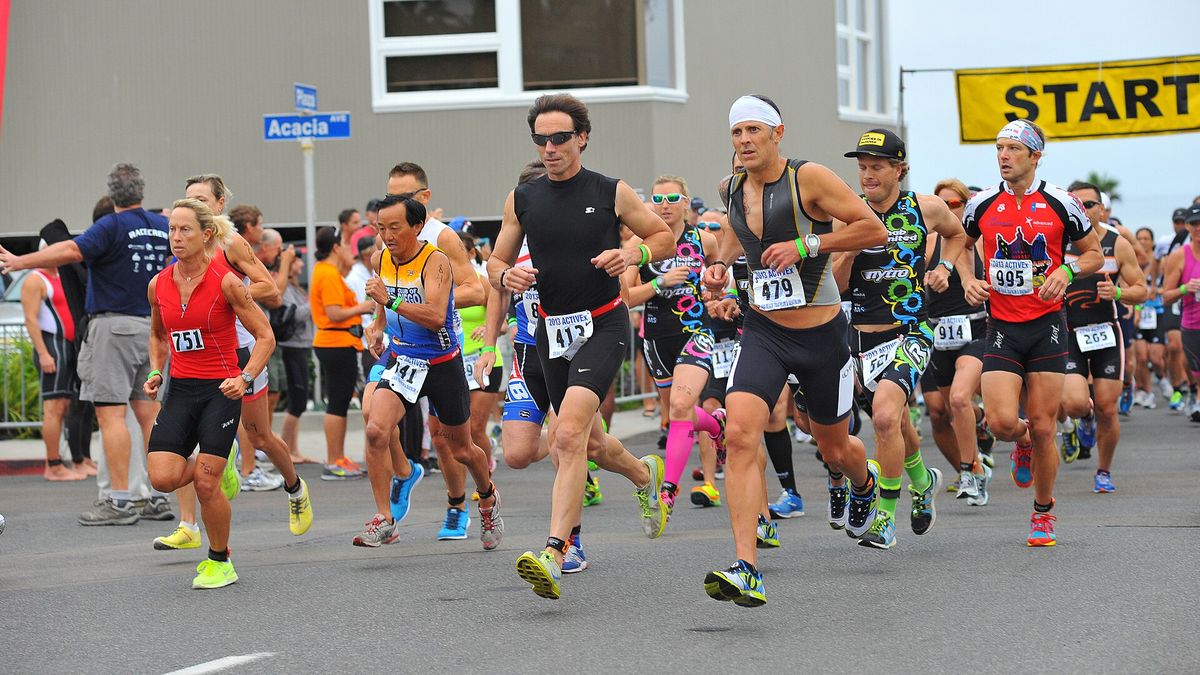
The start of the Solana Beach Duathlon, California, 2013.
An age-group race: the first run, the one that begins on fresh legs. For most of the people in a field like this, the missing swim is the difference between racing and not.
Chris Hunkeler · CC BY-SA 2.0 · Wikimedia Commons
The International Triathlon Union was founded in 1989, largely to pursue Olympic inclusion for triathlon, and inherited the multisport formats that had grown up alongside: duathlon, aquathlon, aquabike, cross and winter variants. World duathlon championships have been held since 1990.
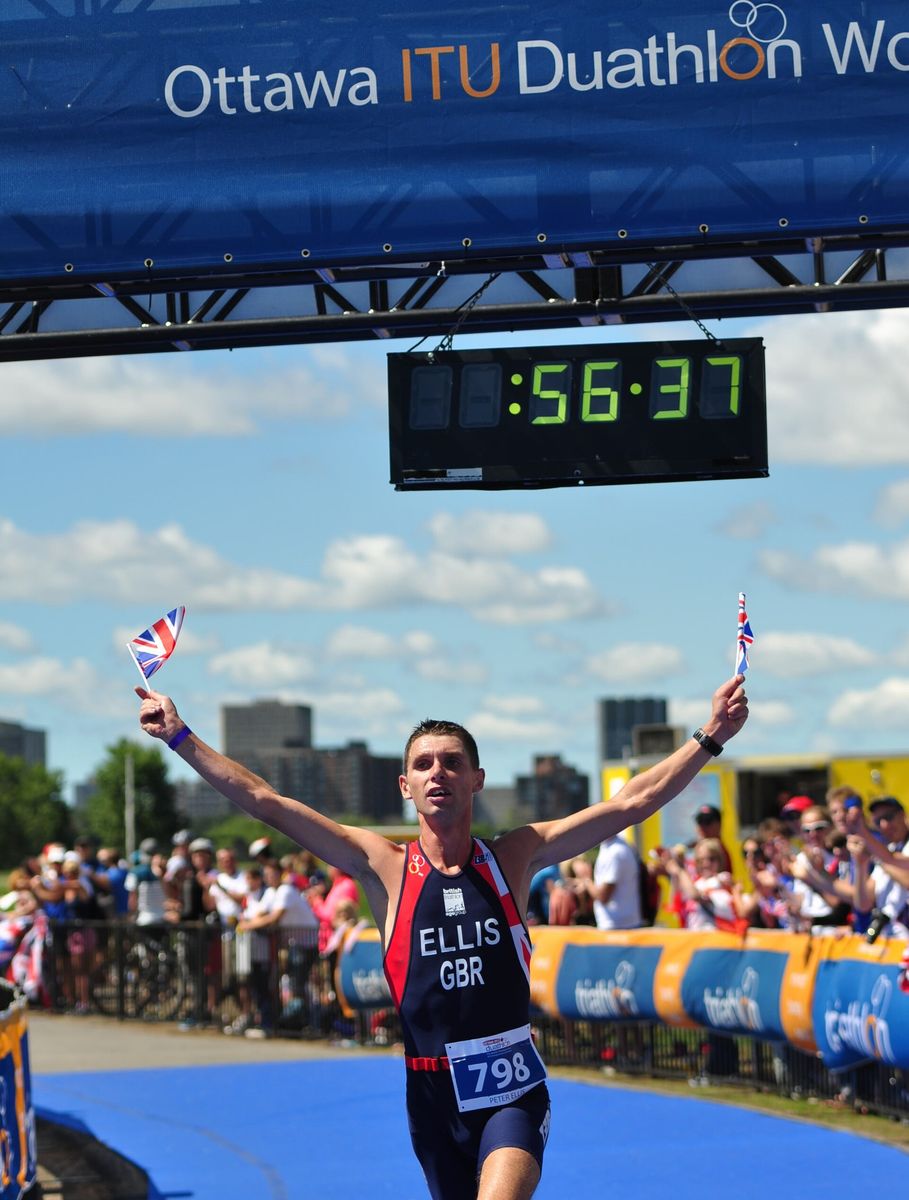
A British athlete at the finish of the ITU Duathlon World Championships, Ottawa, 2013.
World championships have been held since 1990 under the triathlon federation, and they are the top of a sport with no Olympic route.
Ozzymate · CC BY-SA 4.0 · Wikimedia Commons
What the format turned out to be is not simply a smaller triathlon. Removing the swim removed the barrier, and it also changed which discipline decides the race — because the final run now begins on legs that have already run hard, with a bike leg in between that does not let them recover. Elite duathletes treat the second run as a different event from the first.
Duathlon has a World Games place and world championships and no Olympic prospect, for a reason that has nothing to do with the sport: its own federation already has an Olympic event, and it is the one with the swim in it.
07Rule timeline
The sport’s own lane, expanded. Every entry carries a cause from the closed vocabulary and a citation, and says so where the citation is incomplete.
- 1989Fairness and eligibilityalso commercialadopted 1989
An international federation was formed for triathlon, and it took responsibility for a family of multisport formats alongside it: duathlon, aquathlon, aquabike, cross triathlon and winter triathlon. Duathlon is therefore governed by a body named after a different sport, and its institutional position follows from that. The federation's Olympic place belongs to triathlon; duathlon has world championships and a World Games place, and no prospect of a programme place while its own federation's flagship already holds one.
Trigger and citationIncomplete — no confirmed article
Trigger
Triathlon was pursuing Olympic inclusion and needed a single international federation, which then inherited the multisport formats that had grown up around it.
World Triathlon Competition Rules · World Triathlon statutes
- 1990Participation and accessadopted 1990
The format was codified as run, bike, run, with world championships from 1990: a first run, a transition, a bike leg, a second transition, and a final run. The second run is the sport's distinctive demand and it is not a smaller version of triathlon's. A triathlete runs off the bike on legs fatigued by swimming and cycling. A duathlete runs off the bike on legs that have already run hard, which produces a specific and well-recognised deterioration — the running muscles have been loaded twice, with a cycling leg in between that does not let them recover. Removing the swim was not a simplification. It changed which discipline decides the race.
Trigger and citationIncomplete — no confirmed article
Trigger
Triathlon's growth through the 1980s ran into two constraints — athletes who could not swim well enough, and venues without safe open water — and run-bike-run events were organised to work around both.
World Triathlon Competition Rules · World Triathlon Competition Rules, duathlon
- 1995Broadcast and pacingalso fairness and eligibilityadopted 1995
Elite short-course racing became draft-legal: riders may sit in another competitor's slipstream on the bike leg. Long-course and age-group racing remained non-drafting, with penalties for riding within a defined distance of the rider in front. These are two different sports sharing a name. A draft-legal bike leg is a bunch race in which a strong cyclist gains far less than they would alone, so races are decided on the final run. A non-drafting bike leg is a time trial, and the cycling is decisive. Times, and any statistic drawn from them, are not comparable across the two.
Comparability break · Scoped to one competition
Draft-legal and non-drafting racing are separate sports with separate equipment. Times belong to a format, not to duathlon. See the series
Trigger and citationIncomplete — no confirmed article
Trigger
Non-drafting racing spread the field out over the bike leg and produced an event that could not be televised or followed. Allowing drafting compressed the race and made the finish competitive.
World Triathlon Competition Rules · World Triathlon Competition Rules, drafting
08Equipment evolution
Two disciplines' worth of equipment, and a transition governed in more detail than either of them.
Running shoes and a bicycle, and the bicycle is where the sport's split personality shows. Draft-legal racing requires road bikes with restrictions on aerodynamic extensions, because a bunch riding in close proximity on time-trial bars — with the rider's weight forward and the brakes out of reach — is genuinely dangerous. Non-drafting racing permits the full time-trial setup: deep wheels, aero bars, aggressive position.
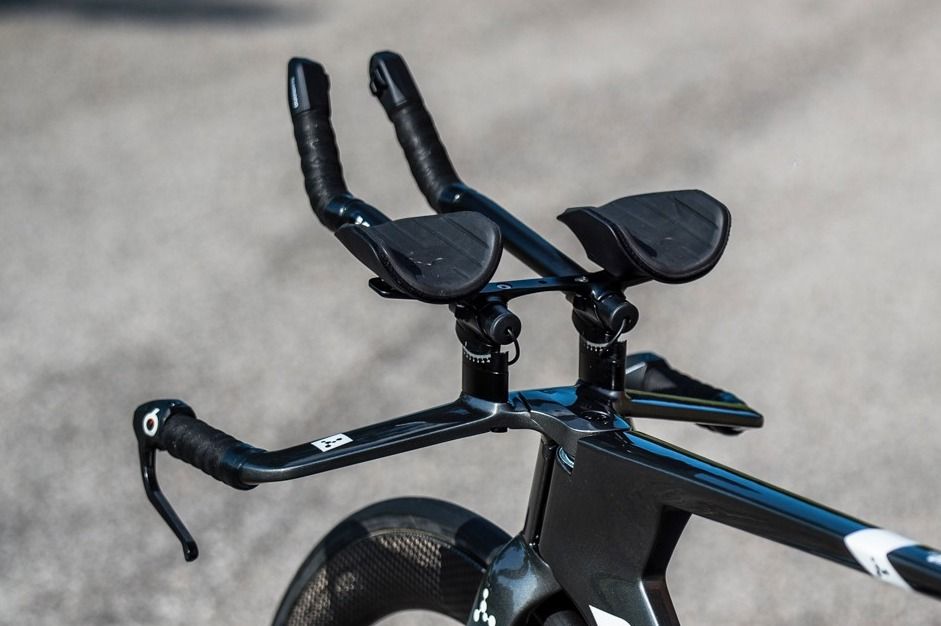
A time-trial bicycle with triathlon extensions.
Legal in non-drafting racing and restricted in draft-legal racing, where a bunch riding on bars like these, weight forward and brakes out of reach, is dangerous.
Glory Cycles · CC BY 2.0 · Wikimedia Commons
So a duathlete competing across both formats owns two bicycles that are barely the same machine, which is the plainest evidence that the formats are separate sports.
The helmet is the sport's most tightly regulated item, and the rule is about sequence rather than specification: it must be fastened before the bike is touched and unfastened only after it is racked. That is a rule about the order of actions, which very few sports on this site have.
The transition itself is equipment-adjacent and is the sport's hidden technical discipline. Shoes left open, bikes racked in an assigned position, elastic bands holding cycling shoes level — these are trained and practised, and the seconds involved are inside the race time.
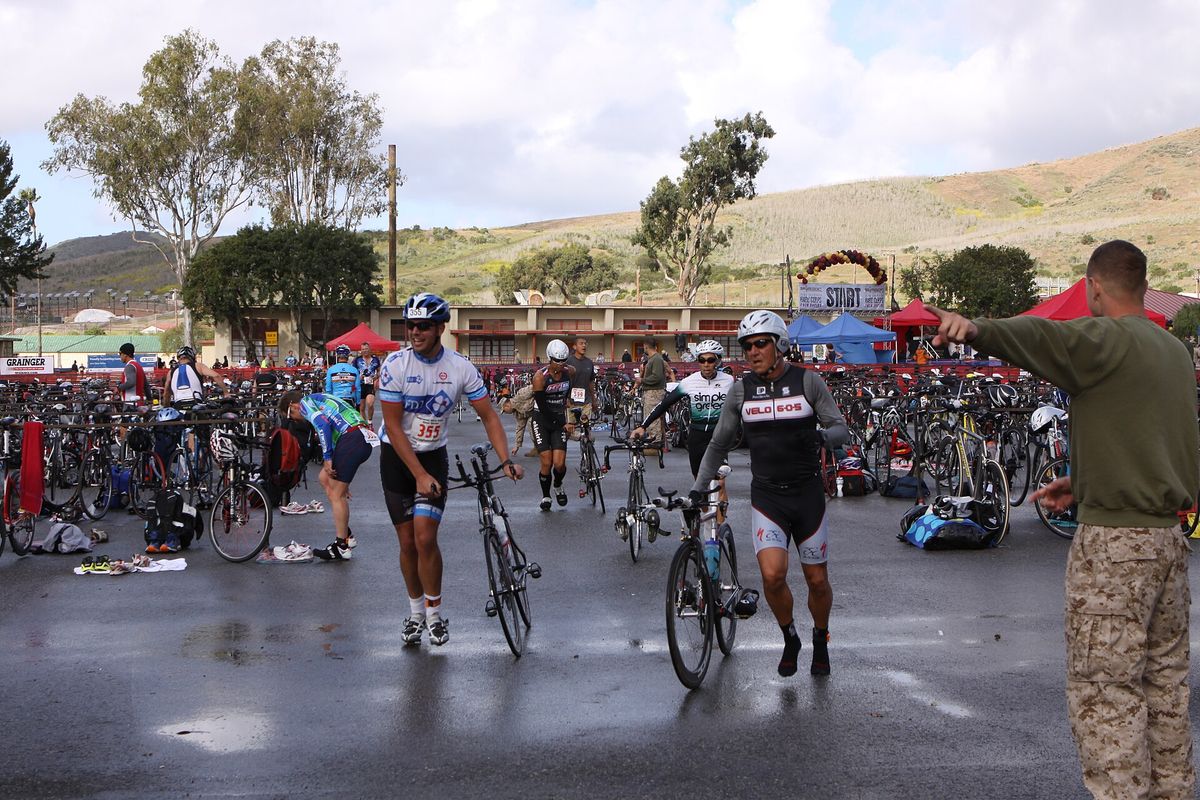
Competitors leaving transition with their bikes at the Devil Dog Duathlon, Camp Pendleton, California, 2012.
Bikes racked in assigned places and walked or run out, never ridden, inside the area: the transition is inside the race time and so it is raced.
US Marine Corps · Public domain · Wikimedia Commons
What duathlon does not need is the thing triathlon spends most on: a wetsuit, goggles and the whole apparatus of open-water swimming. Removing the swim removed a substantial share of the sport's equipment cost along with its entry barrier.
09Governing body politics
Duathlon's institutional position is settled and nobody involved pretends otherwise: it is the second sport in a federation that already has an Olympic one.
World Triathlon — founded in 1989 as the International Triathlon Union — was built to get triathlon onto the Olympic programme, which it achieved for Sydney 2000. It governs duathlon, aquathlon, aquabike, cross and winter formats alongside, and duathlon is the largest of them.
That produces a specific kind of stasis. Duathlon has world championships, a World Games place, a real age-group participation base and a modest elite circuit. It has no realistic route to a Games, because the argument for adding it would have to be made by a federation whose flagship is already there, in a category the IOC would reasonably say is covered.
The federation's decisions reflect the priority sensibly rather than neglectfully. Duathlon's rules track triathlon's — the draft-legal short course format, the penalty box, the transition regulations — because keeping them aligned lets athletes move between the formats and lets one officiating corps work both.
Where duathlon has independent life is at age-group level, and it is substantial: a large population of amateur athletes for whom the absence of a swim is the difference between competing and not. That constituency is bigger than the elite one by orders of magnitude, and it is the sport's actual reason for existing.
There is one recurring internal argument: whether elite duathlon should be draft-legal at all, given that the format was adopted to make triathlon televisable and duathlon is not televised much either way.
10Controversies that forced rule changes
Drafting. The sport's defining split. Elite short-course racing became draft-legal in the mid-1990s, following triathlon, because a non-drafting bike leg spread the field out and produced a race that could not be followed. Long-course and age-group racing stayed non-drafting. The result is two sports with different bicycles, different tactics and incomparable results, held under one name — and the argument about whether elite duathlon needed to follow triathlon into it has never quite gone away.
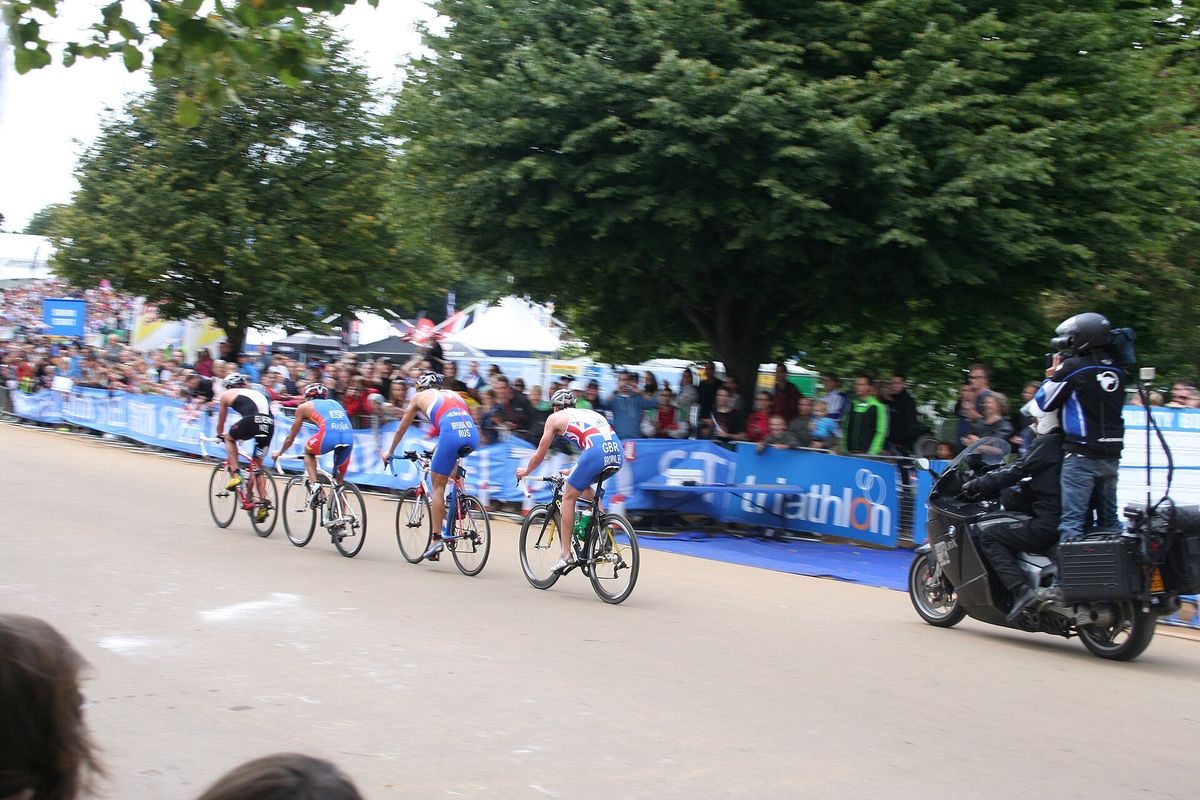
A breakaway on the bike at the ITU World Championship Series triathlon, London, 2011.
Draft-legal racing in its home format, triathlon: riders in a tight line, taking turns at the front. Elite duathlon followed it into this in the 1990s.
Gemma Bardsley · CC BY 2.0 · Wikimedia Commons
Policing drafting where it is banned. In non-drafting racing, officials on motorcycles judge whether a rider is inside a defined distance and whether an overtake was completed in the allowed time. It is a judgement about position and elapsed time made at speed on open roads, and it is the most disputed call in the sport.
Transition rules. Mounting before the line, dismounting after it, helmet fastened before touching the bike, bikes racked in an assigned position — a detailed body of regulation about the act of changing equipment, tightened over time because the transitions are timed and therefore raced.
Penalties rather than disqualification. Time penalties served in a box during the race keep a competitor in the event and make the sanction visible. It is a gentler enforcement model than most measured sports use and it was adopted deliberately.
What to call it. The format was widely called biathlon until the winter sport's prior claim made that impossible — a naming problem that delayed the sport's coherent identity by years.
Where it standsthe record, and what is still open · sections 11 to 12
11Series
No series can exist
Race times
Duathlon times cannot form a progression, and the sport's own rules give two independent reasons. The courses differ. A duathlon is raced on roads, and every course has its own profile, surface, altitude, number of turns and weather. Two standard distance races are the same only in the numbers on the entry form. This is the position road running and cycling are in, and both handle it by treating a time as belonging to a course. The formats differ more. Elite short-course racing is draft-legal and most other racing is not. A draft-legal bike leg is a bunch race in which sitting in a slipstream saves a large fraction of the effort; a non-drafting bike leg is a time trial. The bicycles are different, the tactics are different, and the race is decided by different disciplines. A time from one says nothing about a time from the other. What could be compared is the split — how much slower the second run is than the first — because that ratio is the sport's distinctive physiological signature and is course-dependent in a smaller way. It is collected by teams and is not published in any consistent cited form, so nothing is entered.
1995Scoped to one competitionDraft-legal and non-drafting racing are separate sports with separate equipment. Times belong to a format, not to duathlon.
12What is contested now
Recorded as unsettled.
Whether elite racing should be draft-legal. The format was adopted following triathlon, to make racing compressed and televisable. Duathlon is not televised much either way, and a substantial part of the sport thinks a non-drafting elite format would be a truer test. The split persists and the argument recurs.
Policing drafting. In non-drafting racing the central call is made by an official on a motorcycle judging distance and elapsed time. Automated detection has been proposed repeatedly and is not in general use.
Second place in its own federation. Duathlon is governed by a body whose Olympic sport is triathlon. That is a rational structure and it caps duathlon's institutional ceiling permanently, and there is no proposal that would change it.
Distances. Standard, sprint, long course and cross all have championships, and which one represents the sport is unresolved — the same fragmentation question this site records for several small federations.
Whether removing the swim removed the point. Triathlon's identity rests on three disciplines. Duathlon's case is that the run-bike-run sequence is a distinct physiological test rather than a reduced one, and that its second run is harder than triathlon's only run. That argument is well founded and it has never persuaded anyone with a programme place to give.