Handball
Legalised playing without a goalkeeper, and produced the most extreme risk-reward tactic in team sport.
- Official
- Handball
- Game category
- Invasion
- Adjudication
- Decided by score
- Standing
- Removed, restored
- rule changes
- 5
- comparability breaks
- 2
- Olympic editions
- 16
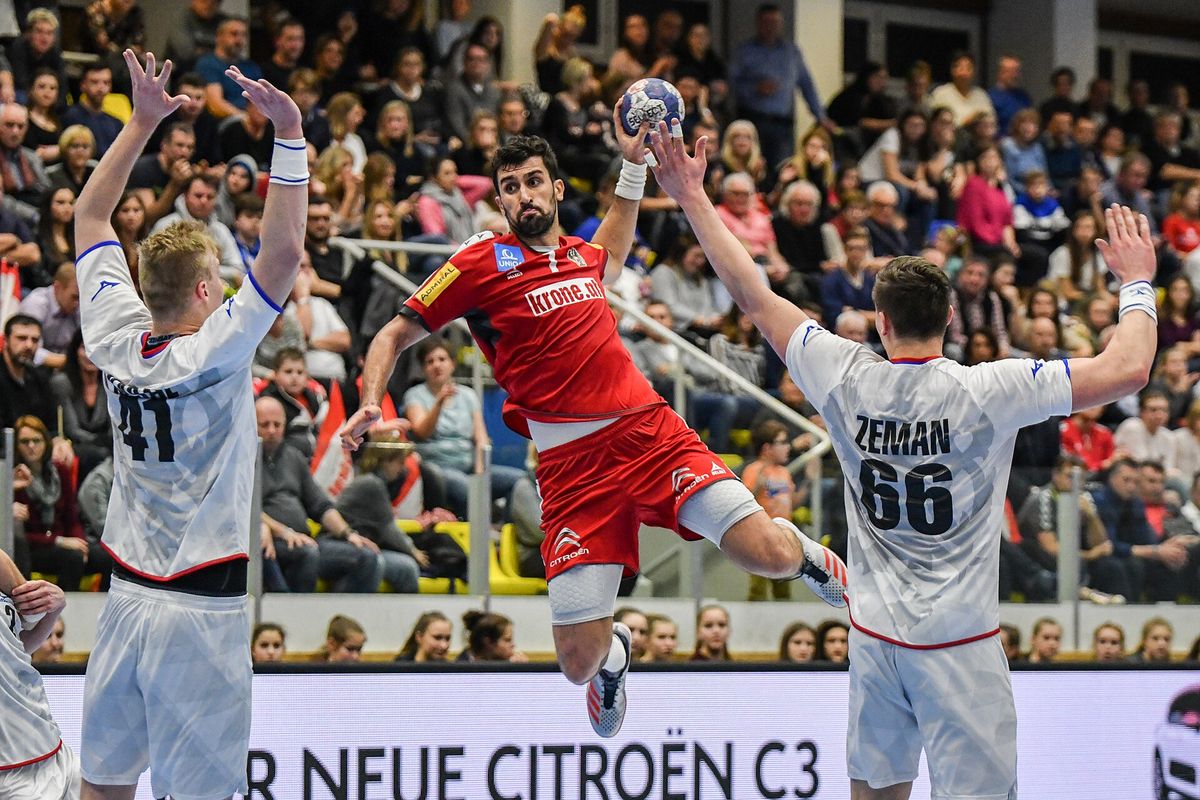
Janko Bozovic of Austria in the air between two Czech defenders, 2018 · Granada · CC BY-SA 4.0
- Governing body
- International Handball Federation
- Founded
- Codified in northern Europe in the 1910s and 1920s; the IHF in its present form from 1946.
- Olympic status
- 16 editions
- on the 2028 programme
- Also contested at
- Asian Games
A rule change in 2016 let a team substitute its goalkeeper for an outfield player at any time without restriction, and elite handball responded by doing it constantly — attacking seven against six with an empty net. It is the clearest recent example on this site of a permissive rule change producing a tactic nobody predicted, and the federation has spent a decade deciding whether it likes what it made.
The gamewhat it is now · sections 1 to 5
01How it is played
Seven a side, throw a ball into a goal, and do not step inside the arc in front of it. Handball's defining rule is that arc — the six-metre area only the goalkeeper may stand in — which forces every shot to be taken from distance or from the air, and produces the sport's characteristic jump into the space above it.
These figures were entered from the edition named above but have not been checked against its text line by line. Treat them as this site’s reading of the laws, not as a substitute for them.
The object of the game
Throw the ball into the opponent's goal more often than they throw it into yours. A player may take three steps, hold the ball for three seconds, bounce it and take three more.
Nobody except the goalkeeper may stand in the six-metre area, but a player may jump into it and must release the ball before landing. That is why handball looks the way it does: attackers leap into the space in front of the goal and shoot in mid-air.
The court
An indoor court with a six-metre goal area marked by an arc, and a nine-metre free-throw line beyond it. Until 1966 the international game was played outdoors on a football pitch by eleven players a side.
- Court
- 40 × 20 m
- Goal area
- 6 m arc
- Free-throw line
- 9 m
- Goal
- 3 × 2 m
- Penalty throw
- 7 m
This clause reads this way because of
The ball
A ball small enough to be held in one hand, in different sizes for the men's and women's game, and grippy enough to be controlled — which is why resin is used and why resin is one of the sport's recurring arguments, because it damages court surfaces and several venues ban it.
- Ball, men
- Size 3
- Ball, women
- Size 2
- Resin
- Widely used, and banned in some halls
Players and officials
Seven on court — six outfield and a goalkeeper — with unlimited rolling substitutions. Two referees, which is unusual and necessary, because the sport's contact is heavy and continuous and one official cannot see enough of it.
Since 2016 a team may substitute the goalkeeper for an outfield player without restriction, and attack seven against six with an empty net.
- On court
- 7
- Substitutions
- Rolling, unlimited
- Referees
- 2
- Empty-net attack
- Legal since 2016
This clause reads this way because of
Time
Two halves of thirty minutes with a running clock, stopped for timeouts and serious incidents. Each team has three team timeouts across a match.
Since 1994 a throw-off after a goal may be taken immediately, without waiting for the opponents to retreat — which created the fast centre, a scoring opportunity generated entirely by a restart rule.
- Halves
- 2 × 30 min
- Team timeouts
- 3
- Fast throw-off
- Since 1994
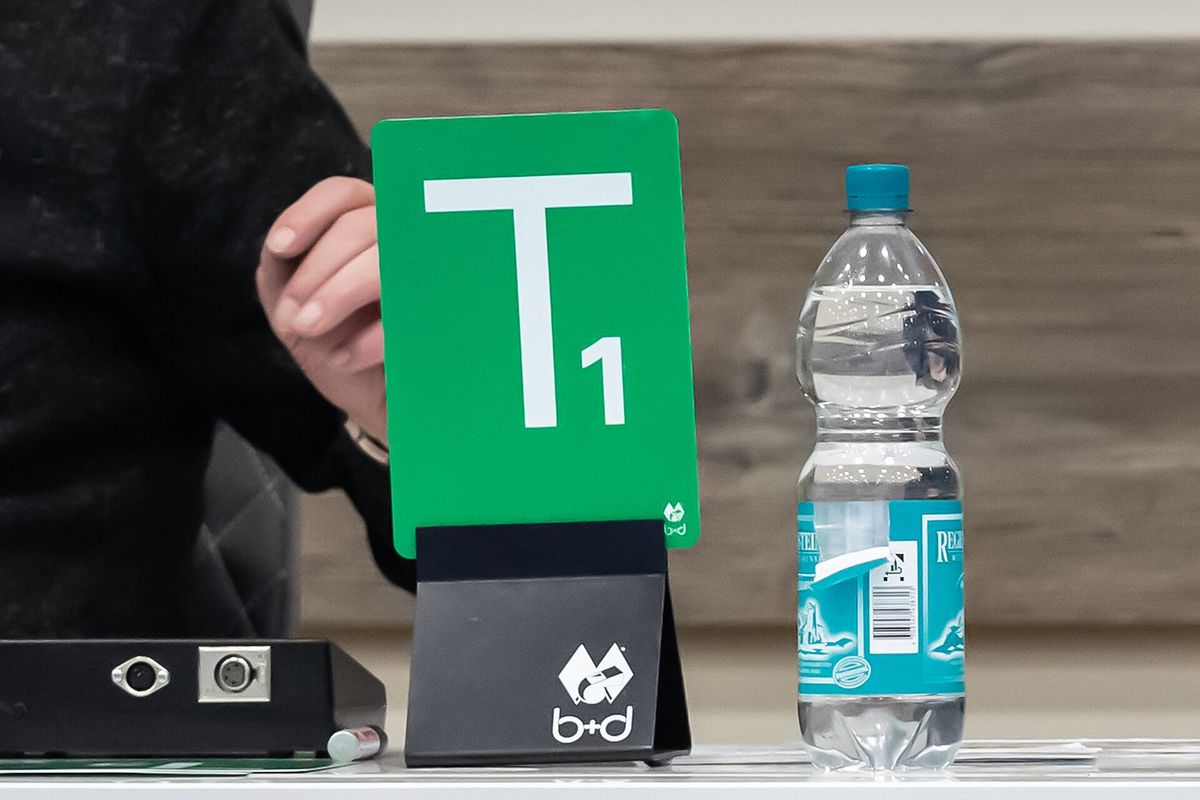
A team timeout card on the bench table, women's Bundesliga, 2021.
Each team has three timeouts, requested with a card like this one.
Steffen Prößdorf · CC BY-SA 4.0 · Wikimedia Commons
This clause reads this way because of
Scoring
One goal, one point, and there are a great many of them — a men's international commonly finishes in the high twenties or thirties per side, which makes handball one of the highest-scoring team sports on this site.
That is a consequence of the goal area rule. Every shot is taken from outside six metres or from the air above it, which favours the attacker enough that conversion rates are high and defences are built to obstruct rather than to intercept.
- Goal
- 1
- Typical score
- 25–35 per side
Throws
Throw-off from the centre after a goal, free throw from nine metres after a foul, seven-metre throw for a clear scoring chance denied, and goalkeeper throw when the ball leaves over the goal line.
After a warning for passive play, a team has four passes to shoot. That replaced a vague sanction with a count, which is the same instrument basketball's shot clock and wrestling's passivity clock are.
- Passes after a passive warning
- 4
- Penalty throw
- 7 m
This clause reads this way because of
Fouls and suspensions
Handball permits substantial contact — a defender may use a bent arm to obstruct a moving attacker — and prohibits striking, pulling, pushing from behind and endangering an opponent.
The sanction is a two-minute suspension, so the offending team plays a player short, and three suspensions disqualify. The blue card, from 2016, accompanies a red for serious foul play and triggers a written report and a disciplinary process beyond the match.
- Suspension
- 2 minutes
- Three suspensions
- Disqualification
- Blue card
- Triggers a written report
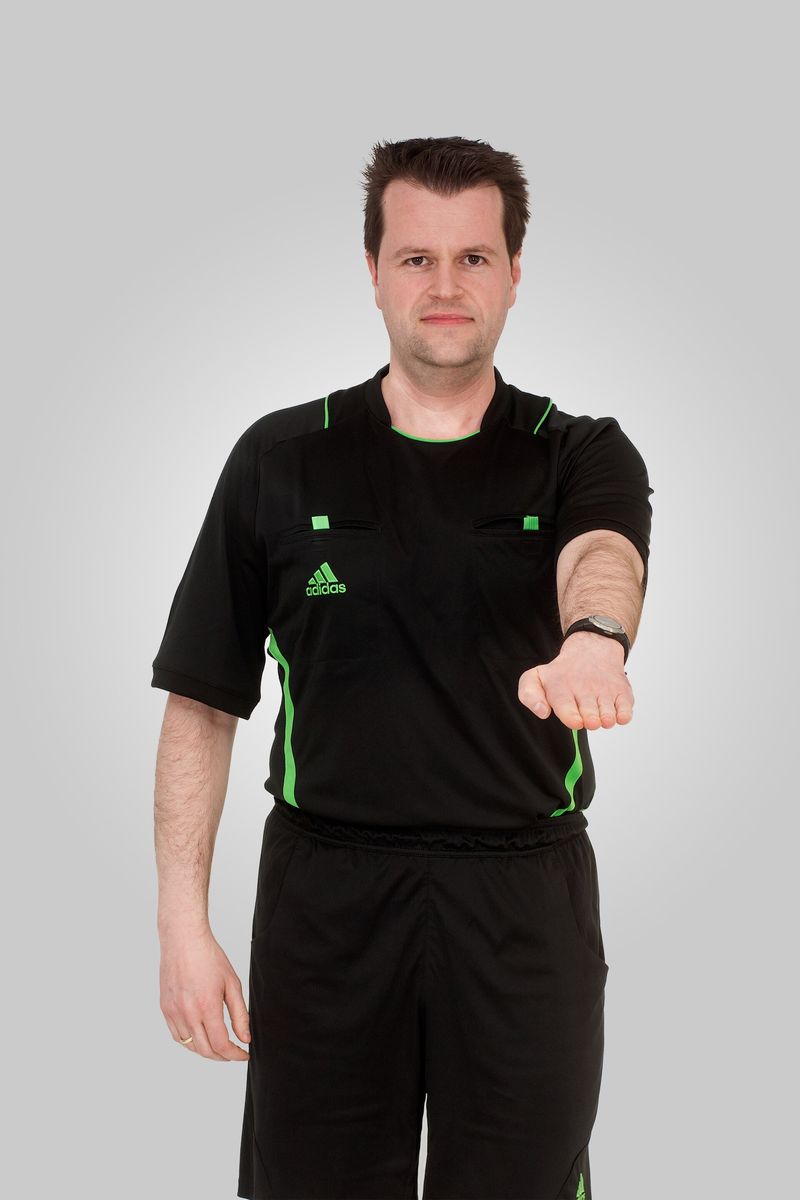
A referee showing the signal for entering the goal area.
Nobody but the goalkeeper may stand in the six-metre area.
LarsKimpel · CC BY-SA 4.0 · Wikimedia Commons
This clause reads this way because of
Deciding the winner
More goals. Draws stand in group play; knockout matches go to extra time and then to a seven-metre shoot-out.
Everything above is current law. Everything below is how Handball got here.
02Disciplines and events
Two Olympic events, in a sport whose Olympic history contains a discontinuity most people have never heard of: handball was contested in 1936 as an eleven-a-side outdoor game on a football pitch, disappeared for thirty-six years, and returned in 1972 as the indoor seven-a-side sport.
- Disciplines
- 1
- Olympic medal events
- 2
- Men’s and women’s counted separately.
- Contested elsewhere
- 3
- world games, world championship, federation only, lapsed.
- Listed for context
- 2
- Not counted as this sport.
Indoor handball2
Seven a side on a court. The international standard since 1966.
- Men's tournament
- Women's tournament
The game it replaced1
- Field handballLapsedEleven a side outdoors on a football pitch. The Olympic sport in 1936; world championships contested into the 1960s.
Contested away from the Games2
- Beach handballWorld championshipWorld GamesFour a side on sand, with a different scoring system in which spectacular goals count double.
- Wheelchair handballFederation only
03Officiating and technology
Handball uses two referees where almost every court sport on this site uses one, and the reason is that the sport permits contact its officials cannot see from a single position.
A defender may obstruct a moving attacker with a bent arm. Collisions happen continuously, at speed, in a confined space, with bodies between the official and the incident. Two referees positioned diagonally is the minimum that works.
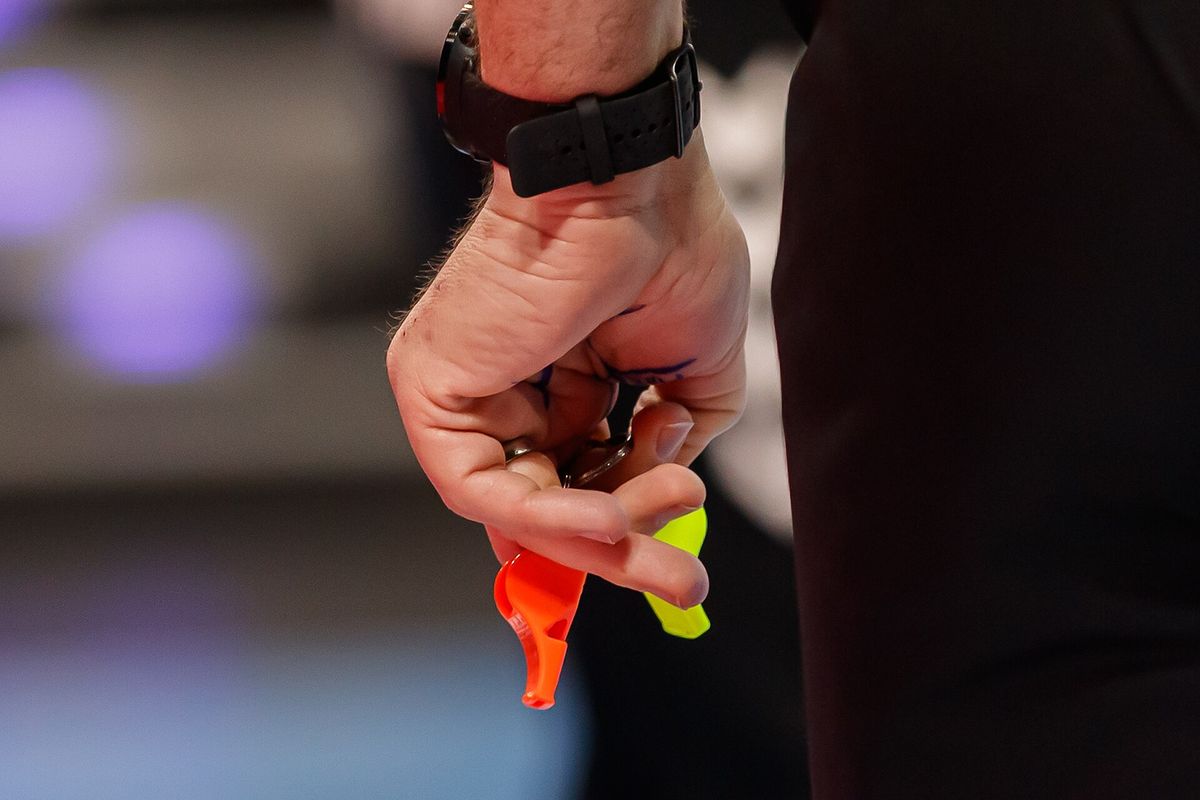
A referee's hand with two whistles, at the women's cup Final Four in Germany, 2021.
One of the two referees handball uses where most court sports use one.
Steffen Prößdorf · CC BY-SA 4.0 · Wikimedia Commons
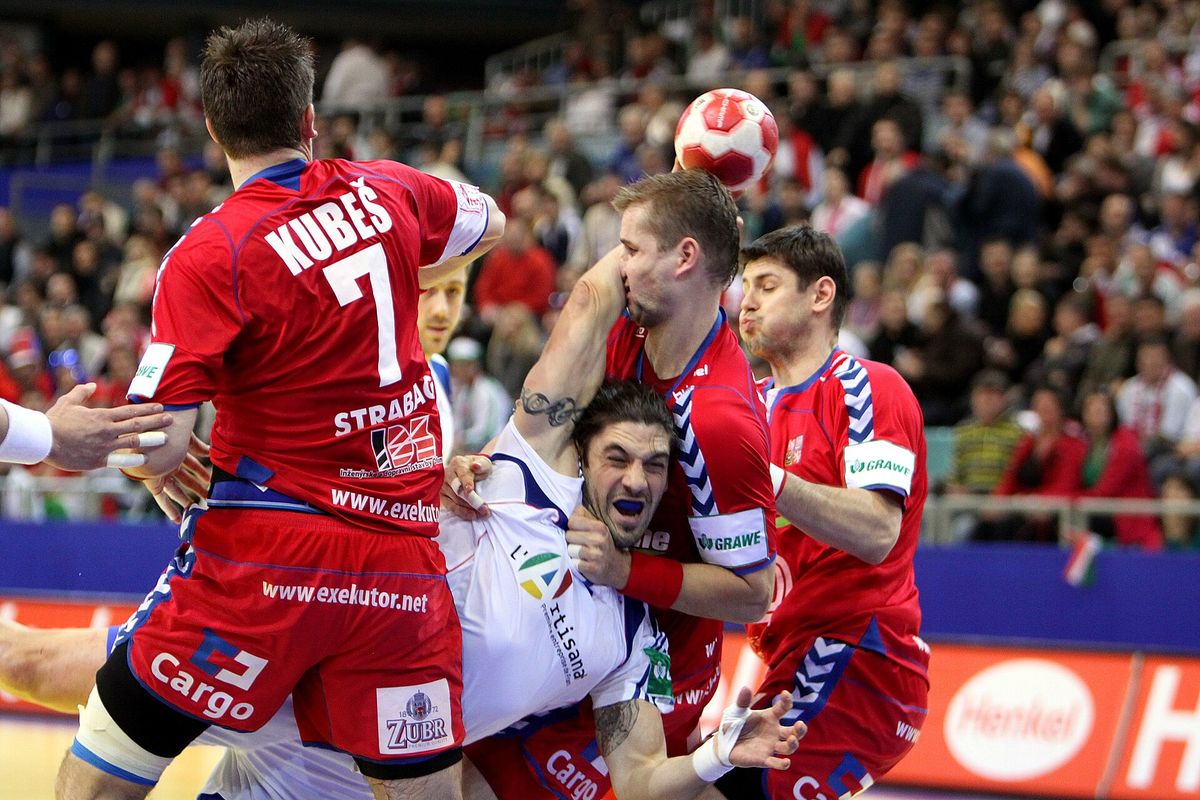
Bertrand Gille of France held up by three Czech defenders at the 2010 European Championship.
Continuous contact, at speed, in a confined space, often with bodies between the incident and an official.
Steindy · CC BY-SA 3.0 · Wikimedia Commons
The two instruments worth recording are both conversions of judgement into counting.
The four-pass rule after a passive-play warning replaced a vague sanction with an arithmetic one. Before it, a referee warned a team for stalling and then had to decide, unaided, when to punish them; now the team has four passes. That is the same move basketball made with the shot clock in 1954 and wrestling made with its passivity clock in 2018, and handball is the third sport on this site to arrive at it.
The blue card, from 2016, separates the on-court sanction from the disciplinary consequence. A referee showing red no longer has to decide whether the offence was tactical or dangerous — the blue card triggers a written report and a process afterwards. That is an official being given permission not to adjudicate everything on the spot, which is rare.
Video review exists at major tournaments for goal-line and end-of-time questions, which are facts. What remains judged is contact, and it always will be: whether a defender's arm was obstruction or a push is a question about degree, and handball's whole style of play sits on that boundary.
04Where it is played
Handball is the most regionally concentrated major team sport on this site. Denmark, France, Germany, Norway, Sweden, Spain, Croatia, Hungary, Slovenia, Poland and Montenegro dominate, with Egypt, Qatar, Brazil and South Korea the significant non-European presences.
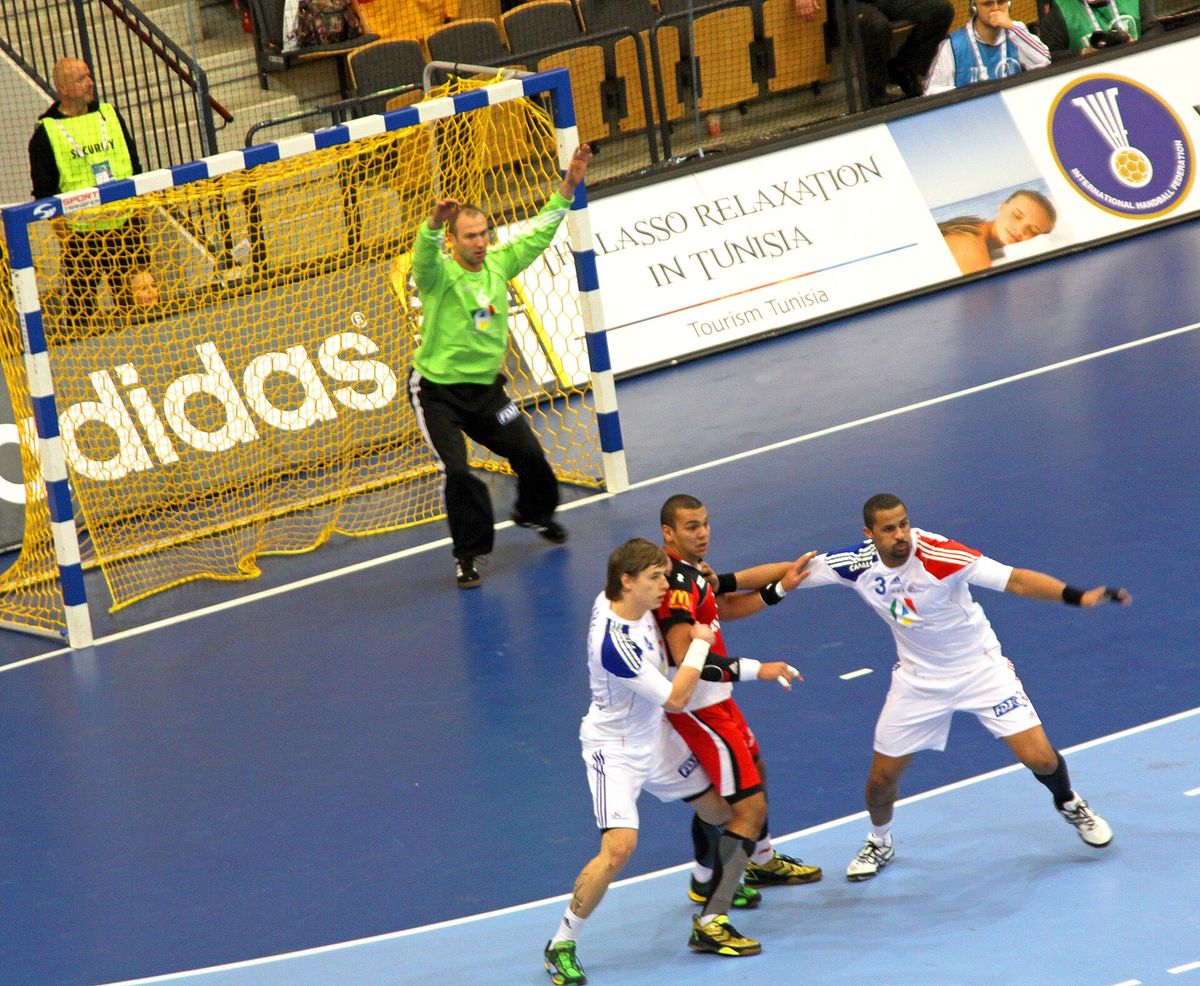
Mohamed Mamdouh of Egypt among the French defence at the 2011 World Championship.
Egypt, one of the significant presences outside Europe.
Guillaume Baviere · CC BY 2.0 · Wikimedia Commons
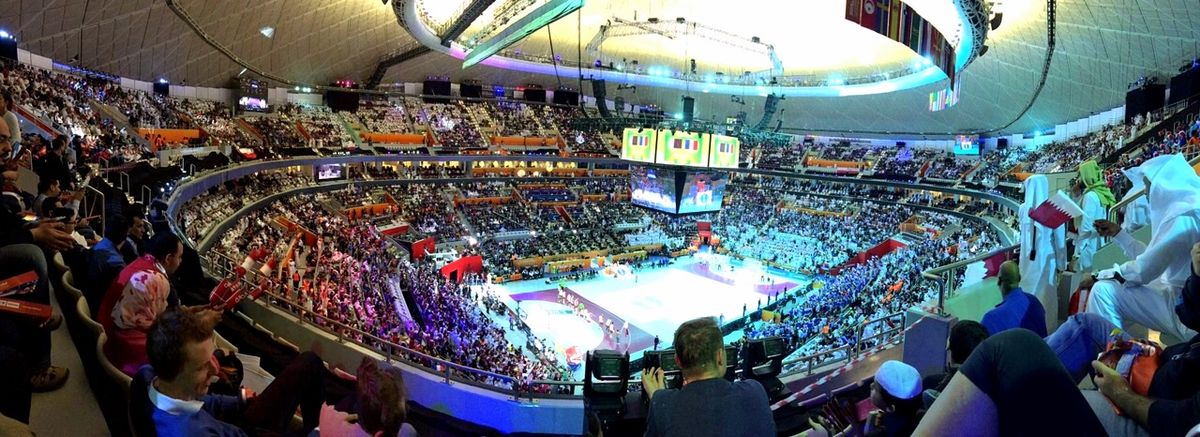
The final of the 2015 World Championship, Qatar against France, in Lusail.
Qatar hosted and reached the final.
Zyzzzzzy · CC BY-SA 4.0 · Wikimedia Commons
Essentially the entire professional economy is European, and much of it is in Germany and France, whose domestic leagues employ most of the world's elite players.
The reason is historical rather than physical. Handball was invented in northern Europe, embedded in European school systems, and never travelled through empire or emigration the way football, cricket and rugby did. It has grown where it was taught and almost nowhere else.
The facility requirement compounds it. A handball court is larger than a basketball or volleyball court and needs an indoor hall, which is a building — so the sport competes for exactly the facilities that basketball and volleyball already occupy in most of the world, and usually loses.
Beach handball is the federation's development answer, in the same way hockey5s and rugby sevens are for their sports: cheaper to stage, played outdoors, and with a scoring system that rewards spectacular goals with double points. It has not yet changed the map.
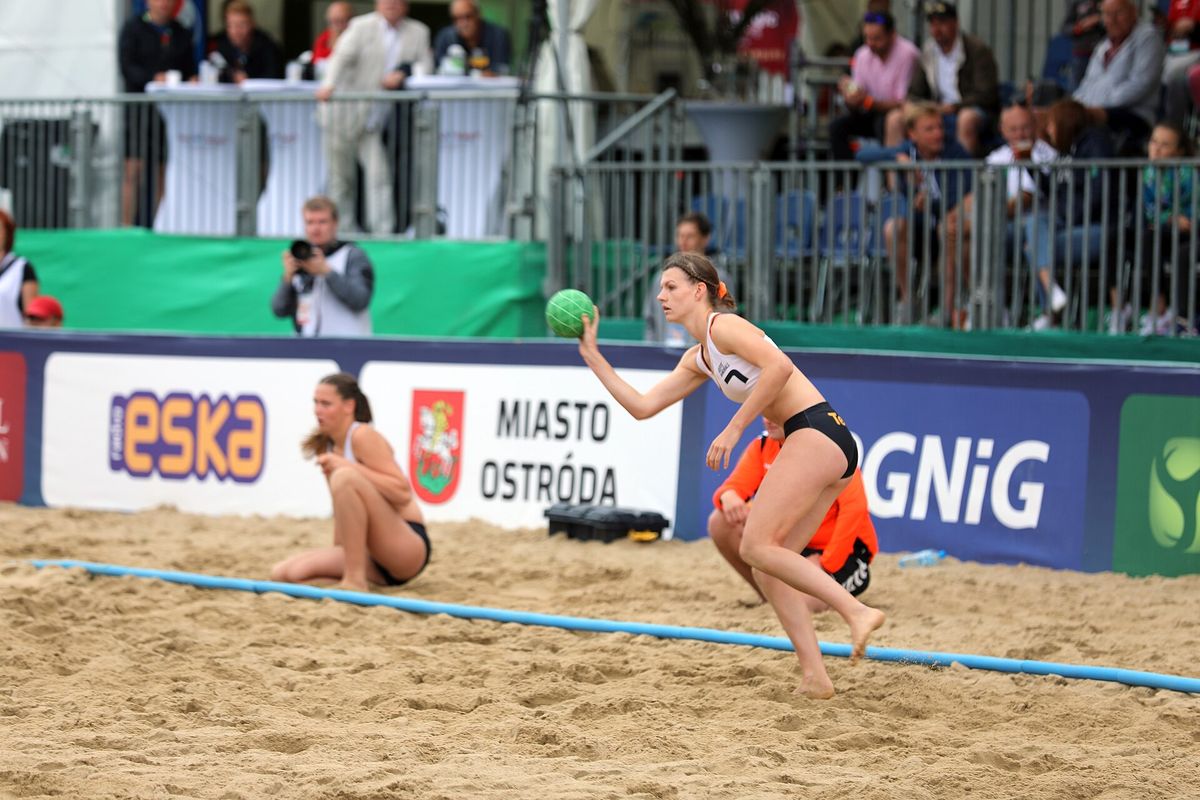
The women's semi-final between Hungary and the Netherlands at the 2019 beach handball European championship.
The federation's development answer: cheaper, outdoor, with double points for spectacular goals.
Marcus Cyron · CC BY-SA 3.0 · Wikimedia Commons
The women's game has a similar geography with Norway, France, Denmark and the Netherlands strongest, and unusually for this site its professional structures are comparably developed to the men's.
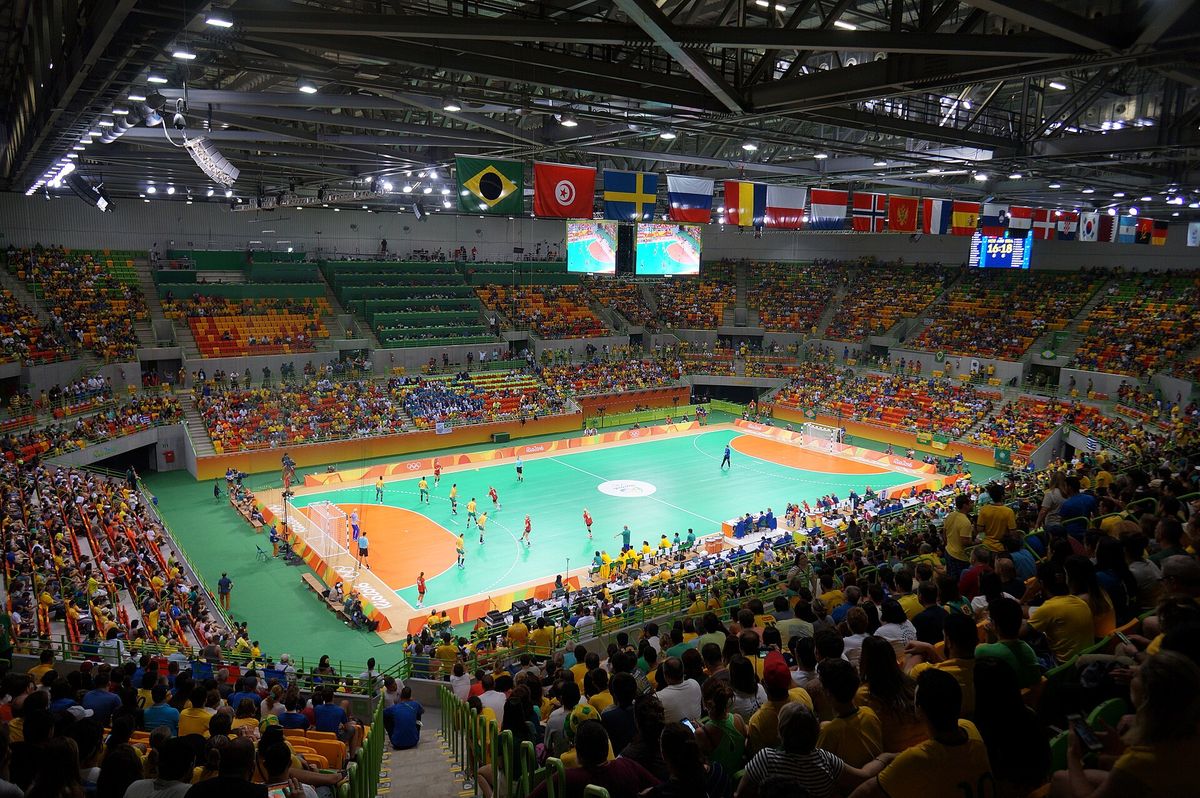
Norway against Brazil in the women's tournament at the 2016 Rio Olympics, Future Arena.
The women's game, with Norway among its strongest nations.
Leandro Neumann Ciuffo · CC BY 2.0 · Wikimedia Commons
05Learning curve
One of the most accessible team sports on this site — throwing and catching are near-universal skills — and a top end that now demands a tactical judgement no other sport asks: whether to play with no goalkeeper.
Editorial — the site’s reading, not a sourced claim
Barrier to entry
How hard is it to get to a real game?
A hall, a ball and fourteen people. The basic actions are already known.
Handball's fundamental skills are running, throwing and catching, which almost everyone can already do. There is no implement, no unusual body position, and no equivalent of a hockey stick or a lacrosse crosse to learn first. A beginner can play a real game in their first session.
It is standard in school physical education across much of Europe for exactly that reason.
The barrier is the hall. Handball is an indoor court sport, so it needs a building — the same constraint volleyball and basketball have, and one that limits it more than either because handball courts are larger.
Evidence
- Kit to startA ballobserved
- FacilityAn indoor courtobserved
- Players needed14observed
- Prerequisite skillsRunningobserved
- Time to a real gameOne sessionestimate
Barrier to the top
How hard is it to be good at?
Heavy continuous contact, and a decision about whether to leave your goal empty.
Elite handball is a contact sport that does not advertise itself as one. Defenders may obstruct a moving attacker with a bent arm, collisions are constant, and shoulder and knee injuries are among the highest in indoor sport.
The tactical demand changed sharply in 2016. Because a team may now field seven outfield players and no goalkeeper, elite sides attack seven against six with an empty net — accepting that a turnover concedes a goal from anywhere on court in exchange for a numerical advantage in attack.
That is the highest-variance legal tactic in any team sport here, it is used constantly, and it arrived from a rule change presented as a procedural simplification.
Evidence
- Seventh field playerLegal since 2016ruleA procedural tidy-up that produced the empty-net attack within two seasons.2016 — the rule this rests on
- Four passes after a passive warningSince 2016ruleA judgement converted into a count.2016 — the rule this rests on
- Fast throw-offSince 1994ruleCreated a scoring opportunity out of a restart rule.1994 — the rule this rests on
- Typical peak age25–31estimate
Why the two differ
Handball's gap is low to very high, and it belongs beside volleyball and basketball as an indoor court sport whose barrier is a building rather than a skill.
Its distinctive entry on this board is the 2016 rule. Almost every rule change in this collection was made to produce an effect — to raise scoring, shorten matches, remove a judgement, protect an athlete. The seventh field player was a simplification of a substitution procedure, and it changed how elite handball attacks.
That is the clearest case here of a federation not knowing what it was doing when it did it, and it is worth recording because most of this site's entries assume governing bodies can predict the consequences of their own rules.
The historyhow it got here · sections 6 to 10
06Origin and invention
Handball is a Scandinavian and German invention of the 1910s and 1920s, and it was two sports before it was one.
The German version, Feldhandball, was played outdoors on a football pitch by eleven players a side. The Danish and Swedish version was indoors and seven-a-side, because northern European winters make an outdoor ball sport impractical for half the year.
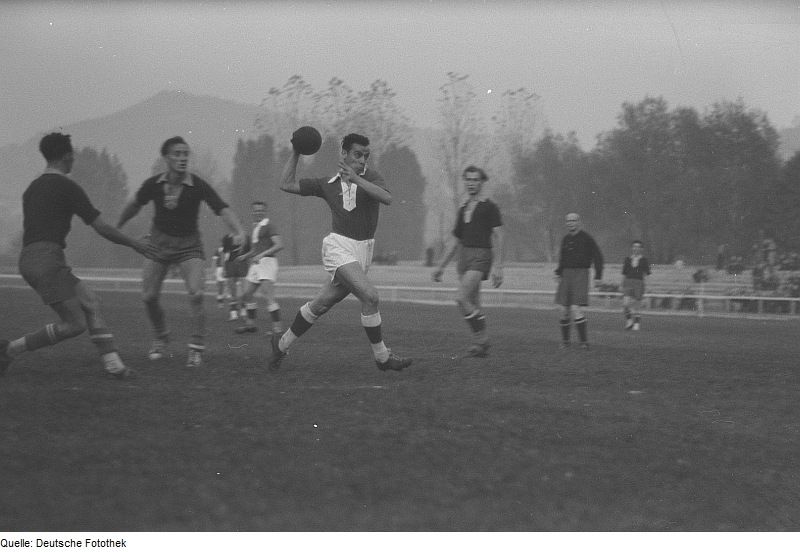
Handball players in a game on a grass field, October 1953.
Feldhandball: eleven a side, outdoors, on a football-sized pitch.
Roger Rössing / Renate Rössing (Deutsche Fotothek) · CC BY-SA 3.0 de · Wikimedia Commons
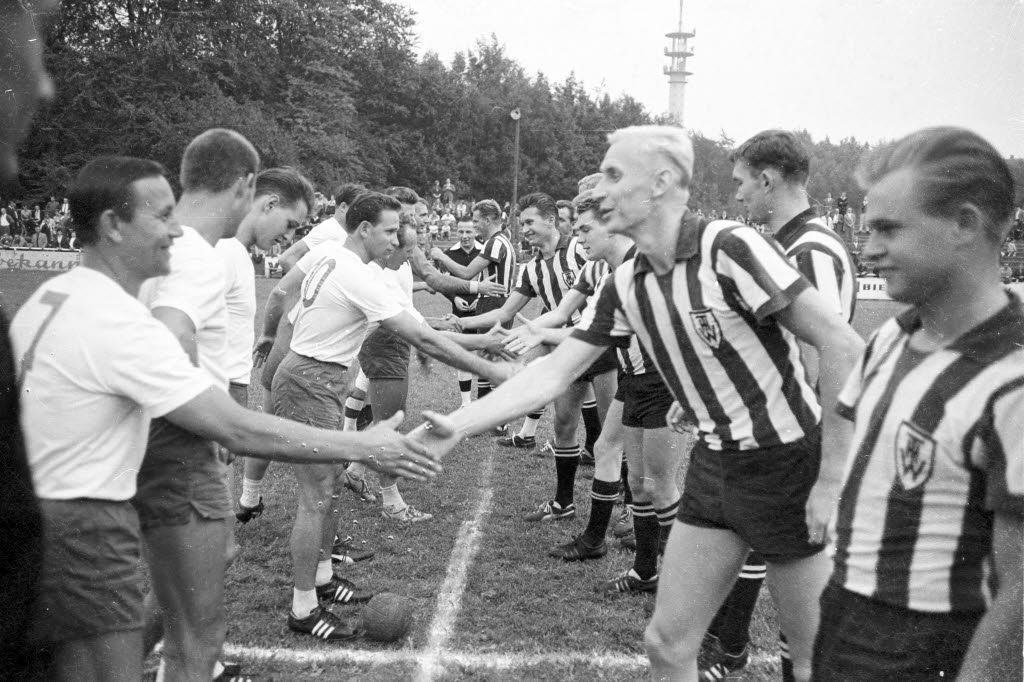
THW Kiel and VfL Wolfsburg shaking hands before the final of the North German field handball championship, Kiel, 1964.
The outdoor game was still being played at championship level two years before the indoor game became the international standard.
Friedrich Magnussen · CC BY-SA 3.0 de · Wikimedia Commons
The outdoor game was the Olympic sport in 1936, in Berlin, and was contested at world championships into the 1960s. The indoor game won, became the international standard in 1966, and the outdoor version simply stopped.
That is one of the cleanest format replacements on this site. Handball did not add a shorter version and keep both, as cricket and rugby did. It changed which sport it was, and its Olympic history has a thirty-six-year gap in the middle where the transition happened.
The rule that gives handball its shape was there from the start: nobody except the goalkeeper may stand in the six-metre area in front of the goal. Attackers may jump into it and must release the ball before landing, which is why the sport's characteristic image is a player suspended in mid-air above the arc.
Janko Bozovic of Austria in the air between two Czech defenders, 2018.
The shape the goal-area rule gives the sport: jump in, and release the ball before landing.
Granada · CC BY-SA 4.0 · Wikimedia Commons
The IHF in its present form dates from 1946, and the indoor game returned to the Olympic programme in 1972.
07Rule timeline
The sport’s own lane, expanded. Every entry carries a cause from the closed vocabulary and a citation, and says so where the citation is incomplete.
- 1966Broadcast and pacingalso participation and accessadopted 1965
Indoor seven-a-side handball became the standard international form, replacing the outdoor eleven-a-side game played on a football pitch. The outdoor version had been the Olympic sport in 1936 and world championships were contested in it into the 1960s. A sport played on grass by eleven became a sport played on a court by seven, and its scoring rate multiplied.
Comparability break · Scoped to one competition
Eleven a side outdoors became seven a side indoors. The scoring rate multiplied, and the two games are not comparable. See the series
Trigger and citationIncomplete — no confirmed article
Trigger
Indoor handball is faster, higher-scoring, weather-independent and stageable in any sports hall. The outdoor game had none of those properties and had already been losing ground in Scandinavia, where the winters made an indoor version necessary.
IHF Rules of the Game · IHF Rules of the Game, 1966
- 1994Broadcast and pacingadopted 1993
The throw-off after a goal may be taken immediately, without waiting for the opposing team to return to their own half. A team that concedes can restart before the scorers have retreated.
Trigger and citationIncomplete — no confirmed article
Trigger
Handball is a high-scoring sport and every goal produced a stoppage while players walked back. Removing the wait raised the tempo and created the fast centre — a scoring opportunity that exists purely because of a restart rule.
IHF Rules of the Game · IHF Rules of the Game, 1994
- 2016-07Broadcast and pacingadopted 2016
The requirement that a substitute for the goalkeeper wear a distinguishing shirt and act as goalkeeper was removed. A team may now field seven outfield players and no goalkeeper at all, substituting freely. Elite teams immediately began attacking seven against six with an empty net, accepting the risk of a long-range shot into it in exchange for a numerical advantage in attack. It is the highest-variance legal tactic in any team sport on this site.
Comparability break · Scoped to one competition
The empty-net attack became standard within two seasons of a rule change that was presented as procedural. See the series
Trigger and citationIncomplete — no confirmed article
Trigger
The previous rule required a specially designated player and a shirt change, which made goalkeeper substitution slow and rare. Simplifying it was presented as a tidying-up of a procedural rule.
Nobody predicted what teams would do with it. Within two seasons the empty-net attack was standard at elite level, and the federation has been arguing since about whether a rule intended to simplify substitution should have been allowed to change how the sport is played.
IHF Rules of the Game · IHF Rules of the Game, 2016
- 2016-07Broadcast and pacingadopted 2016
After a warning for passive play, the attacking team has a maximum of four passes before it must shoot. A referee's judgement about whether a team is genuinely attacking became a countable number of passes.
Trigger and citationIncomplete — no confirmed article
Trigger
Passive play warnings had been inconsistent and the sanction vague, so teams could stall after a warning and argue about it. The four-pass limit is the same instrument basketball's shot clock is: a judgement converted into a count.
IHF Rules of the Game · IHF Rules of the Game, 2016
- 2016-07Safetyalso integrityadopted 2016
A blue card was introduced, shown alongside a red for serious foul play, requiring the referees to file a written report and triggering a disciplinary process beyond the match. It separates being sent off from being sanctioned afterwards.
Trigger and citationIncomplete — no confirmed article
Trigger
Handball is played at speed in a confined court with heavy contact permitted, and the sport needed a way to distinguish a red card for a tactical foul from one for a dangerous act, without asking a referee to decide the consequences on the spot.
IHF Rules of the Game · IHF Rules of the Game, 2016
08Equipment evolution
Handball has almost no equipment history, and its one recurring equipment argument is about a substance that is not part of the sport at all.
The ball is small enough to hold in one hand — that is its whole design requirement, because the sport's actions are throwing, catching and shooting one-handed. Sizes differ between the men's and women's game and have been stable for decades.
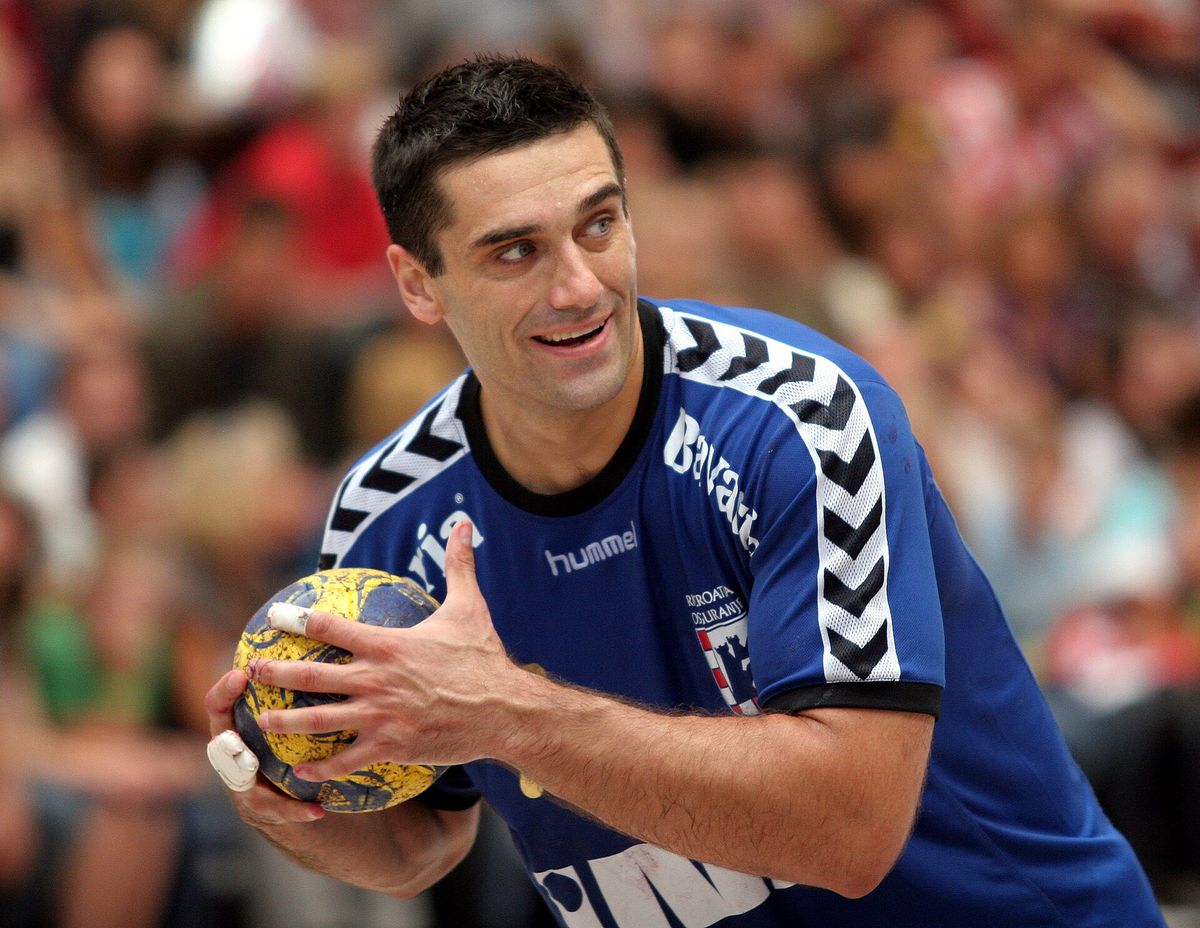
Kiril Lazarov of RK Zagreb holding the ball in one hand, 2009.
The ball's whole design requirement: small enough to hold, throw and catch one-handed.
Armin Kübelbeck · CC BY-SA 3.0 · Wikimedia Commons
Resin is the argument. Players use adhesive resin on their hands to control the ball, which improves grip, ball-handling and shooting accuracy substantially. It is not regulated as performance equipment and is used universally at elite level.
It also coats the ball, the floor and everything else, damages court surfaces, and is banned in a significant number of sports halls — including some that handball would otherwise use. So the sport has an unofficial performance substance that determines which venues it can play in, and no rule about it either way.
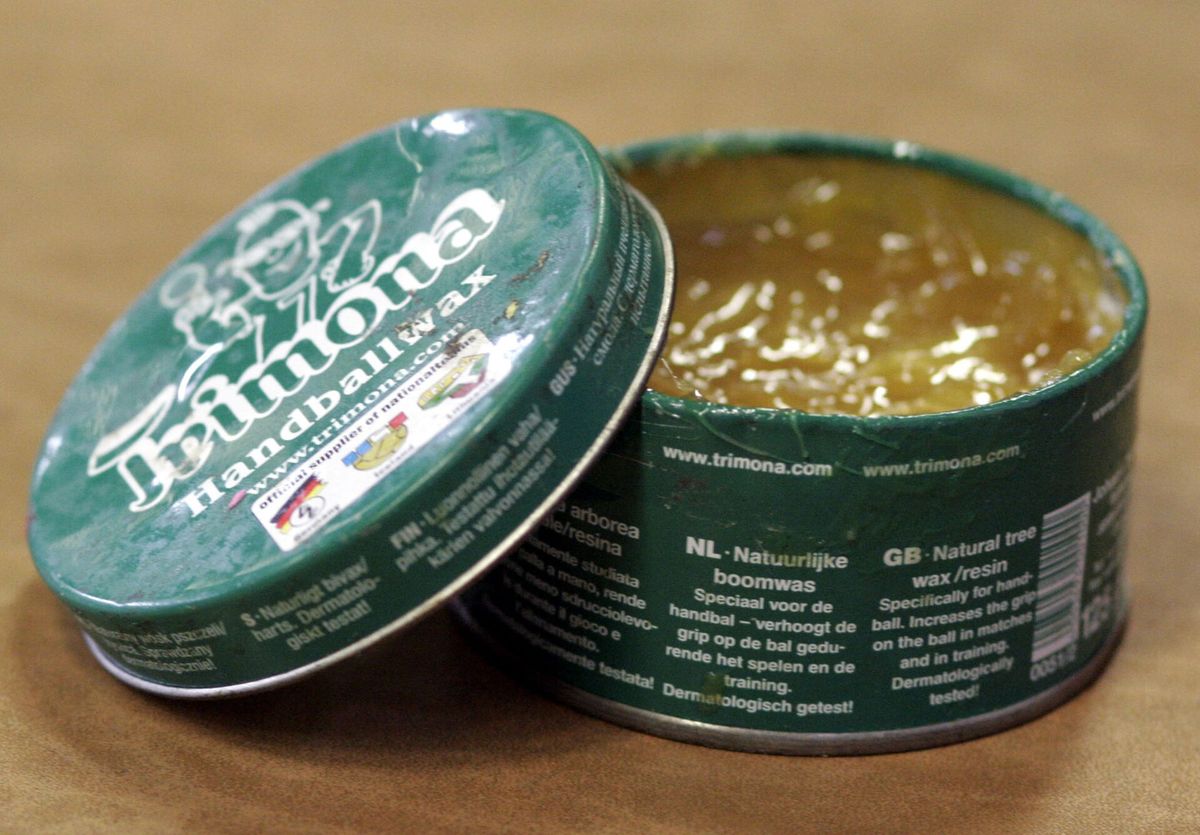
A tin of handball wax, a grip resin for the fingers.
Universal at elite level, damaging to floors, banned in many halls, and unregulated by the rules.
Armin Kübelbeck · CC BY-SA 3.0 · Wikimedia Commons
That is a genuinely unusual position on this site. Table tennis banned speed glue on health grounds in 2008. Athletics wrote a shoe specification. Handball has an ubiquitous grip aid that shapes its facility access and has never legislated on it.
Protective equipment is minimal — knee support and occasional headbands — in a sport with heavy permitted contact, which is one reason its shoulder and knee injury rates are high.
09Governing body politics
The IHF's most consequential recent act was an accident, and that is worth saying plainly.
In 2016 the federation removed the requirement that a substitute for the goalkeeper wear a distinguishing shirt and act as a goalkeeper. The stated purpose was to simplify a clumsy substitution procedure. The effect, within two seasons, was that elite teams began attacking seven against six with an empty net as a standard tactic.
The federation has spent the decade since deciding whether it approves. The empty-net attack is exciting, produces long-range goals into an unguarded net, and increases variance considerably — and it also means a large part of elite handball is now played without one of its seven positions on court.
Nothing else on this site is quite like it. Most rule changes here were made to produce an effect, and the arguments are about whether the effect was worth it. This one produced an effect nobody was aiming at.
The federation's other 2016 changes were more deliberate and more typical of this site's patterns. The four-pass limit after a passive-play warning converted a referee's judgement into a count, which is the same instrument basketball's shot clock and wrestling's passivity clock are. The blue card separated a sending-off from the disciplinary process that follows it.
Handball's structural politics is European. The sport's professional strength is concentrated in Germany, France, Scandinavia and the Balkans, its club competitions are European, and the IHF's global development ambitions run against a domestic economy that is regional.
10Controversies that forced rule changes
The empty net, 2016. Handball's most significant modern change and the one nobody intended.
The old rule required a goalkeeper substitute to wear a distinguishing shirt and function as a goalkeeper, which made the substitution slow and rare. The new rule removed that, on the stated ground that the procedure was clumsy.
Elite teams read it correctly and immediately: if there is no requirement to have a goalkeeper, attack with seven outfield players against six defenders and leave the net empty. The numerical advantage in attack is worth more than the risk of conceding a shot from distance — usually.
Within two seasons it was standard. It is the highest-variance legal tactic in any team sport on this site, and it emerged from a rule change presented as administrative.
The stall. Handball's passive play rule asked a referee to judge whether a team was genuinely trying to score, which is the same judgement wrestling and judo make about engagement and find equally difficult. After a warning, a team now has four passes to shoot. A judgement became a count.
The walk back. Before 1994 a goal was followed by both teams returning to their halves before the restart, which in a sport scoring thirty times a side meant a great deal of walking. Allowing an immediate throw-off created the fast centre, a scoring chance produced entirely by a restart rule.
Resin. Not a controversy that forced a rule, and included because it is one that has not. A performance-enhancing grip substance is used universally, damages venues, is banned in many halls, and remains unregulated.
Where it standsthe record, and what is still open · sections 11 to 12
11Series
No series published
Goals per game — International tournaments
Handball changed which sport it was in 1966 and how it attacks in 2016, and both moved scoring substantially. Before 1966 the international game was eleven a side, outdoors, on a football pitch. Afterwards it was seven a side indoors on a court, and the scoring rate multiplied. Those are different sports sharing a name, in the way rugby fifteens and sevens are. The 2016 change is subtler and this site finds it more interesting. Removing the goalkeeper-substitution restriction let teams attack seven against six with an empty net, and elite teams do it constantly. That raises the attacking team's conversion rate and simultaneously concedes long-range goals into an empty net, so both teams' scoring moved and in the same direction. The series is scoped to international tournaments because domestic leagues adopted the 2016 rule at different points and the IHF publishes no continuous series for the sport as a whole. The figures are not entered because they have not been taken from a cited source. When they are, the chart appears here with two segments and a caption noting that the second break was an accident — a procedural tidy-up that changed how the sport is played.
1966Scoped to one competitionEleven a side outdoors became seven a side indoors. The scoring rate multiplied, and the two games are not comparable.
2016Scoped to one competitionThe empty-net attack became standard within two seasons of a rule change that was presented as procedural.
12What is contested now
Recorded as unsettled.
The empty net. A decade after the rule that permitted it, the sport has not settled whether it likes what it made. Supporters say the seven-against-six attack is exciting and rewards risk. Opponents say a sport with a goalkeeper position should not be routinely played without one, and that the tactic survives because the punishment — a long shot into an open net — is less reliable than it should be.
Proposals to restrict it, by requiring a delay or by making the empty-net goal worth more, circulate and have not been adopted.
Resin. Universal, performance-relevant, unregulated, and the reason a significant number of halls will not host handball. The sport has never legislated on a substance that shapes both how it is played and where.
Contact. Handball permits more contact than any other indoor court sport here, and its shoulder and knee injury rates reflect that. Whether the balance between defensive obstruction and dangerous play sits in the right place is argued after every major tournament.
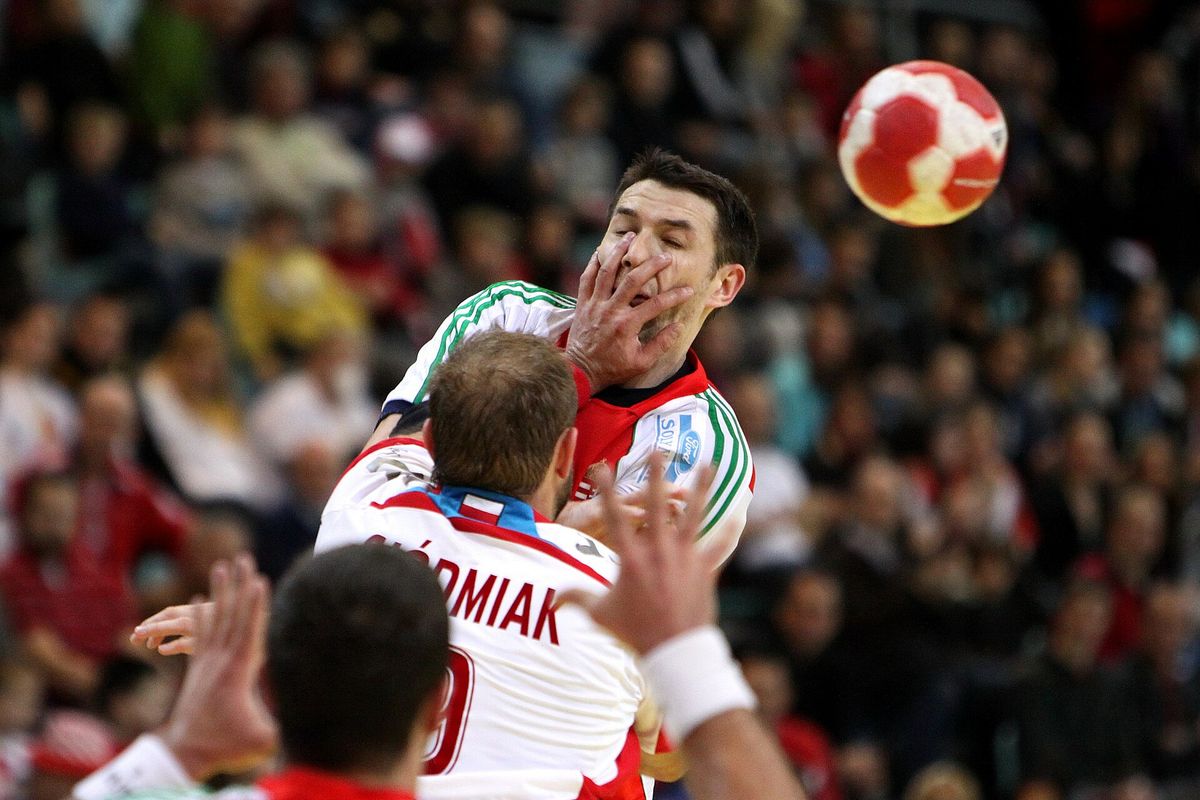
Ferenc Ilyés of Hungary blocked with a foul by Artur Siódmiak of Poland, 2010.
Where obstruction ends and a dangerous play begins, argued after every major tournament.
Steindy · CC BY-SA 3.0 · Wikimedia Commons
The map. The IHF's development ambitions are global and its professional economy is European. Beach handball is the intended answer and has not yet delivered one, and the sport competes for indoor facilities with basketball and volleyball almost everywhere outside Europe.