Judo
Rewrote its scoring three times in twenty years, and banned a whole class of technique to stop looking like wrestling.
- Official
- Judo
- Game category
- Outside this taxonomy
- Adjudication
- Combat
- Standing
- Removed, restored
- rule changes
- 6
- comparability breaks
- 0
- Olympic editions
- 16
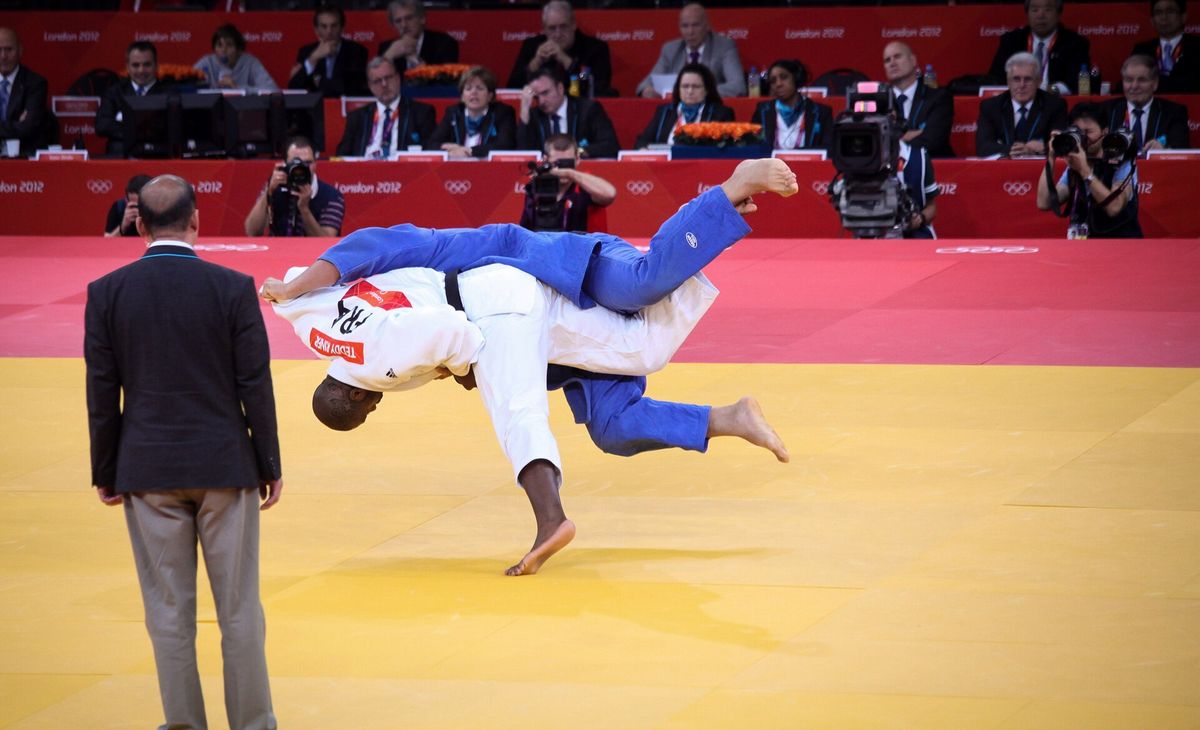
Teddy Riner of France throwing in blue against white at the 2012 London Olympics · Martin Hesketh · CC BY 2.0
- Governing body
- International Judo Federation
- Founded
- Kodokan judo founded by Jigoro Kano in 1882; the International Judo Federation formed in 1951.
- Olympic status
- 16 editions
- on the 2028 programme
- Also contested at
- Asian Games
The only combat sport on this site, and the one that shows most clearly what a rule change costs when the rules are the sport. Judo has removed scores, removed techniques and removed the time limit inside two decades, and the most contested of those — banning direct leg grabs in 2013 — was defended on grounds of identity rather than safety or fairness. It is also the only sport here whose founder wrote down what the sport was for.
The gamewhat it is now · sections 1 to 5
01How it is played
Throw your opponent onto their back with force, control and speed, and the contest ends immediately. Everything else in judo is a partial version of that one outcome. The sport is unusual in defining a complete win first and the lesser scores afterwards, which is why its rule changes keep circling back to the same question: how much less than a perfect throw should be worth anything at all.
These figures were entered from the edition named above but have not been checked against its text line by line. Treat them as this site’s reading of the laws, not as a substitute for them.
The object of the contest
Score ippon. A throw that puts the opponent largely on their back with control, speed and force ends the contest on the spot, as does a pin held for twenty seconds or a submission from a strangle or an armlock.
Judo is the only sport on this site where the primary outcome is instantaneous and total. There is no accumulating towards victory; a contest that goes the distance is, in the sport's own terms, one where nobody managed the thing they were trying to do.
The mat
A square of tatami with a contest area and a safety area around it. The surface has to absorb a body thrown from standing, which is the whole engineering requirement.
- Contest area
- 8 × 8 m
- Up to 10 × 10 m; the safety area extends beyond it.
- Surface
- Tatami
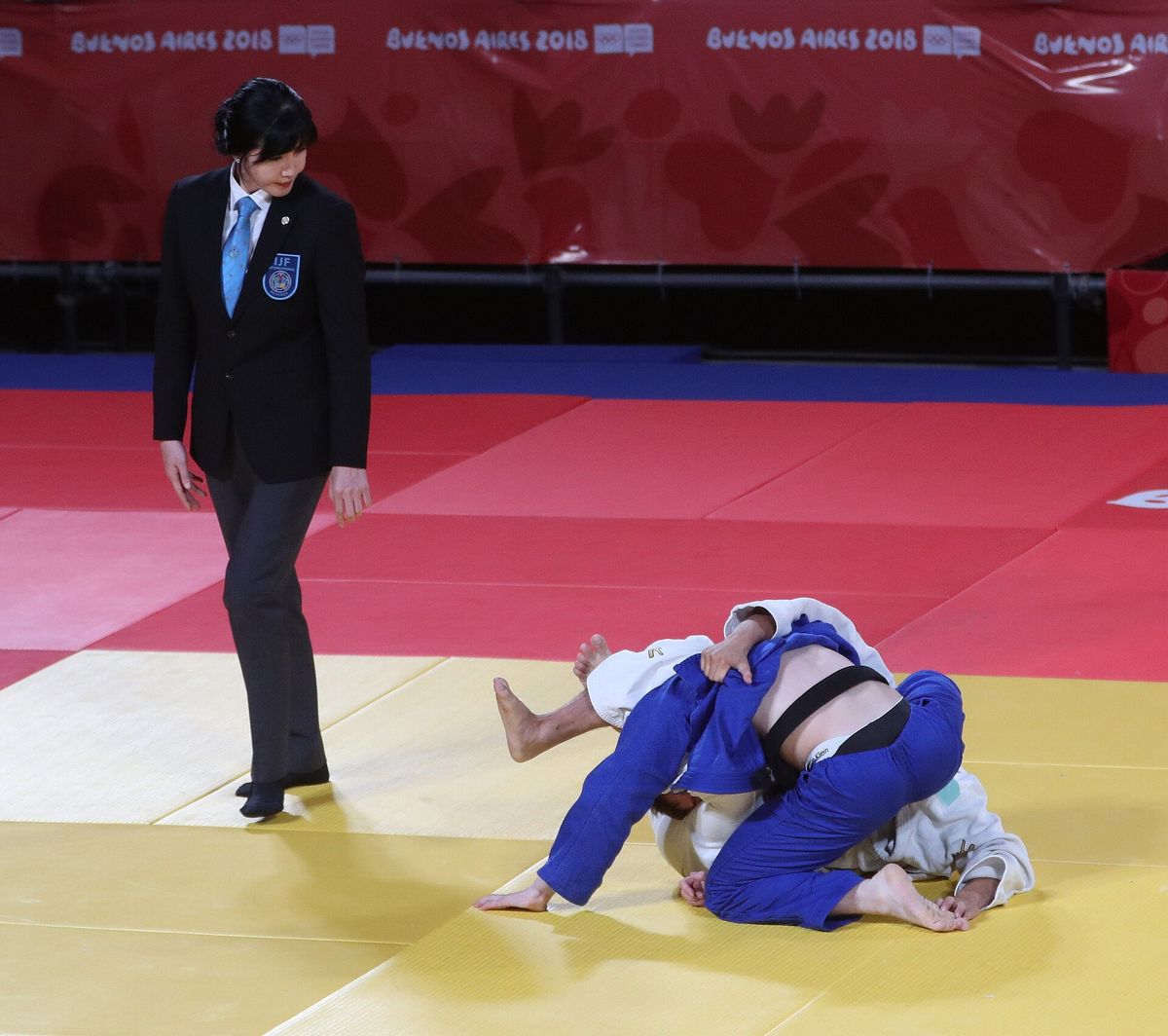
The contest area and its safety zone at the 2018 Youth Olympics, Buenos Aires.
A matted square with a border in another colour.
Martin Rulsch · CC BY-SA 4.0 · Wikimedia Commons
The judogi
A jacket, trousers and belt, specified by weave, thickness, sleeve length and the gap at the wrist and lapel — because the judogi is not clothing here, it is the thing both contestants grip. A jacket cut tight is genuinely harder to grip, so the specification is a performance rule pretending to be a uniform rule.
One contestant wears blue and the other white. That has only been true at the top level since 1998, and it was done for the camera.
- Colours
- One blue, one white
- Belt
- Rank-coloured, tied at the waist
- Sleeve gap
- Measured at the wrist
- A tight jacket resists gripping, so the tolerance is enforced.
This clause reads this way because of
IJF Sport and Organisation Rules · Judogi provisions · article not confirmed
Contestants and officials
Two contestants in a weight category. One referee on the mat, supported by video review officials at the side who can and routinely do correct the mat referee's score — an arrangement in which the official in the room is not the final authority, which is unusual among the sports here.
Time
Four minutes of contest time, the clock stopped whenever the referee calls a halt. If the score is level at the end, golden score begins and runs without limit until somebody scores or receives a third penalty.
There is no cap, no referees' decision and no draw. A contest lasts exactly as long as it takes, which makes judo the only sport on this site to have deliberately made its own duration unpredictable.
- Regulation time
- 4 min
- Golden score
- Unlimited
- Draws
- None
This clause reads this way because of
Scoring
Two scores. Ippon ends the contest. Waza-ari is awarded for a throw missing one of ippon's elements, and two waza-ari make ippon.
There used to be three. Yuko, the smallest score, was abolished in 2017 because contests were being won and then defended on a single minimal advantage. Judo has been narrowing its scoring for a decade, always in the same direction: towards the throw and away from the accumulation.
- Ippon
- Ends the contest
- Waza-ari
- Two make ippon
- Yuko
- Abolished 2017
- Pin for ippon
- 20 s
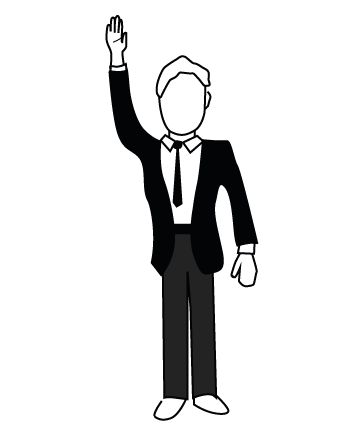
The referee's signal for ippon.
One arm raised: a throw with control, force and landing largely on the back, and the contest is over.
Emmanuel Roquette · CC BY-SA 4.0 · Wikimedia Commons
This clause reads this way because of
IJF Sport and Organisation Rules · Scoring provisions · article not confirmed
Gripping and restarts
A contest begins standing, and everything follows from the grip: judo is a fight for a hold on the jacket before it is a fight to throw. The referee restarts from standing whenever groundwork stops progressing, which keeps the sport a throwing contest rather than a wrestling one.
That preference for the standing game is also the reason for the most contested rule in the sport. Grabbing the opponent's leg with the hand has been forbidden outright since 2013.
This clause reads this way because of
Penalties and forbidden techniques
Three shido and the contest is lost. Since 2018 a shido no longer scores for the opponent, so penalties can only lose a contest, never win one — which removed the tactic of provoking rather than attacking.
The forbidden list divides in two, and the division is the interesting part. Some techniques are banned for safety: diving head-first, throwing onto a trapped arm, anything endangering the neck. Others are banned for identity: leg grabs were removed because they made judo look like wrestling, and the federation said so.
- Shido to disqualification
- 3
- Shido gives opponent a score
- No, since 2018
- Direct leg grabs
- Prohibited since 2013
Deciding the winner
Ippon, two waza-ari, the opponent's third penalty, or a score in golden score. There is no other route. Judo removed the referees' decision in 2017 and has not replaced it, so every contest is now settled by something that happened on the mat.
This clause reads this way because of
Everything above is current law. Everything below is how Judo got here.
02Disciplines and events
Weight categories and one mixed team event. Judo is one of two Olympic sports where men and women compete on the same team in the same competition, and the only combat sport to do it.
- Disciplines
- 2
- Olympic medal events
- 15
- Men’s and women’s counted separately.
- Contested elsewhere
- 2
- world championship.
- Listed for context
- 1
- Not counted as this sport.
Individual14
Seven weight categories for each of men and women.
- Men −60 kg
- Men −66 kg
- Men −73 kg
- Men −81 kg
- Men −90 kg
- Men −100 kg
- Men +100 kg
- Women −48 kg
- Women −52 kg
- Women −57 kg
- Women −63 kg
- Women −70 kg
- Women −78 kg
- Women +78 kg
Team1
- Mixed teamAdded for 2020; three men and three women per team.
Contested away from the Games2
- Kata competitionWorld championshipJudged, not fought — a judged event inside a combat sport.
- Open weightWorld championshipContested at world championships; no weight limit.
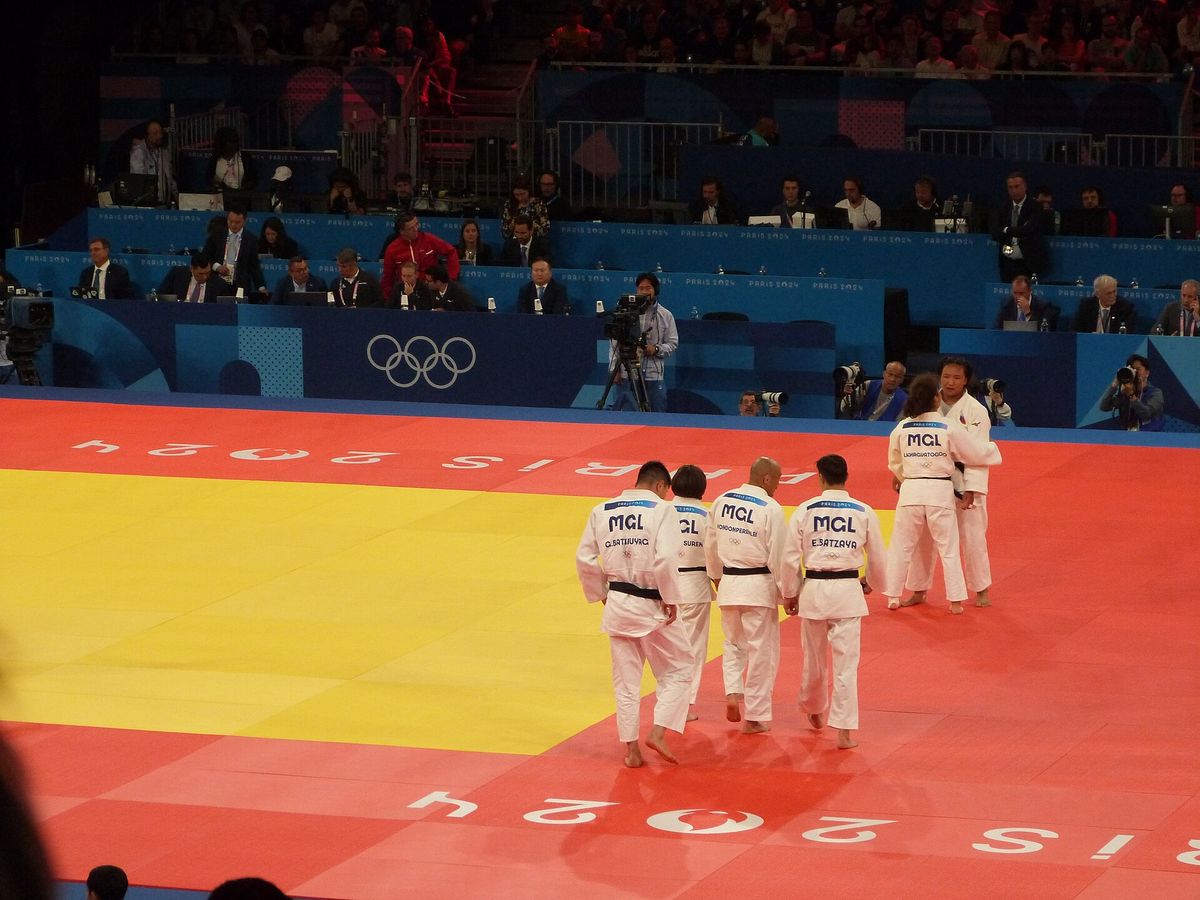
Mongolia's mixed team at the 2024 Paris Olympics.
The mixed team event, added for Tokyo 2020: three men and three women per team.
Daieuxetdailleurs · CC BY 4.0 · Wikimedia Commons
03Officiating and technology
Judo has the most interesting officiating arrangement on this site, because the official on the mat is not the final authority.
One referee runs the contest. Video review officials sit at the side with access to replay, and they can and routinely do correct the mat referee's score — not on appeal, not on challenge, but on their own initiative and within seconds. The referee's call is provisional by design.
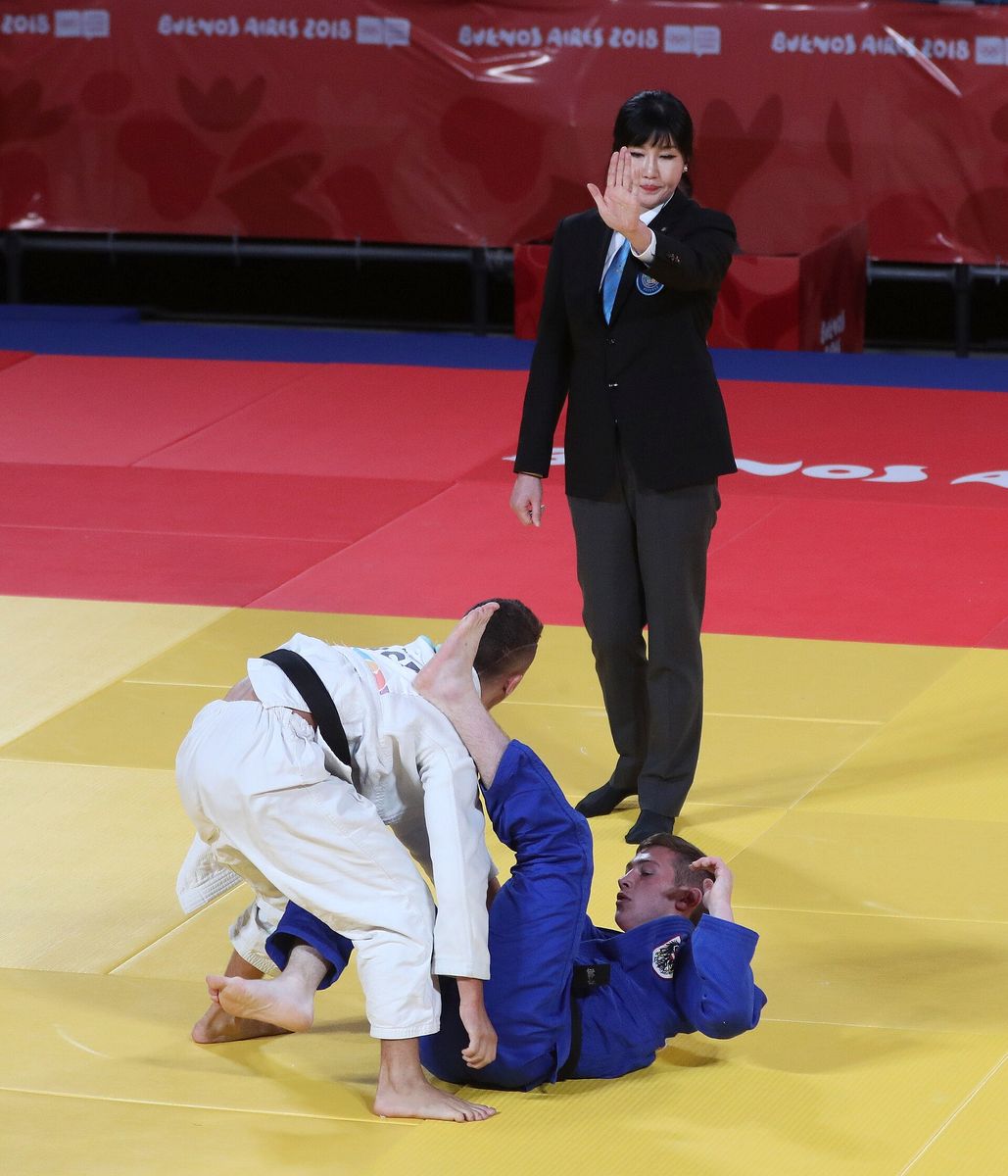
The referee signalling during groundwork in a bronze medal match at the 2018 Youth Olympics, Buenos Aires.
One referee on the mat, with video officials at the side who can correct the score.
Martin Rulsch · CC BY-SA 4.0 · Wikimedia Commons
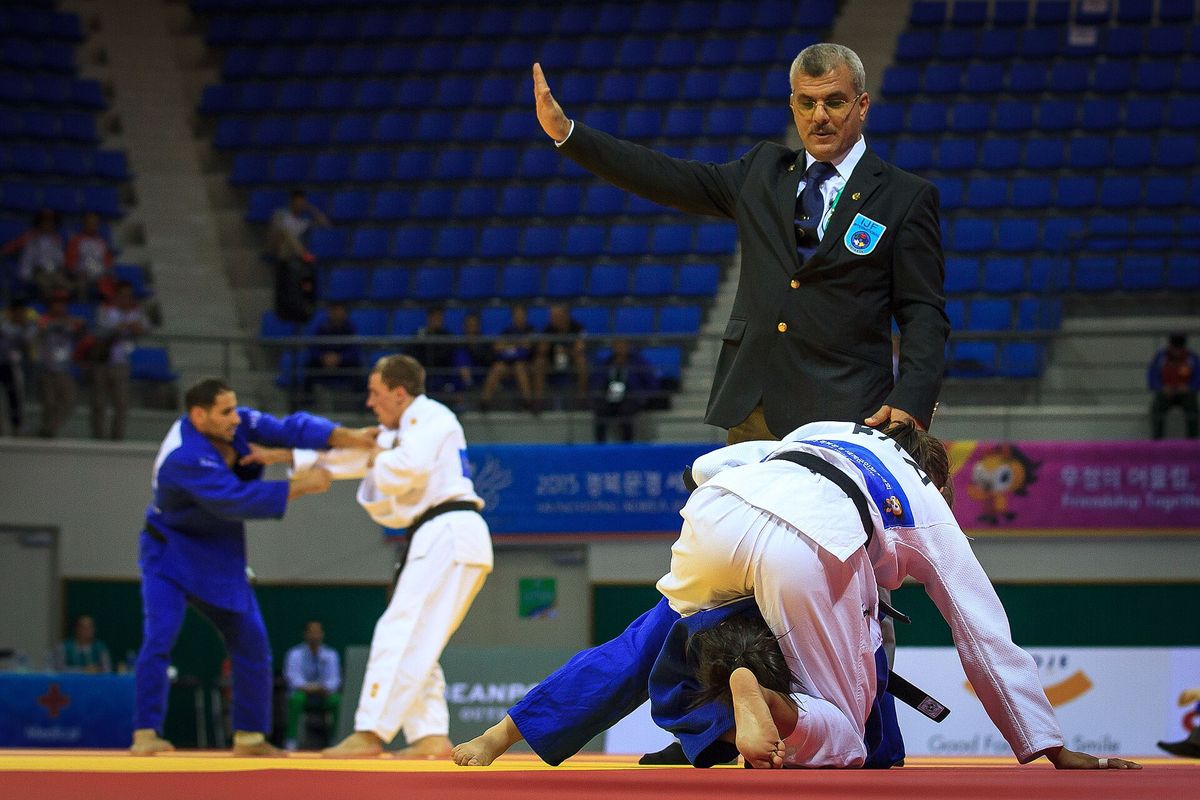
A referee's call at the 2015 Military World Games, one pair throwing, another on the mat beside them.
Whether a throw landed largely on the back, with control and force, is hard to see once from mat level.
Johnson Barros · CC BY 2.0 · Wikimedia Commons
No other sport here works this way. Football's VAR advises a referee who remains the decision-maker. Gymnastics splits its judgement across two panels that each own their part. Judo simply has a second layer that outranks the first, and the sport has largely accepted it, because what a score depends on — whether a throw landed largely on the back, with control, with force — is almost impossible to see correctly once from mat level and quite easy to see correctly twice from a camera.
That is the underlying reason the technology fits here and fits badly elsewhere. Judo's central judgement is about the geometry of a body at a moment in time, which is a question of fact even though it sounds like an opinion. Football's handball law asks about intent and football's cameras cannot help.
What review cannot settle is the penalty. Shido for passivity, for a false attack, for defensive gripping — these are judgements about a pattern of behaviour over time rather than about a moment, and they remain the most disputed calls in the sport. Since 2018 they can no longer win a contest for the opponent, only lose it for the offender, which reduced how much rests on them.
04Where it is played
Judo is the most widely practised martial art in the world and one of the most evenly distributed sports on this site. Its medal table is genuinely global in a way that badminton's and table tennis's are not: Japan, France, Georgia, Brazil, Russia, South Korea, Cuba, the Netherlands, Mongolia and Kosovo have all produced Olympic champions, and several of those are small countries where judo is a national sport.
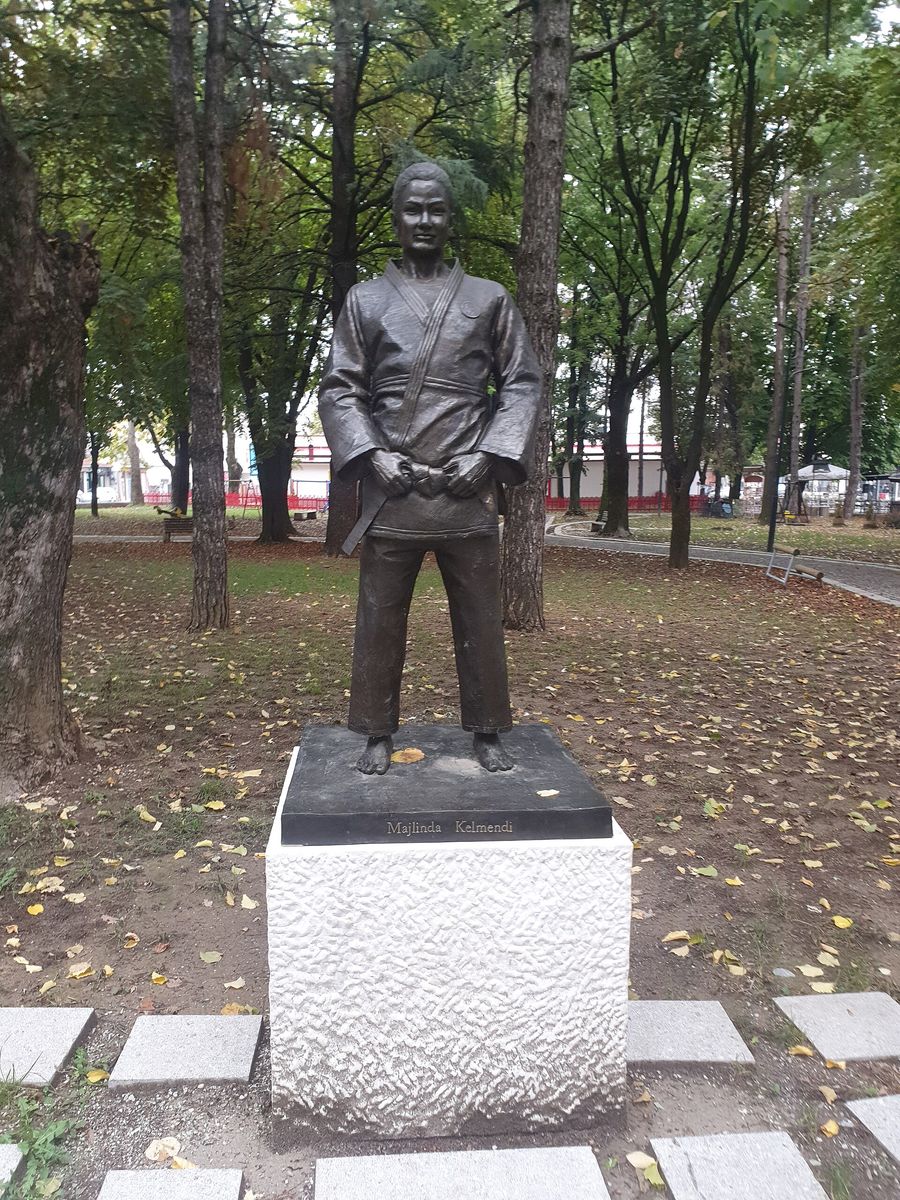
The statue of Majlinda Kelmendi in Pejë, Kosovo.
Kosovo's first Olympic champion, in judo, in 2016.
IsaBoletinii · CC BY-SA 4.0 · Wikimedia Commons
The evenness has a cause. Judo needs a mat, a jacket and a coach, and nothing else — no facility on the scale gymnastics needs, no pool, no bicycle, no grass. It travelled through the twentieth century on the back of Japanese emigration and military instruction, and it embedded in school and club systems rather than in expensive institutions.
France is the case worth recording. It has more registered judoka than Japan, by a wide margin, built on a club structure that treats judo as a children's activity first and a combat sport second. That is a participation strategy rather than an elite one, and it has nonetheless produced sustained elite success.
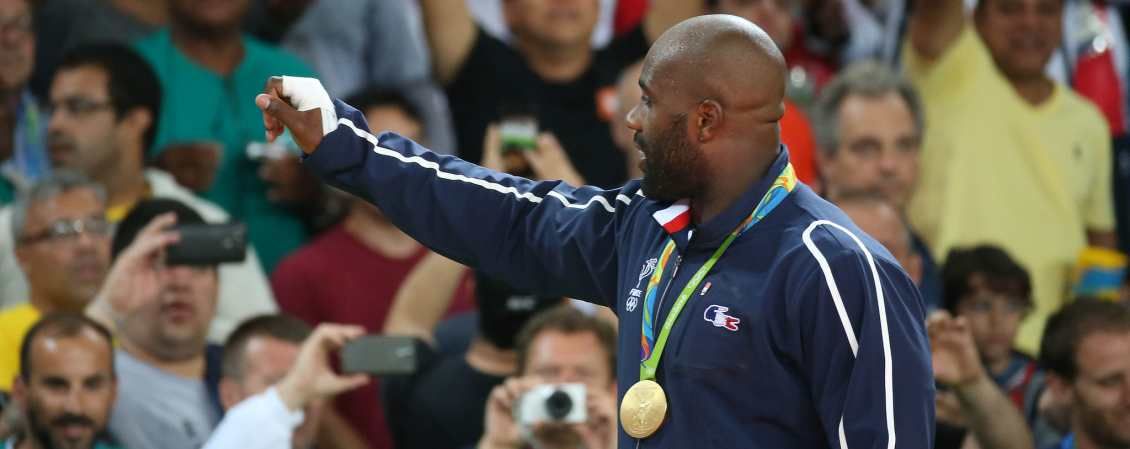
Teddy Riner with his gold medal at the 2016 Rio Olympics.
France: more registered judoka than Japan, and sustained elite success.
Roberto Castro / Brasil2016.gov.br · CC BY-SA 3.0 · Wikimedia Commons
The rule consequence is the one running through this whole page. Because the sport is genuinely global and its strongest competitors increasingly come from outside its founding tradition, the question of what judo should look like has real stakes. The leg grab ban fell hardest on nations with wrestling cultures and lightest on those with classical judo lineages, and whether that was the purpose or the side effect is exactly what the sources disagree about.
05Learning curve
The only sport here where a beginner's first lesson is not the sport at all. Before anyone can be thrown they have to learn to fall, and that comes first in every judo club in the world — which makes the barrier to entry real, and makes it the least negotiable barrier of any sport on this site.
Editorial — the site’s reading, not a sourced claim
Barrier to entry
How hard is it to get to a real game?
You cannot start until you can land, and that is taught before anything else.
Ukemi — breakfall — is the first thing taught and it is a prerequisite rather than a technique. Judo cannot be practised informally between two people who have not learned it, because the basic action of the sport is throwing someone onto their back onto a hard surface.
That rules out the entry route almost every other sport here has. There is no park version of judo, no version with a friend and no equipment, and no way to try it without a club, a mat and an instructor. What partly offsets it is that clubs are cheap, the judogi is the only kit, and a beginner can take part in randori within weeks of starting.
Evidence
- PrerequisiteLearning to fallobservedTaught before any throw
- Facility neededTatami and an instructorobserved
- Kit to startA judogiobserved
- Partner requiredAlwaysobservedNothing in judo can be practised alone.
- Time to first randoriWeeksestimate
Barrier to the top
How hard is it to be good at?
A sport whose rules have changed under its athletes three times in a decade.
The physical demand is extreme and the technical vocabulary is large, but what makes judo's ceiling distinctive here is instability. A judoka who built a career on leg grabs found the technique illegal in 2013. One who won on accumulated small scores found yuko abolished in 2017. One who won on penalties found that route closed in 2018.
Very few sports on this site have removed a whole family of techniques from competition within a single athlete's career. Athletics changed the javelin; judo changed what a judoka is allowed to do with their hands.
The weight categories add a second demand that is not about skill at all: the sport is contested at a made weight, and the practice of cutting to it is a health question the federation has never fully resolved.
Evidence
- Leg grabsBanned 2013ruleAn entire technique family removed mid-career for a stated reason of identity.2013 — the rule this rests on
- YukoAbolished 2017ruleClosed the route to winning on accumulated small advantage.2017 — the rule this rests on
- Penalties no longer scoreSince 2018rule2018 — the rule this rests on
- Golden scoreUnlimited since 2017ruleA contest has no maximum length, so conditioning cannot be planned against a clock.2017 — the rule this rests on
- Typical peak age24–29estimate
Why the two differ
Judo's shape is unusual on this board: a moderate entry rather than a very low one, because of the falling, and a very high top like almost everything else. Gymnastics is the only other sport here with a genuine barrier at the door, and for the same underlying reason — both are sports where doing the beginner's version wrong injures you.
What is particular to judo is the moving target. Every other sport here has changed its rules, but mostly at the edges: a timing method, an implement specification, a scoring scale. Judo has three times in a decade changed what actually wins a contest. Mastery in this sport means mastery of a rulebook that has not held still, and the sport knows it — the leg grab ban is defended on grounds of what judo should look like, which is a claim no other federation on this site has made out loud.
The historyhow it got here · sections 6 to 10
06Origin and invention
Judo is the only sport on this site whose founder wrote down what it was for.
Jigoro Kano established the Kodokan in 1882, taking the throwing and grappling techniques of jujutsu and removing the strikes, the joint attacks the body cannot survive, and the assumption that the goal was to injure. What he built was a martial art reorganised as an educational method, with two stated principles: maximum efficiency with minimum effort, and mutual welfare and benefit.
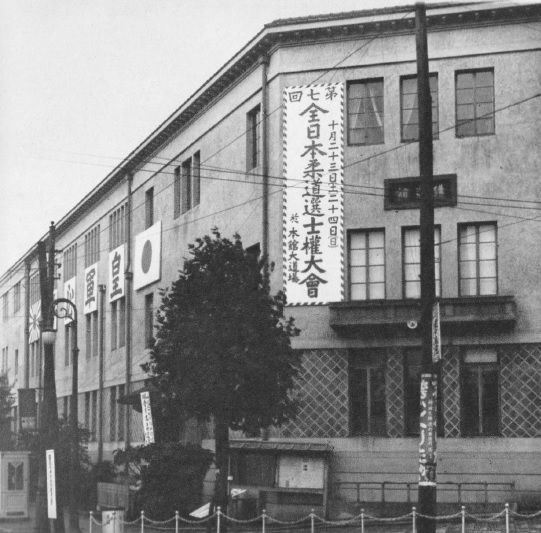
The Kodokan at Suidōbashi, Tokyo, 1937, with banners for a national championship.
The institute Kanō founded in 1882, which still holds authority over judo as a practice.
Kodansha · Public domain · Wikimedia Commons
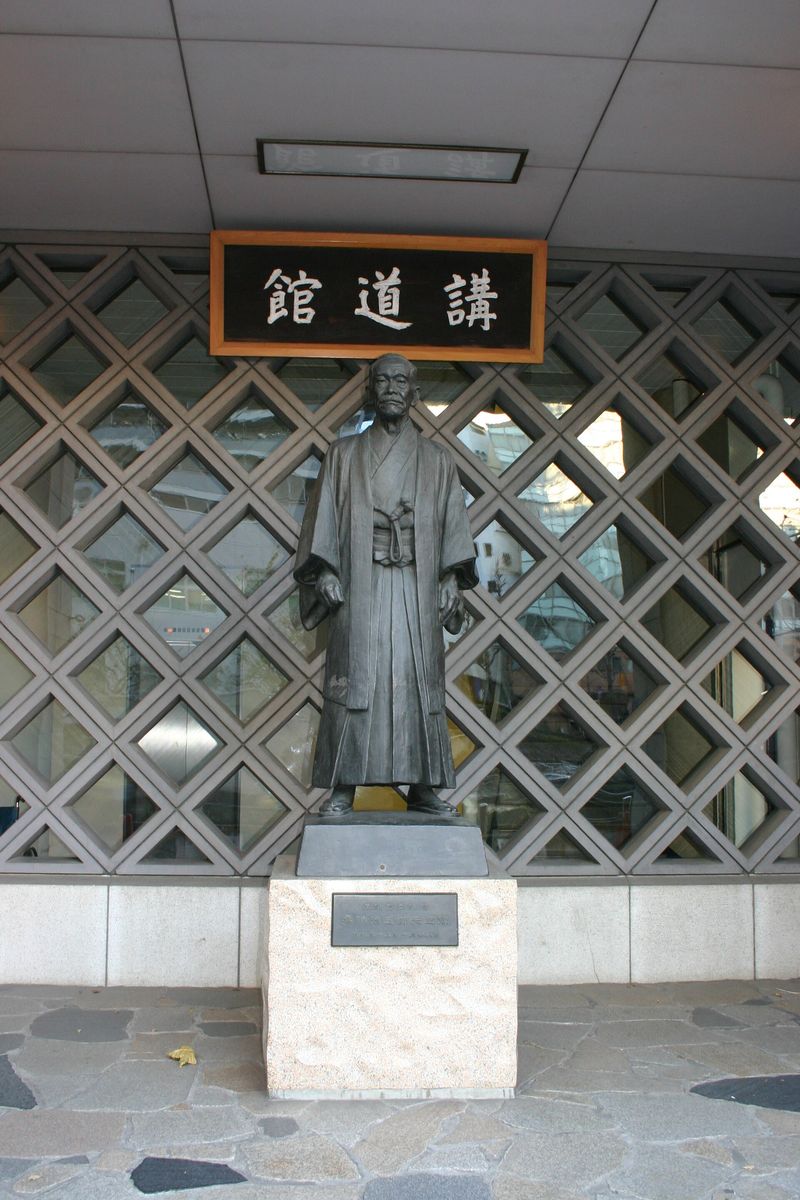
Fumio Asakura's statue of Kanō Jigorō outside the Kodokan, Tokyo.
The founder who wrote down what the sport was for.
Fumio Asakura · Public domain · Wikimedia Commons
That origin explains why judo's rule arguments sound different from every other sport's here. When the federation banned leg grabs in 2013 and justified it by saying that judo should look like judo, it was making a claim that only a sport with a written purpose can make. Football cannot say a tackle is wrong because it is not football. Judo can, and does.
The system spread through the Japanese education system and then internationally through demonstration and emigration; the International Judo Federation formed in 1951. Judo entered the Olympic programme at Tokyo in 1964, was dropped for 1968, and has been permanent since 1972. The women's competition arrived in 1992, twenty-eight years after the men's.
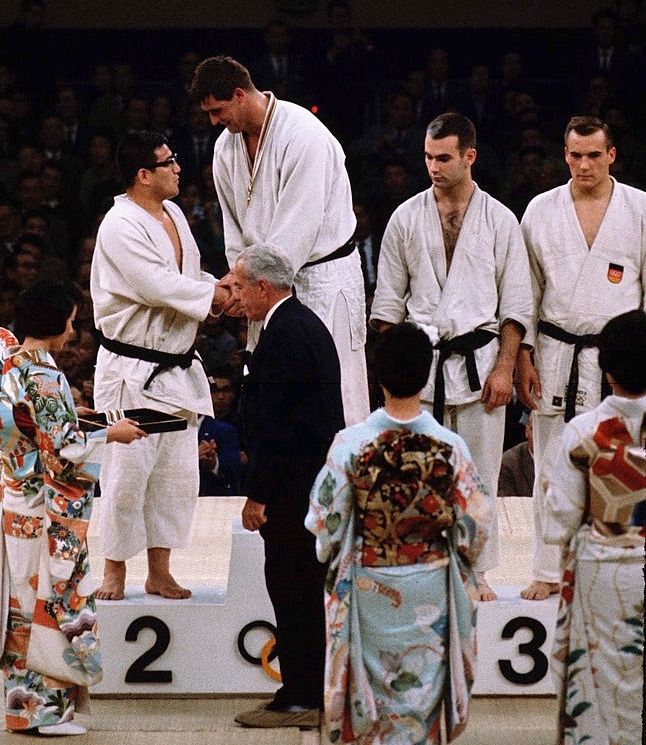
The open-category podium at the 1964 Tokyo Olympics: Anton Geesink on top, Akio Kaminaga second, Ted Boronovskis and Klaus Glahn third.
Judo's first Olympic tournament, and a Dutchman winning the open class in Tokyo.
Unknown photographer (Asahi Shinbun) · Public domain · Wikimedia Commons
Kano's other invention was the coloured belt, which is now so universal across martial arts that its origin is invisible. It was a nineteenth-century administrative idea about how to grade a syllabus.
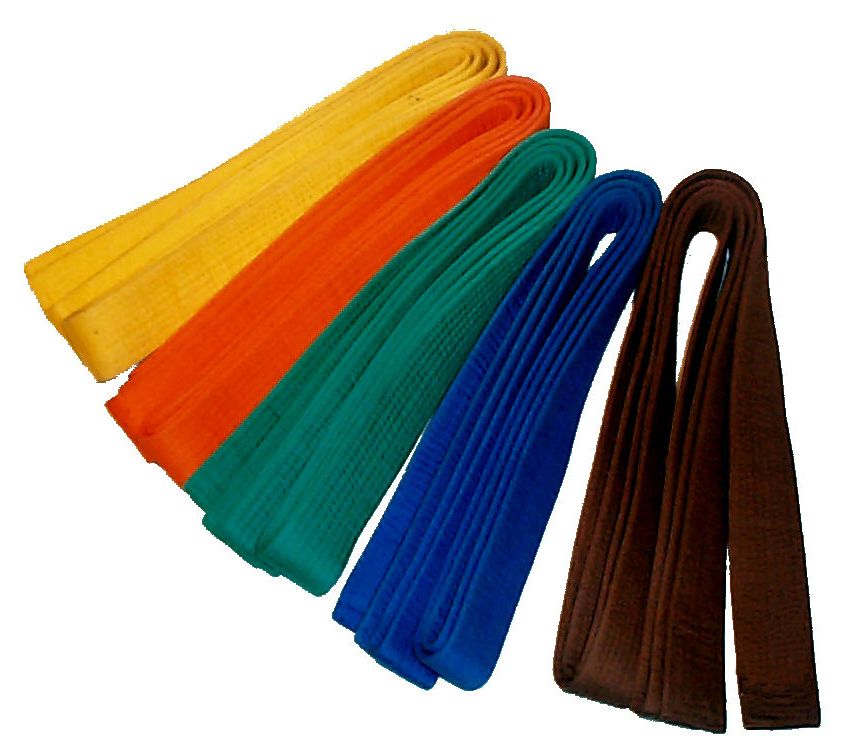
Coloured belts for the student grades.
Kanō's grading idea, now so universal across martial arts that its origin is invisible.
chris 論 · CC BY-SA 3.0 · Wikimedia Commons
07Rule timeline
The sport’s own lane, expanded. Every entry carries a cause from the closed vocabulary and a citation, and says so where the citation is incomplete.
- 1998Broadcast and pacingalso commercialadopted 1997
One contestant wears a blue judogi and the other white, replacing two white judogi distinguished only by a coloured sash. Adopted for major international competition after years of resistance.
Trigger and citationIncomplete — no confirmed article
Trigger
Two athletes in identical white gripping each other on a white mat were close to indistinguishable on television, which made the sport unusable as broadcast and made refereeing decisions hard for spectators to follow.
The change was opposed within the sport, notably in Japan, on the grounds that the white judogi was part of judo's identity and that changing it for a camera subordinated the sport to its audience. That objection recurs in every subsequent entry on this page.
Sport and Organisation Rules · IJF Sport and Organisation Rules, 1998
- 2013-01Disputedadopted 2012
Grabbing an opponent's leg or trousers with the hand was prohibited outright, an immediate penalty. Restricted in 2010 and banned entirely from 2013, this removed an entire family of techniques — including the morote-gari and kata-guruma that had been winning medals at the highest level — from competition.
Trigger and citationIncomplete — no confirmed article
Trigger
The federation's stated reason was to preserve judo's distinct identity: leg grabs made contests resemble freestyle wrestling, and the sport risked becoming indistinguishable from another one on the same Olympic programme.
The competing reading is that the ban favoured the classical throwing styles of the sport's traditional powers against wrestling-influenced approaches that had become effective, particularly among nations without a long judo lineage. The sources do not settle which motive dominated, and the federation's own framing — identity — is unusually candid about being aesthetic rather than sporting.
Sport and Organisation Rules · IJF Sport and Organisation Rules, 2013
- 2017-01Broadcast and pacingalso disputedadopted 2016
The yuko score was abolished, leaving only ippon and waza-ari, and two waza-ari again became equivalent to ippon. A three-tier scoring system that had let contests be won on accumulated small advantages became a two-tier one in which only substantial throws register.
Trigger and citationIncomplete — no confirmed article
Trigger
The federation's stated aim was to remove the incentive to win on a minimal score and then defend, which had produced contests decided by a single small advantage held for four minutes.
It is also read as a return towards Kano's original conception, in which ippon — a decisive throw — was the point of the exercise and anything less was an incomplete version of it. Both readings appear in the record.
Sport and Organisation Rules · IJF Sport and Organisation Rules, 2017
- 2017-01Broadcast and pacingadopted 2016
Golden score was made unlimited. A contest tied at the end of regulation continues until somebody scores or accumulates a third penalty, with no time cap and no decision by the referees. Judo removed the draw, the referees' decision, and the clock all at once.
Trigger and citationIncomplete — no confirmed article
Trigger
Contests had previously been decided by a referees' decision when golden score expired, which meant an important match could end on an opinion rather than an action. Removing the cap guarantees a result produced on the mat.
The cost is that a contest now has no predictable length at all, which is the opposite of what broadcast scheduling usually asks for. Judo is the only sport here to have made match length less predictable on purpose.
Sport and Organisation Rules · IJF Sport and Organisation Rules, 2017
- 2018-01Broadcast and pacingalso integrityadopted 2017
Penalties were separated from scoring. A shido no longer gives the opponent a score; three shido disqualify. A contest can therefore no longer be won by drawing penalties out of an opponent, only by throwing them or by their disqualification.
Trigger and citationIncomplete — no confirmed article
Trigger
Under the previous system a contestant could take a lead through the opponent's penalties and then hold it defensively, so the optimal tactic in a close contest was to provoke rather than to attack.
Sport and Organisation Rules · IJF Sport and Organisation Rules, 2018
- 2022Safetyadopted 2022
Restrictions on techniques that risk the head, neck and shoulder, including limits on how a throw may be finished when the opponent's arm is trapped and prohibitions on diving head-first into the mat.
Trigger and citationIncomplete — no confirmed article
Trigger
A pattern of cervical and shoulder injuries from throws taken onto the head or with the arm locked, which the sport's own medical commission documented. This is the least contested rule change in modern judo, which is worth recording in a sport where almost everything else is argued.
Sport and Organisation Rules · IJF Sport and Organisation Rules, 2022
08Equipment evolution
Judo has almost no equipment, and the one thing it does have is contested in a way that only makes sense once you realise the judogi is not clothing.
Both contestants grip the jacket. It is therefore the interface through which the entire sport happens, and its specification is a performance rule rather than a uniform rule. The IJF regulates weave, thickness, sleeve length, the gap at the wrist and the width of the lapel, and enforces those tolerances with a gauge at weigh-in — because a jacket cut slightly tighter is genuinely harder to grip, and a competitor wearing one is harder to fight.
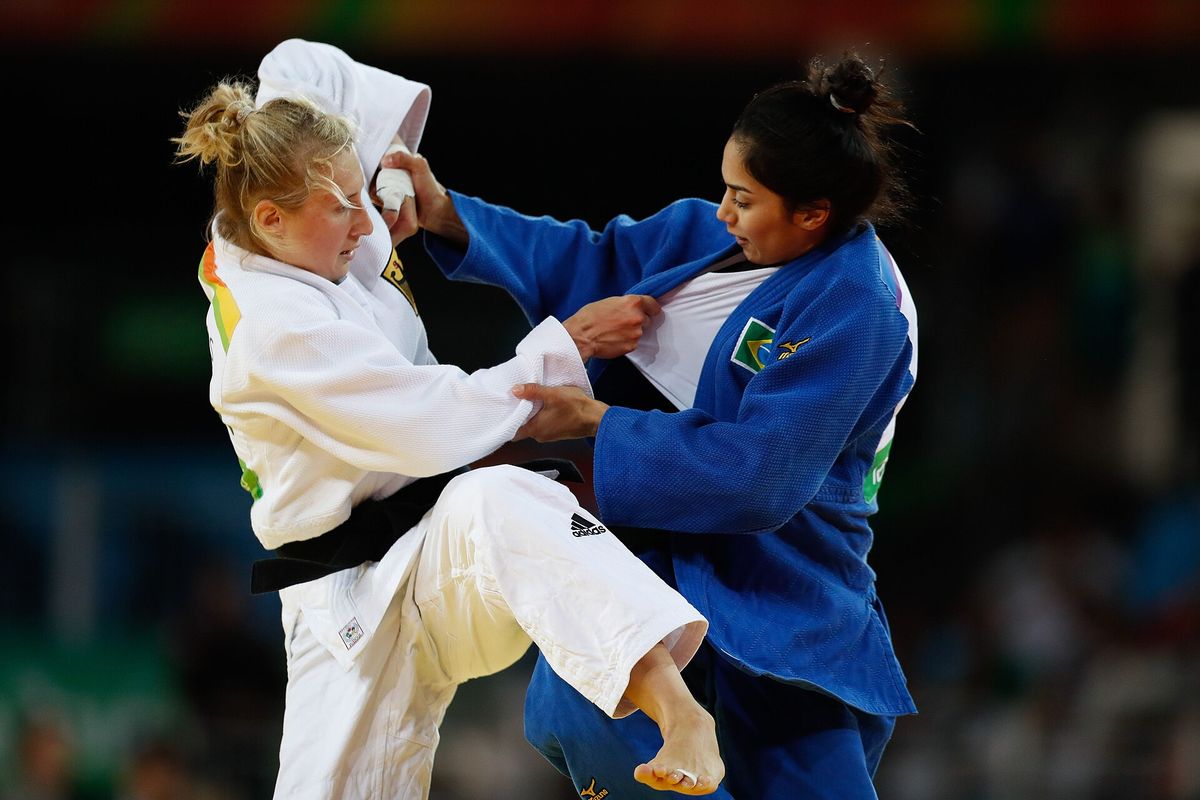
Two judoka, one in blue and one in white, gripping each other's jackets at the 2016 Rio Olympics.
The jacket is the interface through which the whole sport happens, so its cut is a performance rule.
Fernando Frazão / Agência Brasil · CC BY 3.0 br · Wikimedia Commons
The visible change is colour. Until the late 1990s both contestants wore white and were distinguished by a coloured sash, which on television was two indistinguishable figures on a pale mat. The blue judogi was adopted for major competition from 1998 after sustained resistance, particularly from Japan, where the objection was that white was part of what judo was and changing it for a camera got the priority backwards.
Teddy Riner of France throwing in blue against white at the 2012 London Olympics.
Blue and white: a colour change made for the camera, and resisted as a change to what judo was.
Martin Hesketh · CC BY 2.0 · Wikimedia Commons
That argument is worth holding onto, because it is the same argument the sport had about leg grabs fifteen years later and about yuko twenty years later. Judo's equipment history is short, but the dispute inside it — whether the sport exists for its practitioners or for its audience — runs through everything else on this page.
The mat is the other piece of equipment, and its evolution is a safety story: progressively better shock absorption, which is what allows throws to be practised thousands of times.
09Governing body politics
Judo's politics is a long negotiation between the country that invented it and the federation that runs it, and almost every modern rule change is legible as a move in that negotiation.
Japan holds a position no other nation holds in any sport on this site: it is not merely the strongest competitor but the source of the sport's definition of itself. The Kodokan is a separate institution from the IJF and retains authority over judo as a practice rather than as a competition. When the two disagree — over the blue judogi, over scoring, over which techniques belong — the disagreement is not about who wins but about what the thing is.
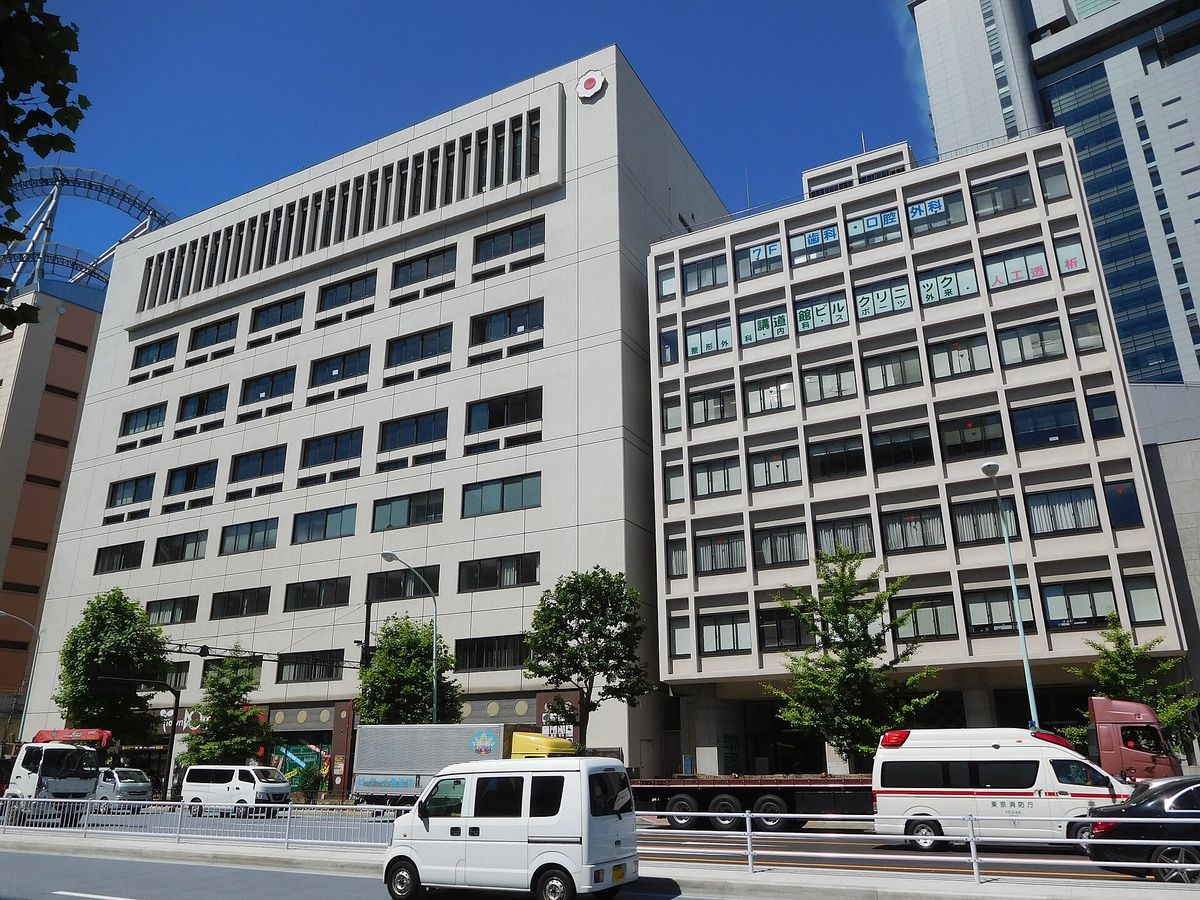
The Kodokan today: the main building and the International Judo Center, Bunkyō, Tokyo.
A separate institution from the IJF, and a separate kind of authority.
Miyuki Meinaka · CC BY-SA 4.0 · Wikimedia Commons
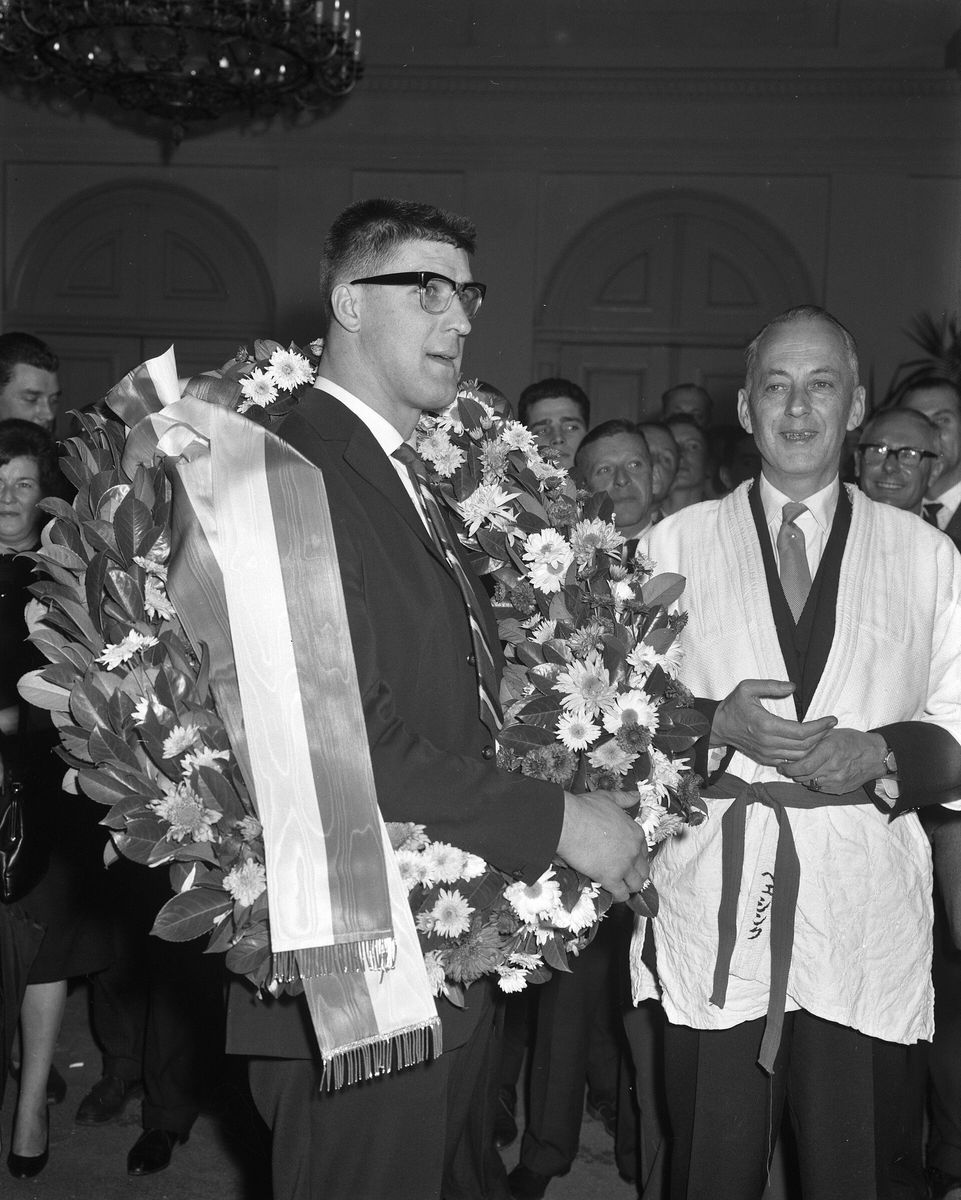
Anton Geesink honoured at Utrecht city hall after his 1961 world title, with mayor Coen de Ranitz.
The first world champion from outside Japan, and the start of judo's argument about who owns it.
Wim van Rossem / Anefo · CC0 · Wikimedia Commons
The IJF's direction for thirty years has been towards spectacle and legibility: distinguishable colours, fewer scores, no draws, no referees' decisions, contests that end with something visible happening. Each step is defensible on its own and the cumulative direction is unmistakable, and it is the direction the Kodokan tradition has resisted at every stage.
The leg grab ban is where those two forces produced something unusual. The federation did not claim safety or fairness. It said judo was starting to look like wrestling, and legislated on the basis of identity — the only governing body on this site to give that as a stated reason, and it could only do so because Kano wrote down what the sport was supposed to be.
Weight categories are the other governance issue, and it is a health one. The sport is contested at a made weight and the practice of cutting to it remains inadequately regulated.
10Controversies that forced rule changes
The white-on-white problem. Not an incident but a broadcast fact: two contestants in identical white judogi gripping each other on a pale mat could not be told apart on television, which made the sport unwatchable and made refereeing decisions impossible for a viewer to follow. The blue judogi arrived in 1998 over sustained objection from within the sport.
Wrestling in a judogi. Through the 2000s, techniques that attacked the legs directly with the hands — morote-gari and its relatives — became increasingly effective at the highest level, particularly among competitors from wrestling cultures. They were legal, they worked, and to the federation they looked wrong. Restricted in 2010, banned outright from 2013.
This is the clearest case on the site of a governing body legislating on aesthetics and saying so. There is a competing reading, recorded in the entry, that the ban advantaged the classical throwing styles of the sport's traditional powers over approaches that had beaten them. The sources do not settle it, and the federation's own reason — identity — is unusually honest about not being a sporting one.
Winning by not losing. By the mid-2010s a contest could be won by taking a minimal score or drawing a penalty and then defending for four minutes. Three separate changes closed that off: yuko abolished in 2017, unlimited golden score in the same year, and in 2018 the removal of penalties from the score altogether. A judoka can now only win by doing something.
Necks and shoulders. The one uncontested area. Throws taken onto the head, or finished with the opponent's arm trapped, produced a documented pattern of serious cervical and shoulder injuries, and the 2022 restrictions attracted none of the argument that surrounds everything else here.
Where it standsthe record, and what is still open · sections 11 to 12
11Series
No series has been assembled for this sport.
12What is contested now
Recorded as unsettled.
The leg grab ban, twelve years on. It has not settled. The argument for reinstatement is that the sport removed a legitimate and effective family of techniques on aesthetic grounds and narrowed itself doing so; the argument against is that judo is a defined thing and a governing body is entitled to defend the definition. This site records that the federation gave identity as its reason, which is rare enough to be the interesting fact regardless of who is right.
Rule churn. Judo has changed what wins a contest three times in a decade. There is a real argument inside the sport that this is too much: that athletes build careers on techniques and tactics that the rulebook then removes, and that the accumulated effect is a sport whose eras cannot be compared. Judo has no comparability break in the sense this site usually means, because it keeps no quantitative series — but it may have the most severe continuity problem here, and no chart can show it.
Weight cutting. The sport is contested at a made weight and the practice of extreme dehydration before weigh-in is a documented health risk that the federation regulates lightly. Same-day weigh-ins and tighter tolerances are proposed periodically.
Passivity. Every combat sport with a clock has to decide what to do about a contestant who does not engage, and judo's answer — shido for passivity — asks a referee to judge intent over time. It is the most disputed call left in the sport, and unlike a score it cannot be settled by looking again.