 AFM Studio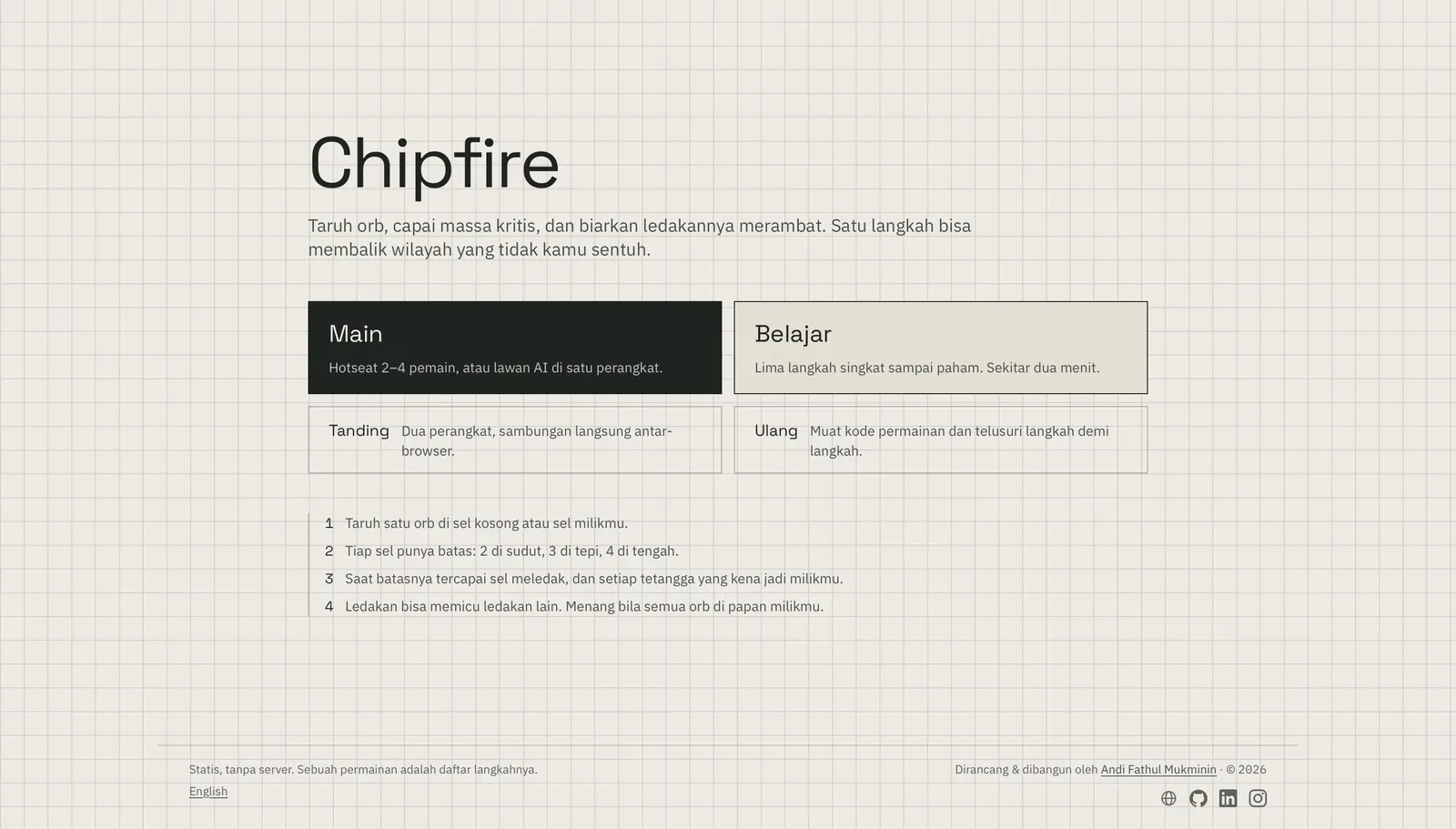

Chipfire
A browser game of chain-reaction explosions — play a friend on another device with no server, no account, and no backend anywhere
Solo Developer & Architect
Aug 2026
On this page
The problem
Chain Reaction is a well-known grid game with dozens of browser clones — and almost all of them get two things wrong. The first is the rule itself: when a cell reaches capacity it should subtract its critical mass, not empty to zero. Most implementations zero it, which still looks like a working game but is quietly a different one — a bug that never announces itself. The second is architecture: every online version reaches for a backend — a lobby, a matchmaker, an authoritative server, and the hosting bill behind them. That cost is exactly why most small games never get an online mode at all.
Chipfire is built for two audiences at once. For a player: a fast, offline-capable game you learn in two minutes and play against a friend on another device — no account, no install. For a technical reader, it's a demonstration that "multiplayer with no backend" is a real answer to a real constraint, and an invitation to ask how.
The approach
One property carries everything: determinism
applyMove(state, move) is a pure function that produces byte-identical results on any device, any browser, any time — no clock, no Math.random, no floating point anywhere, integers only, including in the AI's scoring. That single property buys four features at once: because the same moves always produce the same game, a game is its move list. Replay, undo, shareable game codes, and peer-to-peer sync all fall out of it for free. Nothing derived is ever stored or sent as truth.
No server — and no referee either
In peer-to-peer play each browser holds its own copy of the game. Only moves and a 32-bit hash of the resulting position cross the wire — never the position itself. Both sides run the same pure function on the same moves and compare hashes every turn. A mismatch means the players have silently drifted into different games — the worst possible failure — so the app stops immediately, says so, and offers to rebuild from the move list. It never quietly picks a winner.
The players are the signalling server
Two browsers behind home routers can't find each other, and WebRTC deliberately leaves that first handshake unspecified. Chipfire renders it as a compressed, pasteable code: one code out over WhatsApp, one code back, and the channel opens — with zero infrastructure and nothing that can be rate-limited or shut down.
Ordering is a rule, not an accident
The cascade resolves through an explicit FIFO queue in a fixed scan order — never recursion, which would blow the stack on exactly the long chains that make the game interesting, and never iteration over a Set or object keys, the single most likely source of cross-device divergence and one that never shows up in single-machine testing. A cell's critical mass is derived from one adjacency function, never hardcoded per cell — which is what keeps hex or wrap-around boards a later addition rather than a rewrite.
Honest about what doesn't work
Roughly 10–20% of connections — strict corporate networks, certain NAT configurations — can't establish a direct peer path without a paid relay server, which would break the no-backend premise. Rather than hide that behind an endless spinner, Chipfire detects the failure fast, explains it plainly, and offers local play right there.
Outcome
Live and deployed on GitHub Pages, gated on typecheck, lint, and the full test suite — including a 3,000-game simulation and cross-instance agreement run on every deploy, because determinism is the property everything else rests on. Hotseat play for 2–4, an AI opponent running minimax with alpha-beta pruning in a Web Worker, peer-to-peer play over pasted codes, a replay viewer, shareable game codes, and an interactive tutorial whose lessons are asserted in the test suite are all complete and playable.
Built solo and spec-first, from an empty directory to a deployed site in under 24 hours — roughly 6,700 lines of TypeScript across 66 files, a 984-line deterministic engine, a 300-line AI, and 70 tests, on three runtime dependencies (next, react, react-dom) and zero backend services.
- 0
- ~6,700
- 70
- <24 hrs
Have a project like this?
If you need a system built with the same care — clear scope, solid execution — let's talk.
Start a project