 AFM Studio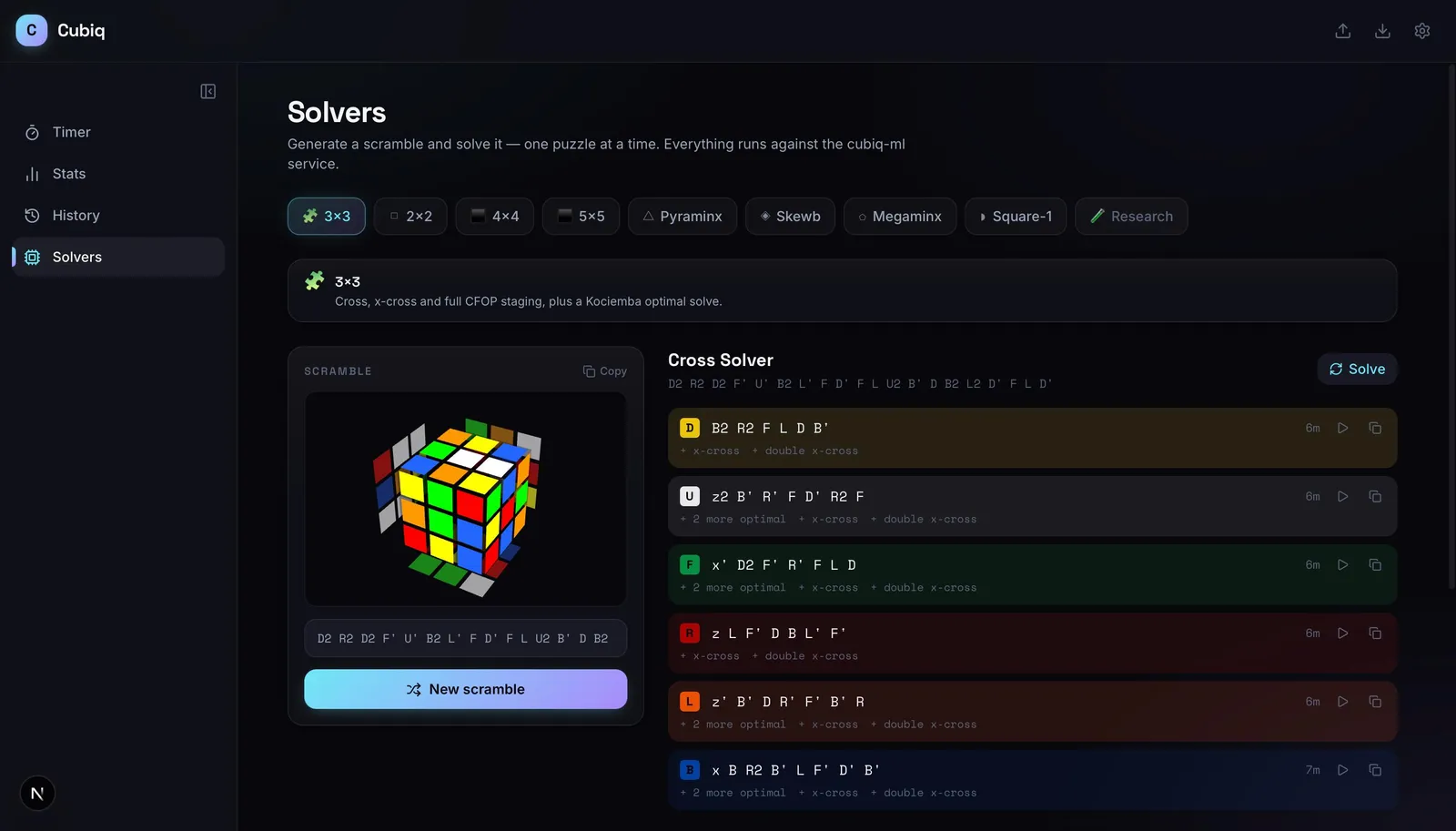

Cubiq
Dark-themed speedcubing trainer with a precision timer, WCA-standard analytics, and from-scratch solvers for all 8 major twisty puzzles
Fullstack Developer
May – Jul 2026
On this page
The problem
Speedcubers track their solves in apps like csTimer — a tool that works but looks like it was designed in 2008. There's no good modern alternative that combines a beautiful training interface with real analytics, per-puzzle solvers, and any kind of AI integration. Cubiq was built to replace csTimer for serious cubers who want a premium feel, rich stats, and solving tools that go well past the cross.
The approach
cubing.js as a web component, not a React component
The TwistyPlayer 3D cube renderer from cubing.js must be instantiated as a DOM element. Importing it as a React component crashes server-side rendering because the library references self (a browser global) at module load time. The fix: dynamic(() => import(...), { ssr: false }) combined with a useEffect-based mounting pattern that calls document.createElement('twisty-player') directly. Turbopack also had to go — cubing.js spawns Web Workers using a relative URL pattern its module resolver breaks, so switching to the Webpack bundler was the actual commit that unblocked the build, a real constraint rather than a theoretical one.
Eight puzzle families, eight solving strategies
Rather than one generic solver, each puzzle got its own from-scratch cube representation and move-table generator, with a strategy chosen to fit that puzzle's state-space size:
- 2x2, Pyraminx, Skewb — small enough (up to ~3.1M positions) to fully precompute a God's-algorithm distance table; the API just looks up the optimal move count and path, provably ≤ 11 moves.
- 3x3 — staged CFOP: exact IDA* cross/x-cross/double-x-cross solving, F2L pair search, and a full OLL/PLL recognition and algorithm database, with move cancellation across stage boundaries so the stitched solution isn't padded with redundant turns.
- 4x4, 5x5 — geometry-generated move tables feeding a reduction pipeline (centers → edge/wing pairing → parity handling → 3x3 CFOP finish), the standard big-cube method, with the reduction and parity-fix logic hand-implemented rather than borrowed.
- Megaminx — layer-by-layer greedy placement with a curated commutator library for the last layer.
- Square-1 — the hardest engineering case: a two-phase solver (shape BFS to restore the cube/square silhouette, then exact piece descent) paired with a custom animated 3D view that renders the puzzle as a real double-sided shell and animates 180° equator flips as rigid geometry rather than a sprite swap.
Timer accuracy without drift
The visible timer calls performance.now() - startTime on every render tick. setInterval only triggers re-renders, never measures time, so drift doesn't accumulate even over long solves. A 300ms hold-to-arm pattern matches WCA inspection behaviour.
An AI that learns to solve itself
The cubiq-ml FastAPI service implements Autodidactic Iteration, the same family of reinforcement learning behind DeepCubeA: the model generates its own training data by scrambling a solved cube to random depths and learning to estimate the move distance back to solved. A dual-head ResNet regresses a value (moves remaining) from one head and a policy distribution over 18 moves from the other. A live MDP research dashboard polls training status every two seconds, charts loss and solve-rate history, and shows the policy probability bars for the current scramble — users can trigger a greedy or MCTS rollout and compare move efficiency directly against Kociemba's optimal solution, which is used only as a ground-truth benchmark, never as part of the solving path itself.
One workspace, deep-linkable
/solvers is a single sticky-scramble workspace — one tab per puzzle plus a Research tab for the MDP dashboard — each backed by its own scramble slot and a shared 3D preview panel, so switching puzzles never loses your place. A "Solve this" button on a completed timer solve deep-links straight into the matching puzzle's solver tab via /solvers?puzzle=<id>&scramble=<alg>, with the scramble pre-filled.
Outcome
Six months of ongoing work, ~70 commits, ~13,700 lines split roughly evenly between TypeScript and Python. What began as a cross solver flagged in the PRD as possibly too complex for an early phase shipped fully in Phase 3 — and every solver after it went considerably further than the original plan specified, growing into a from-scratch engine for all 8 major twisty puzzles plus a self-training RL model, none of it borrowed from an existing cube-solving library beyond cubing.js for rendering and kociemba as a benchmark. It runs as a local prototype — no public deployment yet — with WCA-compliant ao5/ao12/ao50/ao100 stats, a Zustand store persisted to localStorage with skipHydration to avoid SSR mismatches, and full JSON export/import for every solve.
- 8
- 19
- ~13.7K
- 70
Have a project like this?
If you need a system built with the same care — clear scope, solid execution — let's talk.
Start a project