 AFM Studio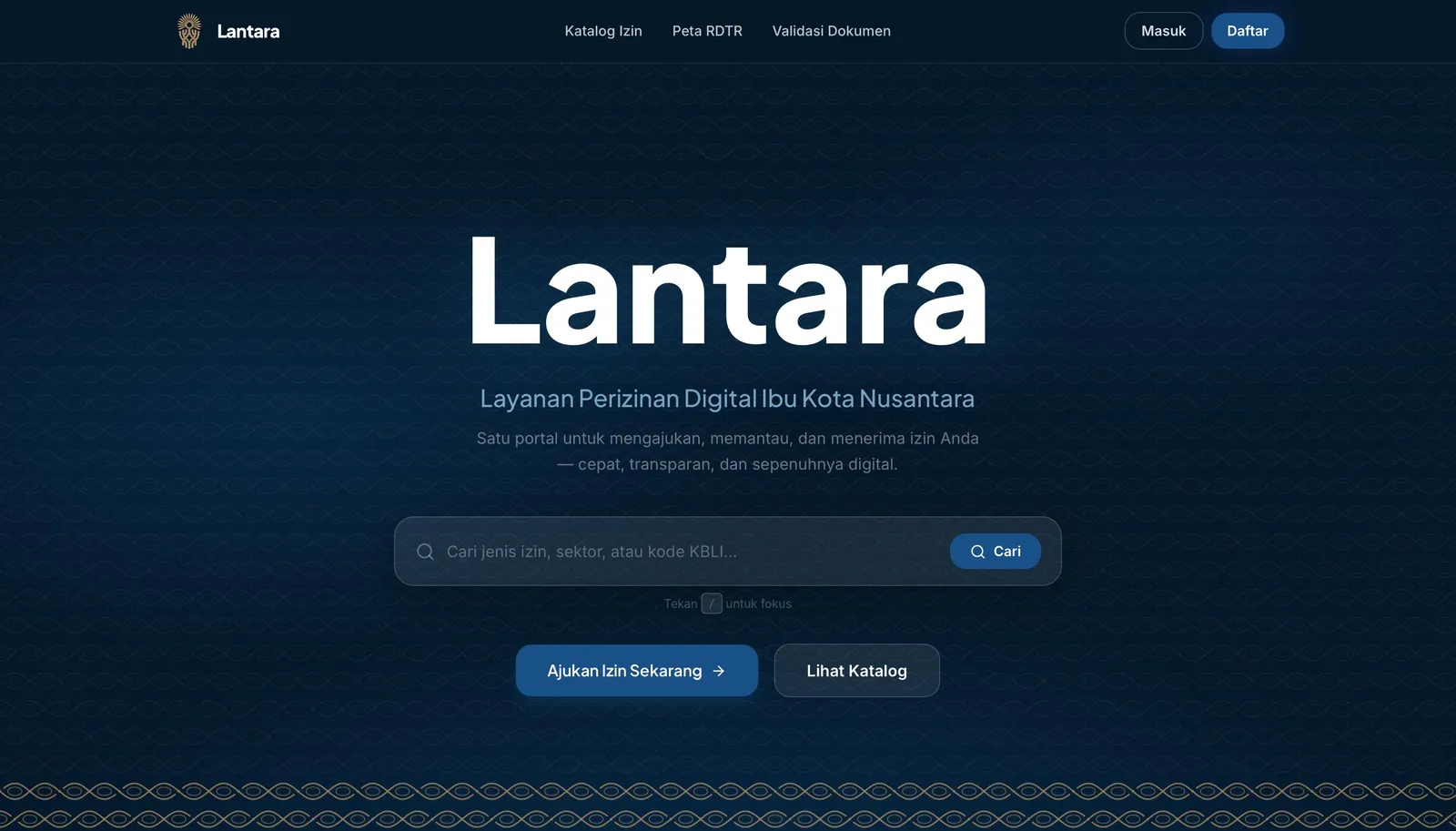

Lantara v2
Dynamic permit engine for IKN Nusantara — add a new permit type as configuration, not code
Fullstack Developer
Jun 2026
On this page
The problem
IKN Nusantara is Indonesia's purpose-built new capital, still under active construction. Its public services authority — Otorita IKN — must issue permits across 31 regulated sectors: social services, health, education, environment, and more. At most government agencies, each permit type has its own hardcoded workflow, form fields, and document requirements baked into the codebase. When a regulation changes — and in a new city, they change constantly — that means a developer, a migration, and a deployment.
The system serves three audiences at once: citizens and businesses applying for permits, government staff reviewing them, and agency administrators who define the rules. And those rules are set by law and ministerial decree, not by engineers. So the core requirement was blunt: a non-technical administrator must be able to define permit workflows, form schemas, and document checklists entirely through a UI — no developer, no deploy.
The approach
The engine — configuration over code
Instead of a table per permit type, all permit configuration lives in five related models: Sektor, PermitType, WorkflowStage, FormField, and DocumentRequirement. Adding a new permit type is a data-entry operation. An administrator can configure a six-stage health permit with twelve required documents and a custom form — no migration, no deploy, no pull request.
The form data on each submission is stored as a JSON field, validated at runtime against the live field schema. When an admin modifies a permit's schema, in-flight submissions are protected: at the moment of submission, the current schema version is snapshot-copied onto the submission record. A citizen who already applied never has their form shape change mid-review, and auditing stays deterministic — you always know exactly what was asked when someone applied.
RBAC without an enum
Staff permissions are generated strings like verifikasi_teknis:izin_posyandu, derived from workflow stage keys and permit type keys. There is no if role == "verifier" anywhere in the codebase. The DRF permission class checks the submission's current stage against the requesting user's assigned role strings. When a new permit type is added through the UI, the correct role slots are automatically available — no code change required.
SLA as a first-class concern
Every workflow stage carries an sla_hours field; every permit type has an sla_days total. A Celery Beat task sweeps submissions periodically, recomputes SLA deadlines using a working-days calendar that accounts for government holidays and weekends, and fires notifications when submissions are at-risk or breached. The verifier queue renders submission cards that visually age from amber to red as deadlines approach. Keyboard shortcuts (j/k to navigate, a/r/d for approve/revise/reject) let staff process without touching the mouse.
Accountable verification
Review is built to survive a real government office. A verifier can claim a submission to work it exclusively; stale claims auto-release after inactivity, and every claim and decision carries actor attribution, so two verifiers can never silently collide on the same file. Revisions are per-field: each flagged field carries its own note and deadline, and the applicant sees the original value beside a before→after diff instead of a single generic "please revise." And because some permits legally require sign-off from two different technical departments, verifier assignments are scoped per workflow stage — enforcing that no one verifier can approve both stages of their own review.
Two registers, one dynamic renderer
Public surfaces — the landing page, permit catalog, and public validation page — use an immersive royal-blue palette with an animated hero, scroll-reveal, and glassmorphism, appropriate for the digital front door of a national capital. Authenticated surfaces — the applicant portal, verifier workspace, and admin engine builder — are calm and dense; a verifier processing fifty permits a day needs clarity, not decoration. Both are fed by a single <DynamicForm> React component that fetches the permit's FormField[] schema from the API and builds a zod validation schema at runtime, handling twelve field types (text, NIK, NPWP, phone, geolocation, file upload, select, and more). Adding a permit type requires zero frontend code.
Beyond the brief — a physical queue system
Once the permit engine was demoable, a gap was obvious: it only models online, document-driven, days-long workflows. It has no concept of a citizen walking into a building and taking a numbered ticket — which is exactly what the Mal Pelayanan Publik (Public Service Mall) housing OIKN and partner agencies like BPJS and the tax office needs. So I scoped and shipped MPP Antrean, a full walk-in/online queue system, as a deliberately isolated bounded context: its own Django app, its own models, its own RBAC, and no foreign keys into the permit domain. It handles kiosk ticketing, QR check-in, counter-officer triage, and call/recall/serve flows, with live state pushed over the existing Django Channels WebSocket layer. A nice fairness detail: a citizen who reserved online but arrives late is demoted back into the walk-in pool by actual arrival time rather than having their ticket voided — which meant the online/walk-in quota split had to be enforced at reservation time, not at serving time.
Outcome
The original four build phases (P0 scaffold through P4 hardening) shipped, and development continued past the brief into a dedicated security-hardening pass, a broad accessibility sweep, and the standalone MPP Antrean module — 241 commits across roughly three weeks, spanning 13 Django apps and ~30,000 lines. The whole system is demo-able from a fresh docker compose up: migrations run, ~2,200 KBLI master records load, 46 sample permits across three sectors seed, demo queue tenants and counters seed, and a superadmin is created. Anyone can scan an issued permit's QR code at the public validation page to confirm its authenticity without logging in. RDTR spatial zoning and embedded digital signature (TTE) are fully wired behind feature flags, awaiting external data-sharing and agency partnerships before production activation. The repository is private; deployment targets Otorita IKN's own infrastructure.
- ~2,200
- 43
- 241
- ~30.5K
Have a project like this?
If you need a system built with the same care — clear scope, solid execution — let's talk.
Start a project