 AFM Studio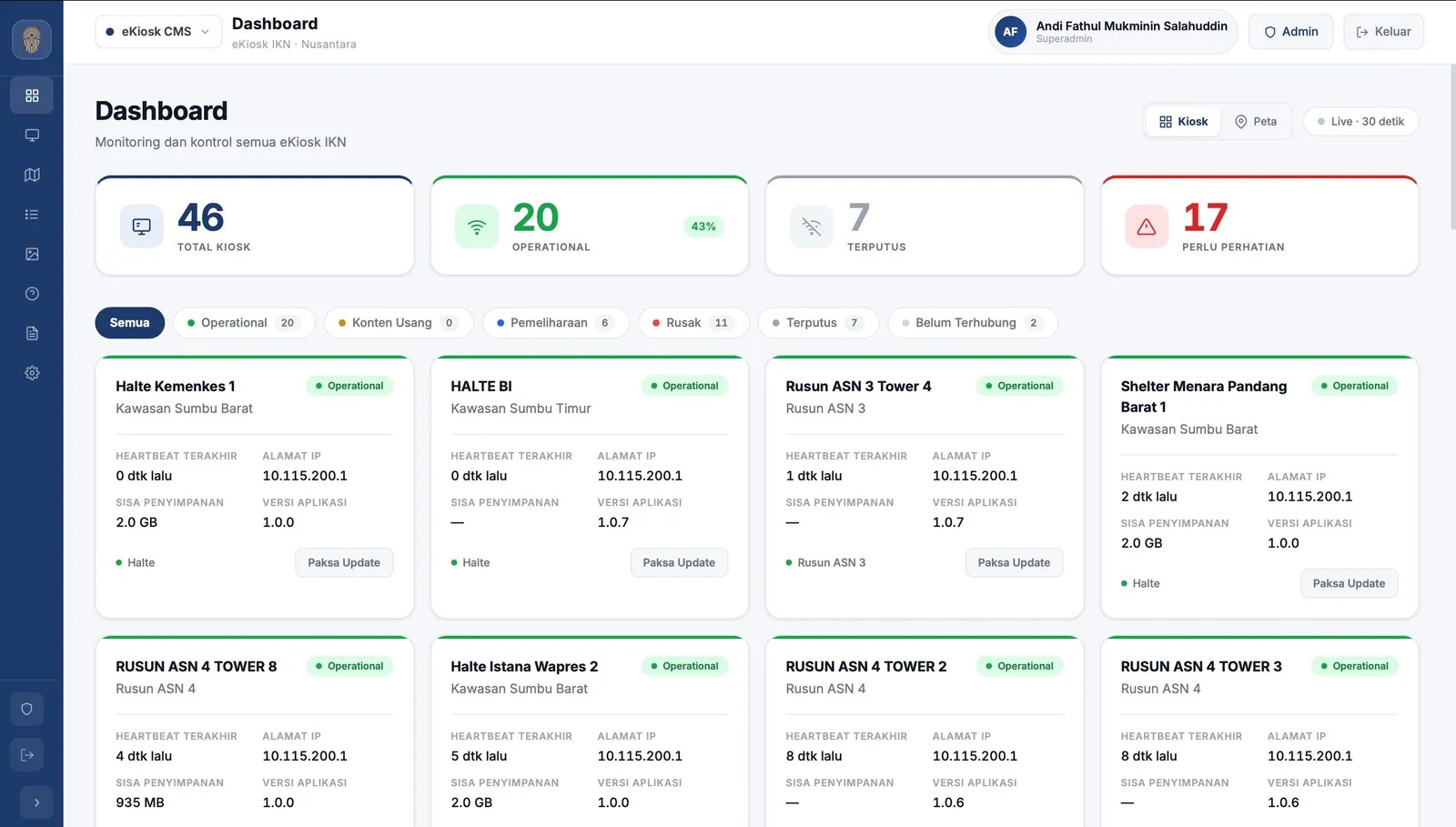

eKiosk IKN
Two web control rooms for Nusantara: digital kiosk content management and real-time BRT fleet tracking with predictive ETAs
Fullstack Developer
Mar – Jul 2026
On this page
The problem
IKN's smart city initiative deploys physical information kiosks in public areas across Nusantara, each running a custom Flutter app that displays government content — maps, announcements, transport schedules. Without a central management layer, updating what any kiosk shows requires touching each device individually, which doesn't scale as the fleet grows. Operators also had no visibility into whether a kiosk was running, had crashed, or had fallen out of sync.
Separately, IKN operates a BRT (bus rapid transit) fleet. A prior in-house Go service tracked bus GPS positions in memory, with no persistence, no historical analytics, and a race-condition-prone shared state — and no way to tell riders or operators when a bus would actually arrive.
Two operator groups depend on this system: non-technical content staff managing kiosk playlists and media, and transport/IT staff monitoring fleet health, GPS tracking, and ETA accuracy.
The approach
Heartbeat-driven kiosk status
Each physical kiosk pings the server every five minutes with its current state — playlist hash, GPS coordinates, free storage, free memory, app version. Status (OPERATIONAL / STALE / DISCONNECTED / MAINTENANCE) is computed live from that heartbeat on every API read rather than stored as a column, keeping the data model simple and always current. Content sync avoids diffing entirely: each playlist computes a deterministic SHA-256 hash of its ordered items on every save, and kiosks report the hash they last synced, so the server can tell instantly — in O(1) — whether a device is stale.
From one dashboard to two products
What began as a single dashboard with a "Fleet" tab has since split into two standalone single-page apps — eKiosk CMS and Fleet Management — each with its own layout and sidebar, reachable through a shared app launcher and a cross-app switcher embedded in both topbars. Fleet Management is additionally gated behind a staff role. All of it runs on a hand-rolled design system (a token file plus inline CSS objects, no component library) rather than Tailwind, kept deliberately consistent across both apps.
Real-time GPS tracking and a statistical ETA engine
A long-running poller (poll_gps_data) hits a live GPS vendor API every ~5 seconds per vehicle, matches each position to a route graph, and buffers movement into a track-history table — its own Docker service alongside the main API. The route graph itself is a small hand-rolled directed graph, built deliberately without networkx or any data-science library, to keep the image slim.
ETA isn't a fixed-speed guess: it projects the vehicle's live GPS fix onto the polyline segment it's currently traveling, then walks forward through the route's stops using learned historical travel times — median seconds per (route, from-stop, to-stop, hour-of-day, weekday/weekend) bucket, computed nightly from trip-split GPS history with outlier trimming. Where there isn't enough learned data yet, the estimate falls back through scheduled-timetable deltas, then haversine distance over an assumed speed, then a stop-count heuristic — so it degrades gracefully instead of failing.
Measuring the ETA engine against itself
The system doesn't just predict — it grades its own predictions. The poller periodically samples its ETA output into a log, then closes each prediction out the instant the bus actually crosses the target stop's geofence, recording the signed error. That feeds a dedicated accuracy report: mean absolute error, percentage within 1/2/3 minutes, broken down by hour and by stop — so it's possible to see exactly where the model is weakest, not just that it exists.
Self-correcting route detection, without oscillation
Buses sometimes get manually reassigned or drift from their scheduled route. A separate service continuously scores each vehicle's recent GPS trail against every route's polyline and proposes a correction when the best match is both close enough and clearly better than the runner-up. An early version — "N consecutive ticks near route X" — caused oscillation at stops shared between overlapping routes. The fix adds a spatial confirmation gate on top of the scoring: a correction only commits once the bus visits a stop unique to the new route, or at least 80% of its named stops. Every correction is journaled for audit.
Auth split by audience
Dashboard operators authenticate through IKN's Keycloak SSO, which issues a JWT the frontend stores in Zustand; user fields (NIP, jabatan, direktorat) sync from Keycloak claims on every login. Flutter kiosks never touch that layer at all — they use a separate AllowAny registration flow, since a kiosk phoning home from a factory-assigned UUID has no user to authenticate as.
Outcome
Both apps run in production, containerized via Docker Compose with GitHub Actions publishing images to GHCR. The backend has grown to 113 commits, 66 of them in the transport module alone — the busiest and most recent stretch of work covered the ETA-accuracy feedback loop, point-of-interest journey planning, and rewriting the daily fleet-analytics query from a Python loop into a single PostgreSQL query with window functions, after the original implementation started timing out gunicorn workers under load. The whole ETA and analytics layer — geometry, statistics, graph structure — runs on the Python standard library and raw SQL, with zero new heavyweight dependencies (no pandas, numpy, geopy, shapely, networkx, Celery, or Redis) added to support it.
- 2
- 0
- ~24.7K
- 246
Have a project like this?
If you need a system built with the same care — clear scope, solid execution — let's talk.
Start a project