 AFM Studio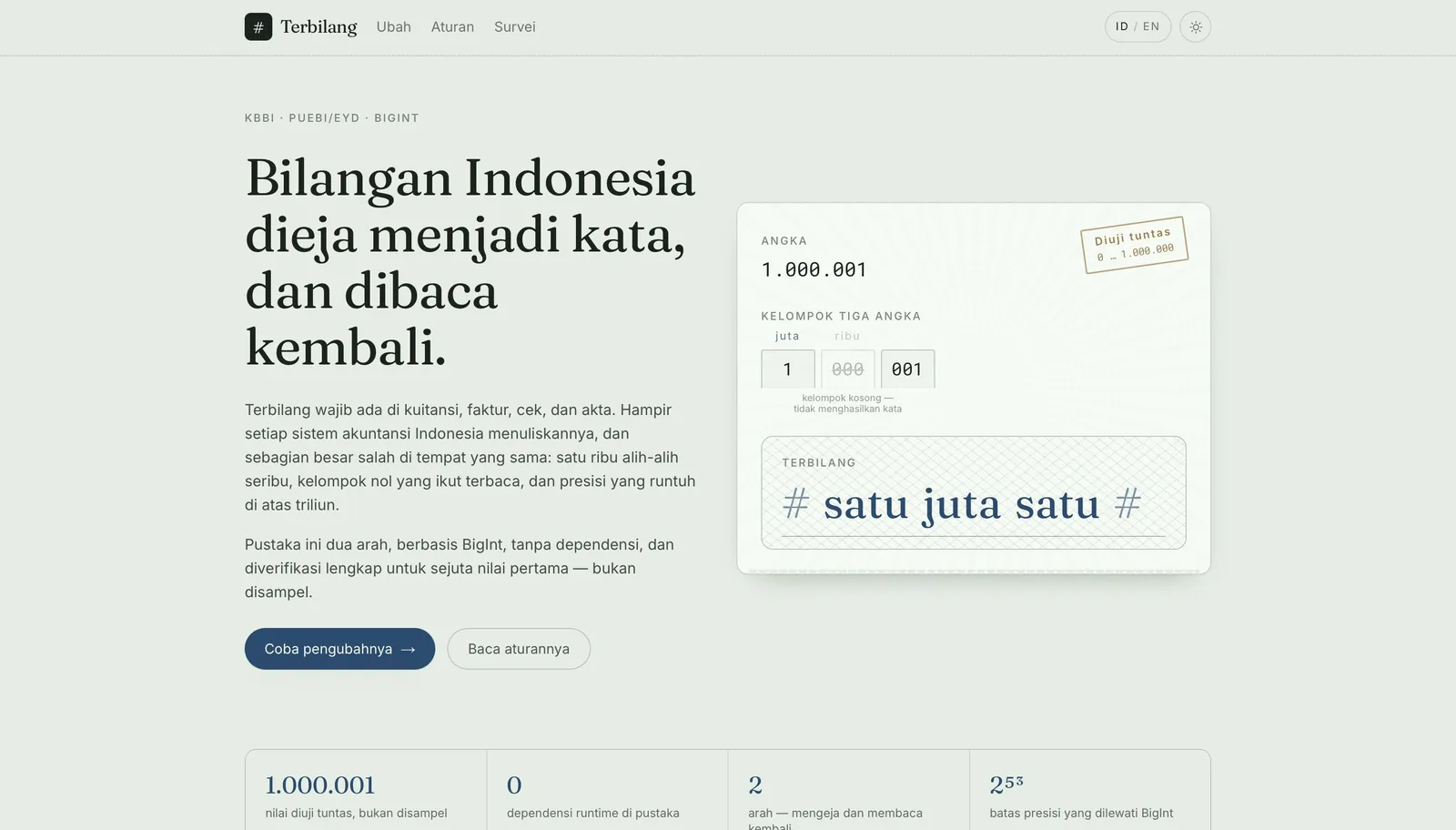

Terbilang
Turns Indonesian numbers into the words required on invoices and cheques — 1.500 becomes seribu lima ratus — and reads them back, correctly, at any size an accounting system can throw at it
Solo Developer
Aug 2026
On this page
The problem
Indonesian commercial documents legally and conventionally carry the amount twice: once in digits, once spelled out in words (terbilang). Every accounting, payroll, and invoicing system in the country needs this function, so almost every one writes its own — and a large share get it wrong in ways that reach printed paper:
- Spelling irregularities. Indonesian fuses
se-onto a leading 1 for sepuluh, sebelas, seratus, seribu — but standard usage takessatu juta, not sejuta. The rule looks uniform and isn't. Naive implementations emitsatu ribu. - Empty-group leakage.
1.000.001is satu juta satu, never satu juta nol ribu satu. A group of000must emit nothing at all — the single most common structural bug in the ecosystem. - Silent float corruption. JavaScript loses integer precision above 2⁵³ ≈ 9×10¹⁵. A
number-based implementation is correct all the way through triliun and silently wrong immediately after — so it passes casual testing and then corrupts a real invoice.
The approach
A library first; the site only demonstrates it
Nothing in the package knows a browser exists — no React, no DOM, no Intl, no Date. It behaves identically in Node and the browser, and the site imports it rather than reimplementing anything. The published library has zero runtime dependencies, a hard constraint rather than an outcome, verified by a build that keeps the type declarations free of DOM and framework types.
BigInt end to end, number nowhere
The API accepts a bigint or a digit string and never a number — passing one is a typed refusal, not a coercion. There's no parseInt, no Number(), no number arithmetic anywhere in the value path. This is the whole reason the project exists, and it's asserted by a permanent test suite above 2⁵³, not verified once by hand.
Refuse rather than guess
Out-of-range magnitude, non-integer input, unparseable words, and contradictory options all return a structured discriminated-union error naming exactly what failed — never a best-effort string, never a partial result, never a silent clamp. Scale words stop at kuadriliun (10¹⁵), because KBBI carries the lemma; anything at 10¹⁸ or above is rejected, because usage there is genuinely unsettled and the library won't extrapolate the pattern. A wrong-but-plausible amount on a document is worse than no amount.
Exhaustive verification, not sampling
The domain is bounded and the function is pure, so it can be verified completely. All 1,000,001 values from 0 to 1,000,000 are formatted, structurally checked, parsed back, and compared to the original — every commit, in about five seconds — not sampled, not skipped, not marked slow. It gates CI. Having a parser is also what makes this round-trip test possible: format and parse are exact inverses under identical options, and that invariant is what the exhaustive sweep actually proves. Parsing is the harder direction — dua ratus lima puluh ribu is (2×100 + 5×10) × 1000, not 200 + 50000.
Outcome
A dual ESM/CJS library (built, ready to publish, zero runtime deps) plus a public bilingual site that demonstrates it, offline-capable with a before-first-paint day/night theme. The converter draws each three-digit group as a labelled bracket above the digits — juta, ribu — as you type, and empty groups visibly collapse to nothing, which shows the ecosystem's most common bug not happening. It ships a cheque/kwitansi document mode (# seribu lima ratus rupiah #), five cited variant options each documenting the usage behind both choices, six typed refusals surfaced in a reserved treatment, and an implementation-survey page that ships empty by design — nothing is claimed about a package that wasn't actually measured.
Built solo in one ~7-hour sitting — ~4,370 lines of TypeScript, a deliberately small public API (2 functions, 8 types, 4 constants), zero runtime dependencies, and 1,000,001 exhaustive assertions per run. The reverse direction and the exhaustive proof are what most implementations in this space don't have; the rigour is in the verification, not the hours.
- 1,000,001
- 0
- BigInt
- 6
Have a project like this?
If you need a system built with the same care — clear scope, solid execution — let's talk.
Start a project