 AFM Studio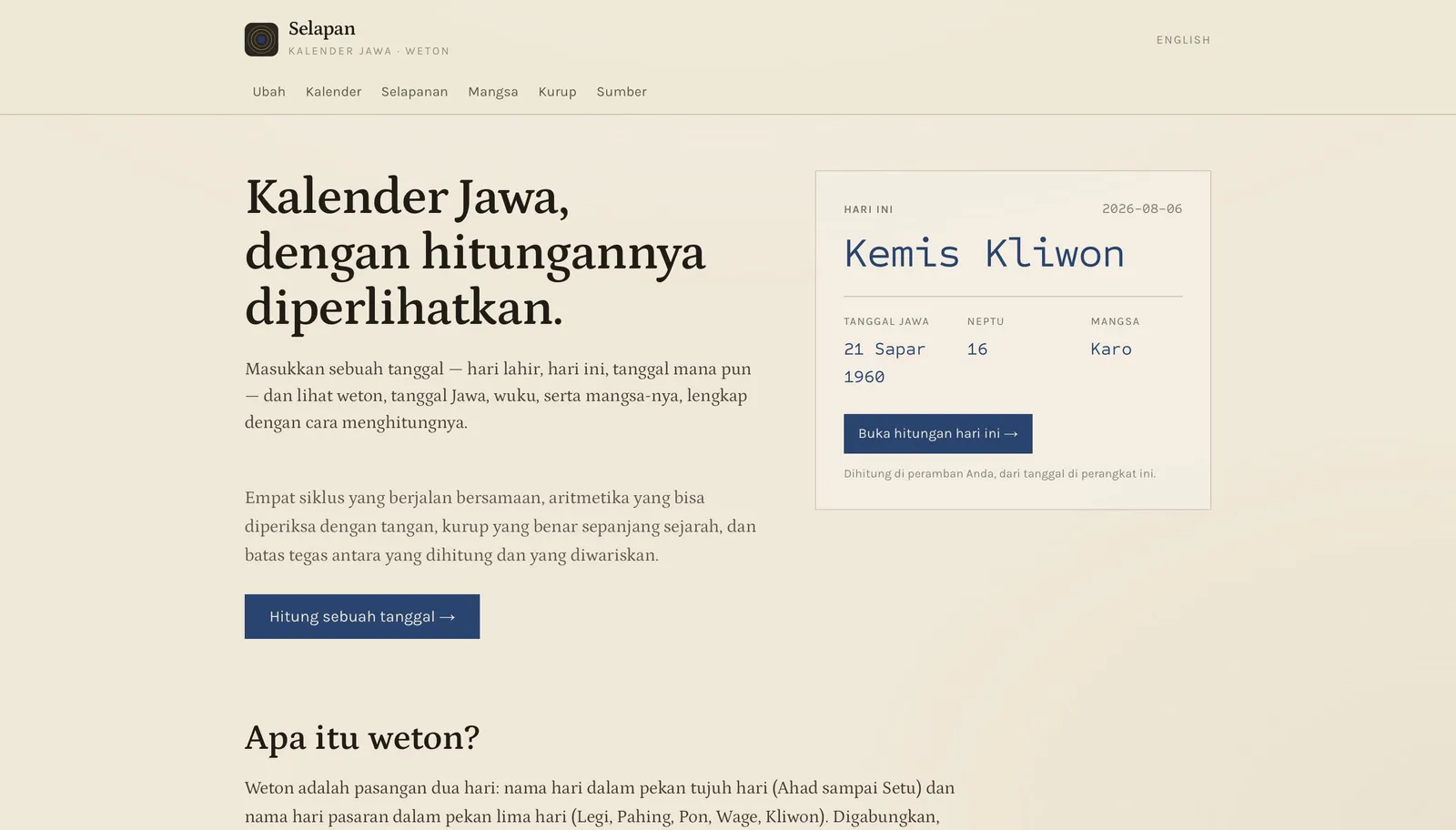

Selapan
A Javanese calendar that converts any date into its traditional reckoning — and, unlike every other site that does this, shows the arithmetic behind each number and cites where the reference points came from
Solo Developer
Aug 2026
On this page
The problem
Weton — a person's Javanese birthday-cycle, used across Java for naming ceremonies, weddings, and the mourning calendar — looks like a table lookup but is actually four overlapping cycles: the 5-day pasaran, the 7-day week, the 210-day wuku, and a lunar year that begins in 1633 CE, plus a historical correction system called the kurup that shifts every 120 years.
Existing weton sites are ad-supported, cite nothing, show no method, and disagree with each other. Three failure modes were the actual design targets: they hardcode the current kurup, so any historical date is wrong; they happily convert dates before 1633 CE, where the lunar system didn't exist; and they show no working, so a wrong answer is undetectable by the reader. There's a fourth, socially real gap: some communities reckon by the older Aboge rule rather than Asapon — which is why Aboge villages sometimes observe Idul Fitri a day after the national determination — and no site surfaces that divergence; they simply contradict those users.
There's also an ethical problem the project treats as a first-class requirement. Weton feeds primbon — character readings, marriage compatibility, auspicious days — which many take seriously and many others reject. The response is a hard separation between computed and interpreted, enforced in the type system, the data schema, the build validator, and the colour palette.
The approach
Julian Day Number as the only internal representation
Every date becomes an integer day count at the UI boundary; everything downstream is integer arithmetic. There's no Date object anywhere in the engine — no timezones, no DST, no locale, no clock ("today" is resolved in the UI and passed in as a parameter). No date library, on purpose: date-fns, Luxon, and Temporal all carry timezone semantics that are actively wrong for a cycle-modulo calendar. The dependency list is four packages.
Every cycle is a modulo against a cited anchor
Anchors live in JSON with a source, a locator, and a verification date — no epoch is ever hardcoded in a .ts file. The build fails on an uncited or self-inconsistent anchor: the validator recomputes each anchor's JDN from its stated Gregorian date and rejects mismatches. Validity ranges are per-subsystem, not global — a request for 1500 CE returns a structured refusal for the lunar subsystem and valid pasaran and wuku values, because those cycles are genuinely continuous. Refusals are typed objects, never a thrown string, a silent null, or a nearest-match fudge.
The trace is the product
The engine's signature is (jdn, options) → CalendarTrace, and every value in that trace carries a Derivation — anchor id, anchor JDN, offset, modulus, result, source, and a verified/unverified status. Every expandable figure in the UI is rendered from that structure, so a value without a derivation cannot be displayed — the UI can't drift from the arithmetic. Colour carries the ethical line: indigo renders computed values only, rubric red renders traditional/primbon material only, grey marks out-of-range and unverified — mirroring the rubrication of printed primbon almanacs, so a reader learns the distinction in seconds without being lectured.
Honesty as a build artifact
Where a datum is inferred rather than transcribed — the kurup Ajumgi span, a 1987 transition projection, the wuku epoch (which rests on a single source, where a phase error of a whole wuku would pass every period test) — it's marked unverified in the data, rendered grey, and listed on a public sources-and-gaps page. The validator rejects a verified claim that names no independent cross-check. And the whole interpretive primbon layer is deliberately withheld: its schema and validator already run (citation required, attribution must begin "Menurut", any second-person phrasing or scoring rejected at build time), but it won't ship without a named reviewer familiar with Javanese practice.
Outcome
Live and public, bilingual (Indonesian default), fully static. It ships a conversion with an expandable trace (every figure opens to anchor → offset → modulus → result → citation, so any answer can be redone by hand from the screen); the Aboge/Asapon divergence view — the same date reckoned both ways with the mechanism beside it, the feature nothing else on the internet has; animated concentric cycle wheels that visibly realign at 35 days (selapan) and 210; a wall-calendar month grid; selapanan/slametan reckoning presented as plain, cited date arithmetic with no interpretation attached (it serves people during bereavement); pranata mangsa; and a sources-and-gaps page that publishes what's still unverified rather than hiding it.
Built solo in a single day — ~6,300 lines of source, 126 tests (the longest an invariant over 36,524 consecutive days), four production dependencies and no date library. Framed as a personal project, not an authority, with regional variation acknowledged and the incomplete parts surfaced in the UI.
- 4
- 126
- 1633
- 0
Have a project like this?
If you need a system built with the same care — clear scope, solid execution — let's talk.
Start a project