
Diterawang — held to light
Watermark & electrotype
An image in the substrate itself, visible when the note is held up to the light.
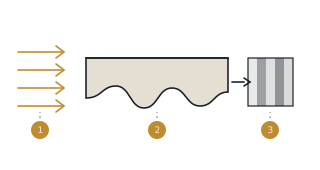
The substrate is not of even thickness. Thinner areas pass more light and thicker areas hold it back, and that difference in brightness is the image.
- Light arrives from behind the sheet. This is why the check is diterawang and not dilihat.
- The material is thicker in some places and thinner in others, in a pattern that forms the image.
- The eye receives light of differing brightness according to the thickness it passed through. The image is not printed; it is the material.
What to observe
- Hold the note up to the light. The hero portrait appears from either side of the sheet, not just one.
- On the Rp100,000, Rp50,000, Rp20,000, and Rp10,000 notes there is an electrotype — the BI logo and certain ornaments — which likewise appears only when held to the light.
- The image sits within the material rather than on its surface. Rubbing moves nothing and removes nothing.
This page explains how to check a feature, not how one is produced. Nor does this site say whether any note is genuine — that authority rests with Bank Indonesia.
Light table
Move the light source behind the sheet. Brightness follows thickness: the more material the light crossed, the less of it reaches your eye.
Light transmitted at this point: ≈69%
The shape here is deliberately abstract — a lens and an ornament ring — not a portrait and not the watermark of any note. What is demonstrated is the relationship: brightness follows thickness.
Sources
- Bank Indonesia — Gambar Uang — Rp100.000 Tahun Emisi 2016, Unsur Pengaman ↗open source: Gambar Uang — Rp100.000 Tahun Emisi 2016
- Artech House — R. L. van Renesse, Optical Document Security, 3rd edition (2005), Ch. 3, Watermarks