Diving
Jumping from a springboard or a high platform, turning in the air, and entering the water cleanly, with judges marking every dive.
- Official
- Aquatics
- Game category
- Performance
- Adjudication
- Judged
- Standing
- Never off
- platform height
- 10 m
- judges for one dive
- 7
- each judge's mark
- 0–10
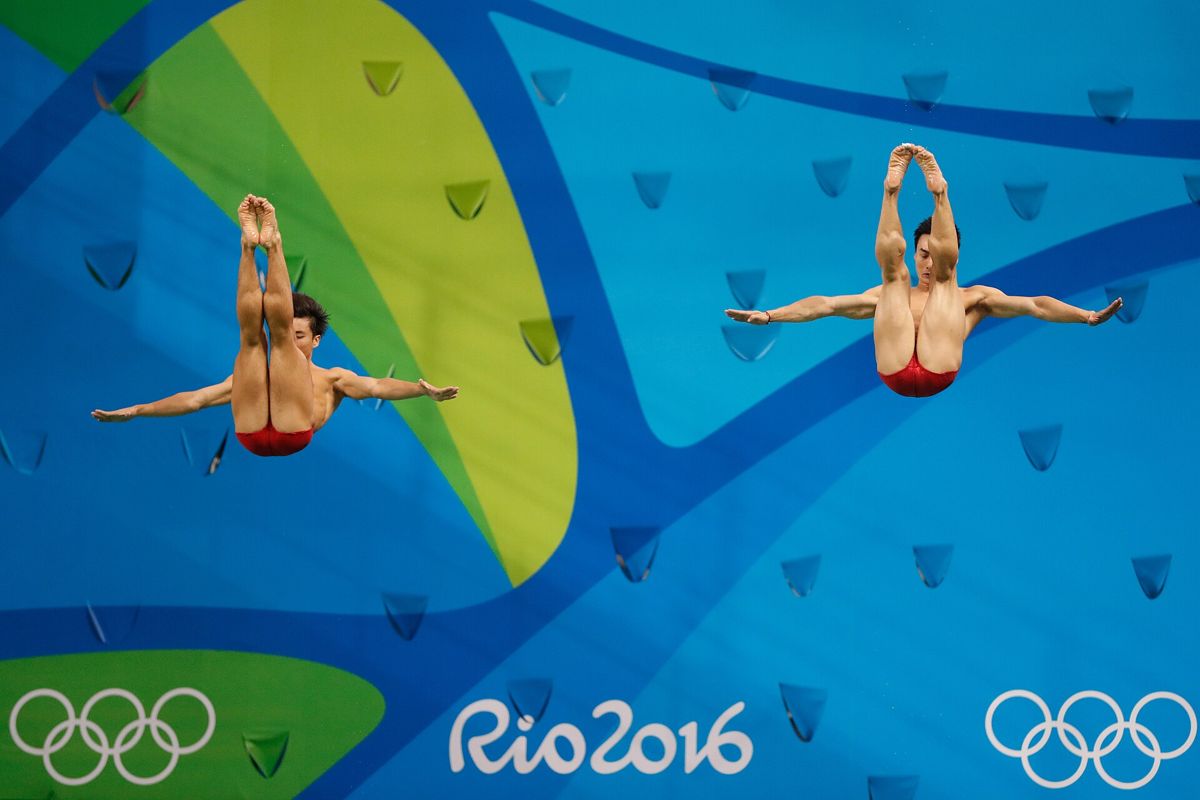
Two divers in matching pike positions side by side against a blue and green backdrop · Fernando Frazão / Agência Brasil · CC BY 2.0
- Governing body
- World Aquatics
- Founded
- Fancy diving grew out of gymnastic water landings in nineteenth-century Germany and Sweden; Olympic since 1904 and governed by FINA from 1908, renamed World Aquatics in 2023.
- Olympic status
- 29 editions
- on the 2028 programme
- Also contested at
- No other programme here
A diver leaves a springboard at one or three metres, or a fixed platform at ten, performs somersaults and twists in the air, and enters the water. Every dive is chosen and declared before the competition. Its difficulty is a published number, worked out by formula. Seven judges mark how well the dive was done, from 0 to 10. The two highest and two lowest marks are thrown away, the middle three are added, and the sum is multiplied by the difficulty. So what a diver attempts is fixed in advance, and only the quality of the dive is judged. The highest total over five or six dives wins.
The gamewhat it is now · sections 1 to 6
01How it is played
Leave a springboard or platform, perform a declared dive, and enter the water. Each dive is scored by a panel and multiplied by its degree of difficulty, so the sport separates what was attempted from how well it was done — the distinction gymnastics took until 2006 to make.
One dive, from the board to the score
This follows a single dive in an individual event, marked by seven judges as at the Games.
The list
Before the competition each diver chooses dives from the published list and declares them. Every dive on a diver's list must be different.
What the dive is worth
Each dive has a number and a letter, which give its group, its somersaults and twists, and its body position. Its degree of difficulty is worked out from published values. The judges do not decide it.
The take-off
The diver goes from a springboard at 1 or 3 metres, or from the 10-metre platform. A diver who stops after starting the approach is given a restart and loses two points from every judge's mark. A second failed attempt, or a double bounce on the end of the springboard, is a failed dive.
The flight and the entry
The diver must perform the dive that was announced. A dive of a different number, a twist that is off by ninety degrees or more, or a head-first dive in which the feet enter first, is a failed dive and scores zero. A dive clearly done in the wrong position can earn at most two points from each judge.
The marks
Each of the seven judges gives a mark from 0 to 10, in half points. The two highest and the two lowest marks are cancelled.
The score
The middle three marks are added and multiplied by the degree of difficulty. Three marks of 7.5 make 22.5, and on a dive of difficulty 2.0 that scores 45.0.
Winning
In a final, men make six dives and women five. The diver with the highest total for the final wins. Scores from the earlier rounds are not carried forward.
That is the game. What follows is the same game clause by clause, with the measurements.
The object of the competition
Score the highest total over a fixed number of dives. Men dive six times in a final and women five, each a different dive, chosen in advance from the published list and declared before the competition.
- Men's final
- 6 dives
- Women's final
- 5 dives
- Repeats
- No dive number twice
World Aquatics Competition Regulations, Part Four — Diving Rules (November 2024) · Part Four, 3.1–3.3
Boards and water
Springboards at one and three metres, a fixed platform at ten. The water under each board must be deep enough to stop a diver entering at speed, and the deeper the board the deeper the pool.
- Springboards
- 1 m and 3 m, at least 4.8 m long
- Platform
- 10 m
- Depth under 3 m board
- 3.70 m minimum
- Depth under 10 m platform
- 4.50 m minimum
The playing area
The boards and the water, from the side
- water, deeper under the higher board
- the boards a diver leaves from
Not to scale. The platform is 10 metres above the water. The springboards are at 3 metres and 1 metre, and each is at least 4.8 metres long. The water must be deep enough to stop a diver who enters at speed: at least 4.5 metres under the platform and 3.7 metres under the 3-metre board. Heights and depths are shown in proportion. Widths are not.
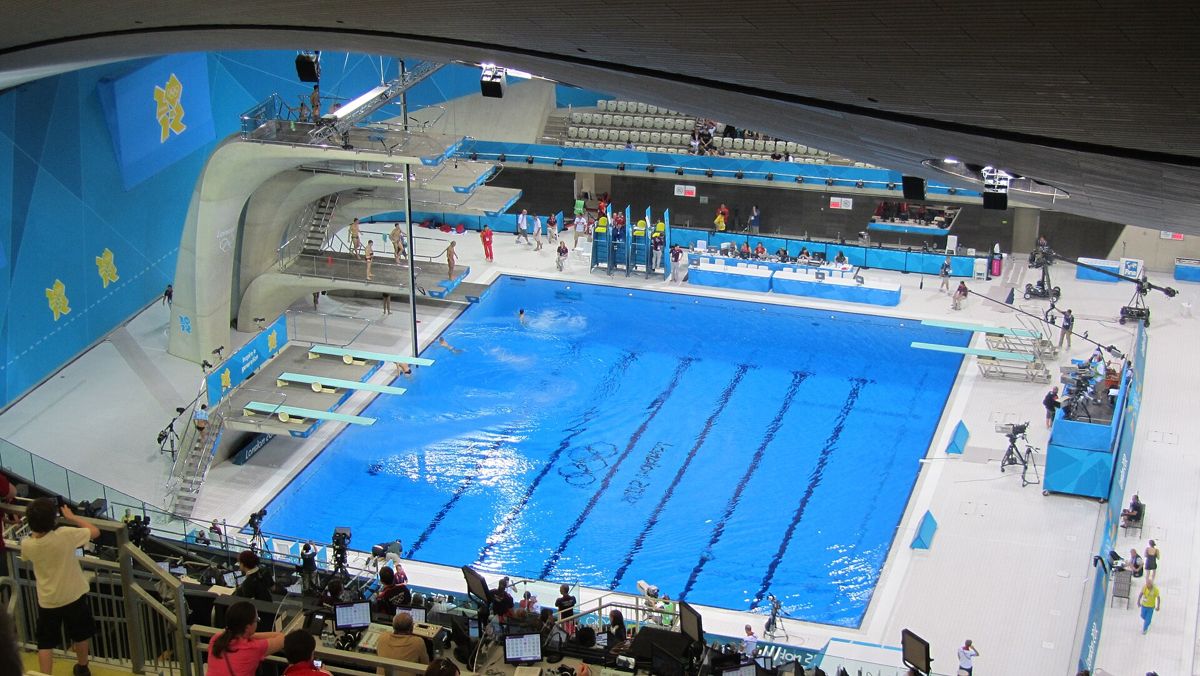
An aquatic centre seen from above, with the diving tower and springboards at one end of a pool
The London 2012 aquatics centre: springboards, the platform tower, and the deep diving pool in front of them.
David Jones · CC BY 2.0 · Wikimedia Commons
World Aquatics Competition Regulations, Part Four — Diving Rules (November 2024) · FR 5.1.1, FR 5.3 table
Dives and difficulty
Every dive has a number and a letter. The number gives the group and the somersaults and twists; the letter gives the body position. Its degree of difficulty is not judged but computed, by adding published values for the somersaults, the position, the twists, the approach and the entry. A forward three and a half somersaults in pike from three metres is 107B and carries a difficulty of 3.1.
- Groups
- Forward, back, reverse, inward, twisting, armstand
- Positions
- A straight, B pike, C tuck, D free
- Difficulty
- Sum of five published components
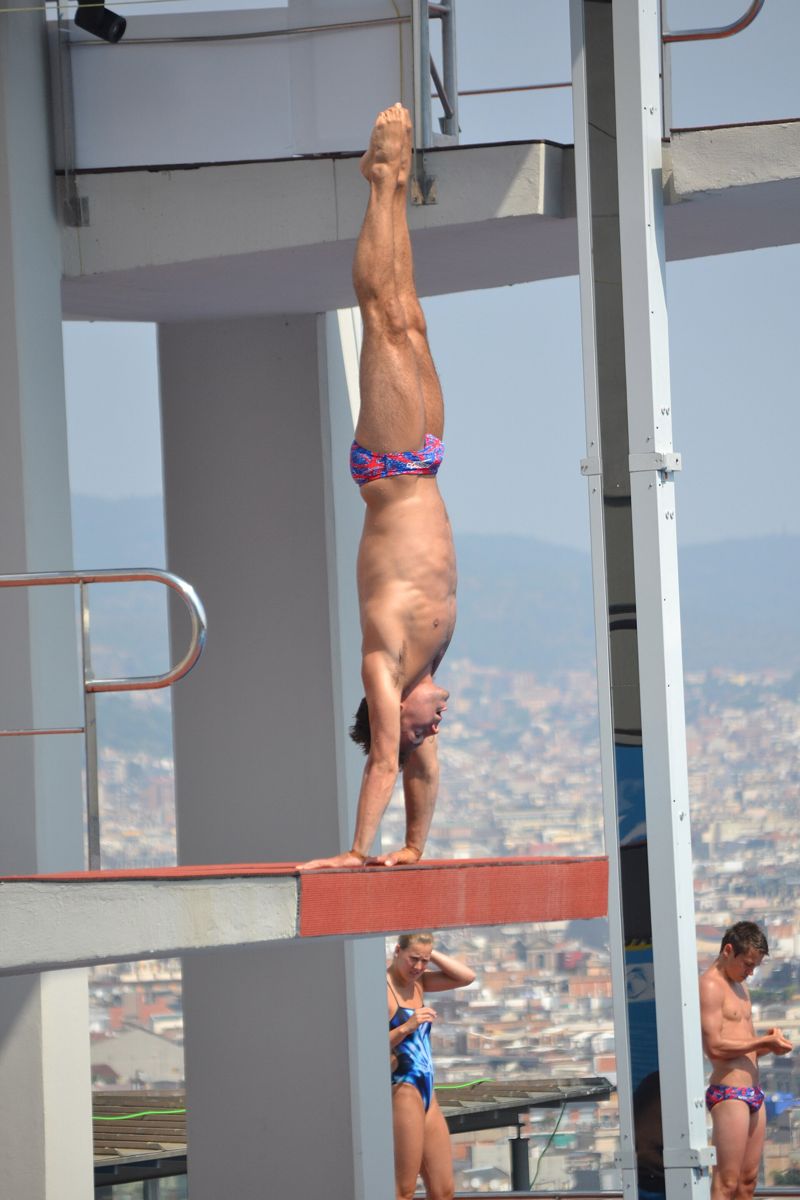
A diver balanced in a handstand on the edge of a platform
An armstand start on the platform at the 2013 world championships in Barcelona — group 6 of the six dive groups.
Xavier Vergés · CC BY 2.0 · Wikimedia Commons
World Aquatics Competition Regulations, Part Four — Diving Rules (November 2024) · Appendices 8–9
Divers and judges
Individual events, and synchronised pairs who dive side by side. At the Games seven judges mark an individual dive and eleven a synchronised one — five for synchronisation, three for each diver's execution. Divers must be fourteen in the year of competition.
- Individual panel
- 7 judges
- Synchronised panel
- 11 judges
- Minimum age
- 14 by 31 December
This clause reads this way because of
World Aquatics Competition Regulations, Part Four — Diving Rules (November 2024) · Part Four, 1.4, 5.2.1
Rounds
A preliminary round, a semi-final and a final for individual events, each starting from zero, so a lead does not carry forward. Synchronised events go straight to a final. At the Games eighteen divers reach the semi-final and twelve the final.
World Aquatics Competition Regulations, Part Four — Diving Rules (November 2024) · Part Four, 2.3.1–2.3.3, 2.4.1
Scoring a dive
Each judge awards a mark from 0 to 10 in half points. With seven judges, the two highest and two lowest marks are cancelled and the middle three are added, then multiplied by the degree of difficulty. Seven marks of 8.0, 7.5, 7.5, 7.5, 7.5, 7.5 and 7.0 on a dive of difficulty 2.0 score 22.5 × 2.0 = 45.0.
- Judge's scale
- 0–10, in halves
- Marks counted
- Middle 3 of 7
- Score
- Sum × difficulty
World Aquatics Competition Regulations, Part Four — Diving Rules (November 2024) · Part Four, 5.1.4, 7.5, 7.8
The take-off and the restart
A diver who stops after starting the approach, or stops pressing the board once the legs have begun to, is given a restart and loses two points from every judge's mark. A second unsuccessful attempt is a failed dive. So is a double bounce on the end of the springboard.
- Restart
- −2 from each judge's mark
- Second restart
- Failed dive
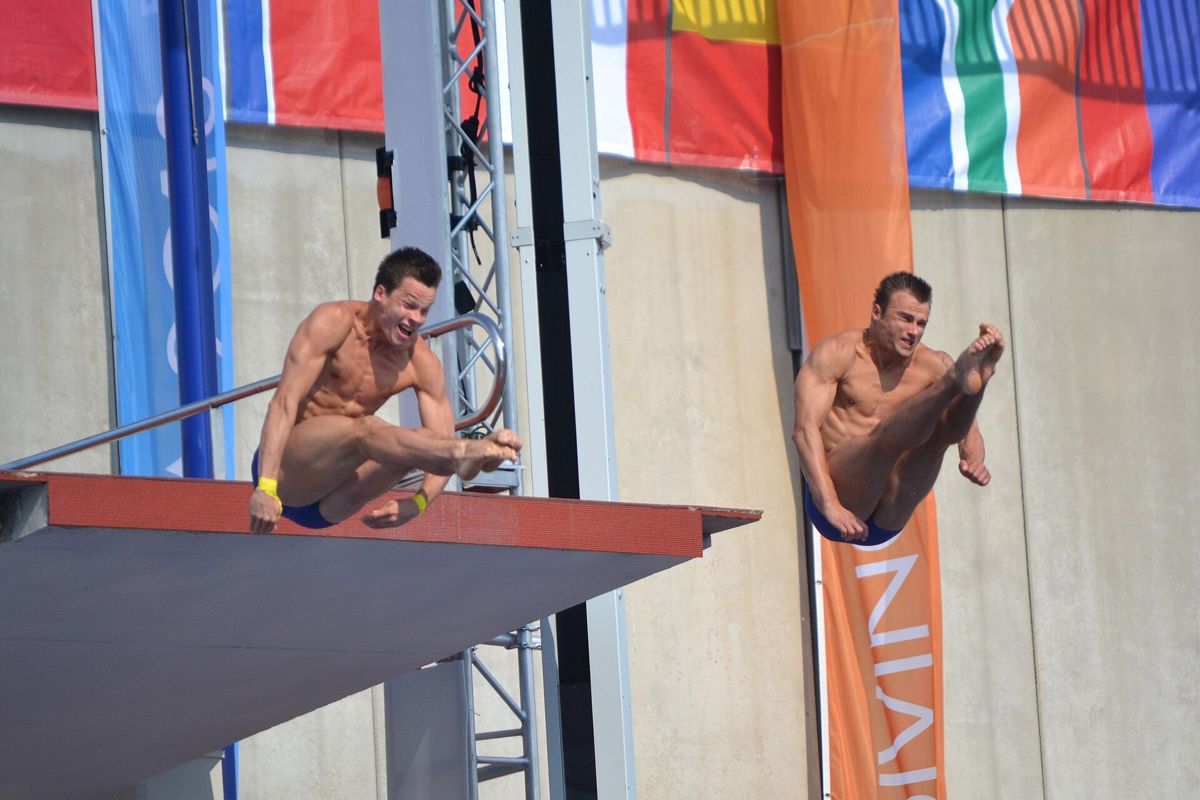
Two divers on the edge of a high platform crouched for the take-off
Platform divers at the take-off at the 2013 world championships at Montjuïc, Barcelona.
Xavier Vergés · CC BY 2.0 · Wikimedia Commons
World Aquatics Competition Regulations, Part Four — Diving Rules (November 2024) · Part Four, 6.5.1–6.5.4
Failed dives and capped marks
The referee declares a failed dive, scoring zero, for a dive of a different number from the one announced, a twist off by ninety degrees or more, or a head-first dive in which the feet enter first. A dive clearly performed in the wrong position is capped at two points per judge; arms in the wrong place on entry cap it at four and a half.
- Wrong dive
- Failed — zero
- Wrong position
- Capped at 2 points
- Arms wrong on entry
- Capped at 4½ points
World Aquatics Competition Regulations, Part Four — Diving Rules (November 2024) · Part Four, 6.4.12–6.4.13, 6.5.7–6.5.9
Deciding the winner
The highest total of the dives in the final. Totals from the preliminary and semi-final are not carried forward.
World Aquatics Competition Regulations, Part Four — Diving Rules (November 2024) · Part Four, 2.3.3
Everything above is current law. Everything below is how Diving got here.
02Disciplines and events
Eight Olympic events since 2000, unchanged for 2028; the world championships add the one-metre board, mixed events and high diving.
- Disciplines
- 3
- Olympic medal events
- 8
- Men’s and women’s counted separately.
- Contested elsewhere
- 4
- asian games, world championship.
- Listed for context
- 1
- Not counted as this sport.
Individual6
- 3 m springboard
- 10 m platform
- 1 m springboardWorld championshipAsian Games
Synchronised4
- Synchronised 3 m springboardAdded to the Games in 2000.
- Synchronised 10 m platformAdded to the Games in 2000.
Mixed events3
- Mixed synchronised 3 m and 10 mWorld championshipOn the world championship programme since 2015, not at the Games.
- Mixed team eventWorld championship
High diving1
- High diving — 27 m men, 20 m womenWorld championshipAdded to the world championships in 2013.
Two divers in matching pike positions side by side against a blue and green backdrop
Cao Yuan and Qin Kai of China in the synchronised 3 m springboard at Rio 2016: two divers, two boards, one score.
Fernando Frazão / Agência Brasil · CC BY 2.0 · Wikimedia Commons
03The words of the game
- Armstand
- A dive that starts from a handstand on the edge of the platform.
- In the laws: Dives and difficulty
- Degree of difficulty
- The published value of a dive, worked out by adding figures for its somersaults, position, twists, approach and entry. The judges' marks are multiplied by it.
- In the laws: Dives and difficulty
- Dive number
- The code that names a dive. The number gives its group, somersaults and twists, and the letter gives the body position.
- In the laws: Dives and difficulty
- Entry
- The moment the diver goes into the water, head first or feet first as the dive requires. It is the last thing the judges see.
- In the laws: Failed dives and capped marks
- Failed dive
- A dive that scores zero, declared by the referee. Examples are a dive different from the one announced and a second unsuccessful take-off.
- In the laws: Failed dives and capped marks
- Fulcrum
- The movable support under a springboard. Moving it forward makes the board stiffer, and moving it back gives more lift.
- Group
- One of the six families of dive: forward, back, reverse, inward, twisting and armstand.
- In the laws: Dives and difficulty
- Platform
- A fixed, rigid stage 10 metres above the water. It gives no spring, so the diver's height comes only from the jump.
- In the laws: Boards and water
- Position
- The shape of the body during the dive. There are four: straight, pike, tuck and free.
- In the laws: Dives and difficulty
- Restart
- A second try at the take-off, given to a diver who stopped after starting. It costs two points from every judge's mark.
- In the laws: The take-off and the restart
- Somersault
- A full turn of the body, head over feet. Dives are counted in half somersaults.
- In the laws: Dives and difficulty
- Springboard
- A flexible board, at least 4.8 metres long, set 1 metre or 3 metres above the water. The diver bounces on its end to gain height.
- In the laws: Boards and water
- Synchronised diving
- An event in which two divers perform side by side at the same moment. Some judges mark each diver and others mark how well the two match.
- In the laws: Divers and judges
- Tuck
- A body position rolled into a ball, with the knees bent and drawn up to the chest.
- In the laws: Dives and difficulty
- Twist
- A turn of the body around its own length, from head to feet. A twist that finishes ninety degrees or more off makes the dive a failed dive.
- In the laws: Failed dives and capped marks
04Referee and judges
A referee runs the competition and the judges mark each dive. The referee decides matters of fact: whether the dive was the one announced, whether a restart is due, whether the feet entered first. The referee can declare a failed dive, or cap the marks before the judges show them.
The judges award from 0 to 10 in half points. They mark their overall impression of the approach, the take-off, the flight and the entry. At the Games there are seven. The two highest and two lowest marks are cancelled. The remaining three are added, and the sum is multiplied by the degree of difficulty.
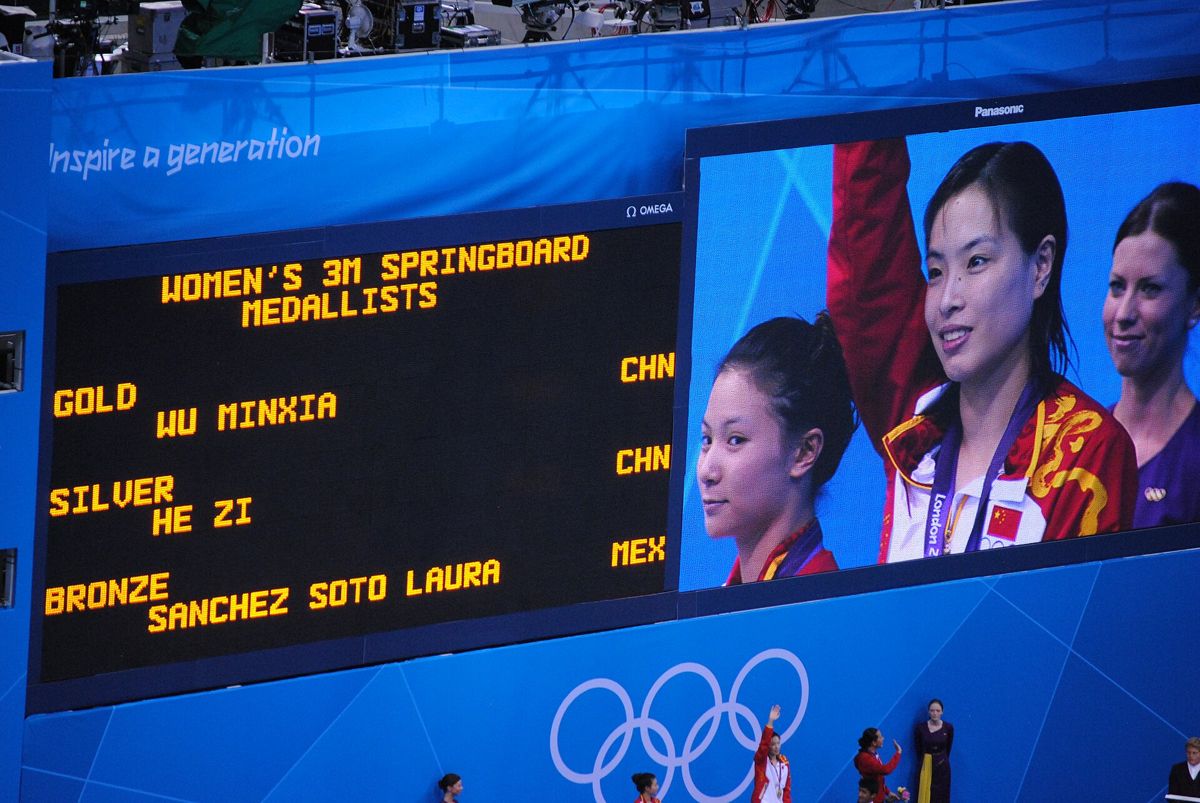
A big screen listing the women's 3 m springboard medallists beside a shot of the podium
The scoreboard after the women's 3 m springboard at London 2012: Wu Minxia and He Zi of China, Laura Sánchez of Mexico.
Joel Solomon · CC BY 2.0 · Wikimedia Commons
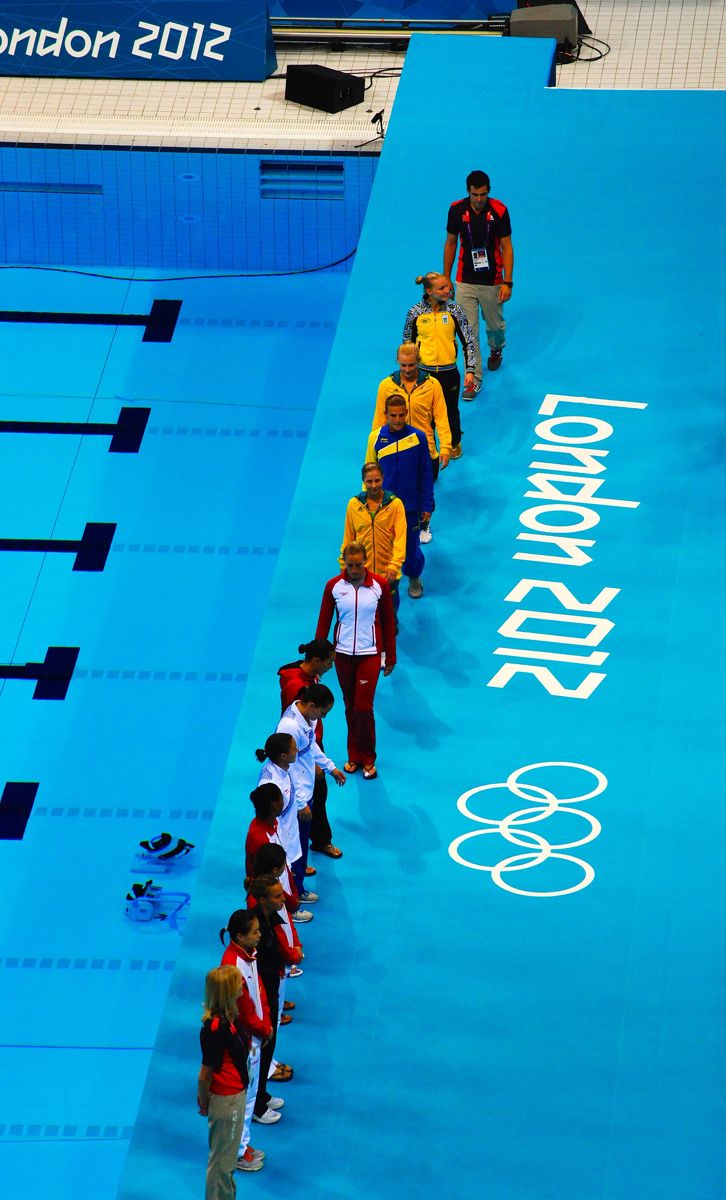
Divers in team tracksuits walking in line along the poolside
The women's springboard finalists walking out at London 2012.
Joel Solomon · CC BY 2.0 · Wikimedia Commons
Cancelling four marks is the sport's answer to a biased judge. It does not settle the question. A 2009 statistical study of the scores from Sydney 2000 is one of several to look for national bias in the marks that remain.
Two divers, one score
Synchronised diving joined the Games at Sydney in 2000 and doubled the programme from four events to eight. It had been performed as an exhibition since at least 1939. Olympedia records that the events were added "purportedly … because television asked for more diving events". That account is reported, not official.
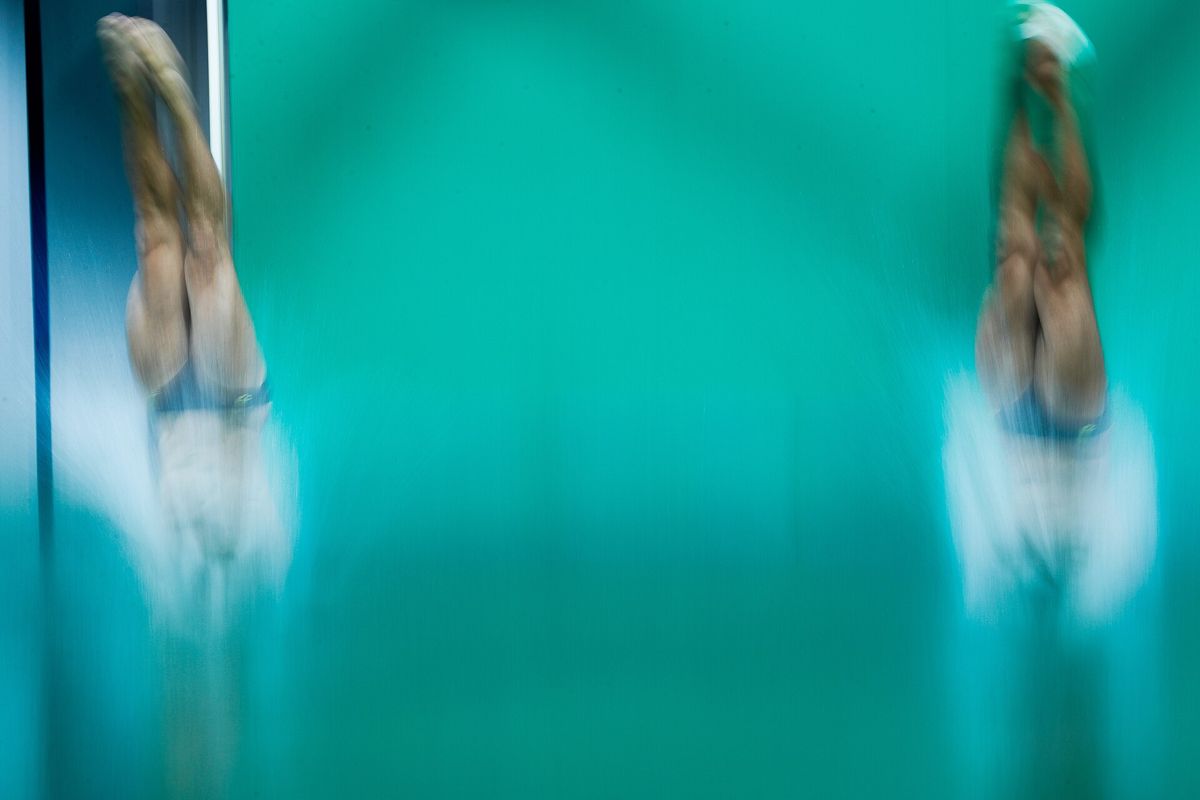
Two divers blurred in mid-somersault side by side
Stephan Feck and Patrick Hausding of Germany in synchronised 3 m springboard at Rio 2016.
Fernando Frazão / Agência Brasil · CC BY 2.0 · Wikimedia Commons
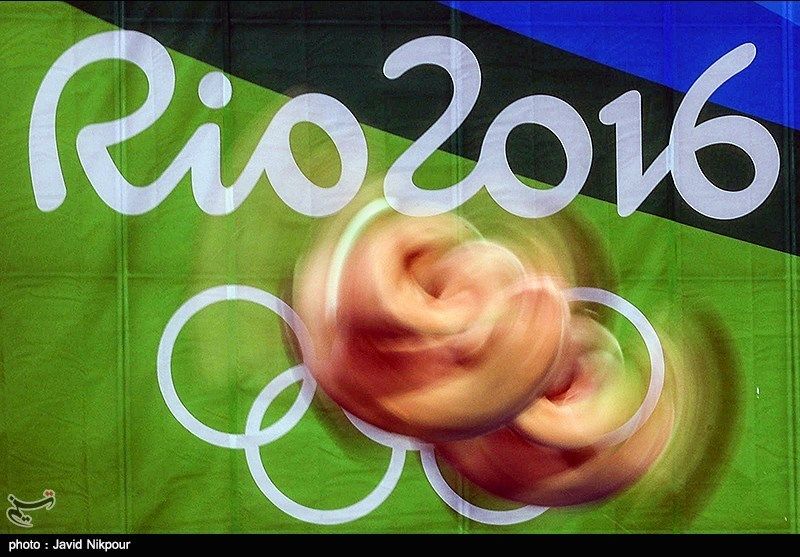
Two divers blurred into a spinning shape against a Rio 2016 backdrop
A synchronised platform pair in a fast somersault at Rio 2016.
Javid Nikpour / Tasnim News · CC BY 4.0 · Wikimedia Commons
A synchronised dive has eleven judges. Three mark each diver's execution and five mark how well the two match. Each group loses its highest and lowest mark. The rest are averaged onto the same three-judge scale, so a synchronised score sits on the same footing as an individual one.
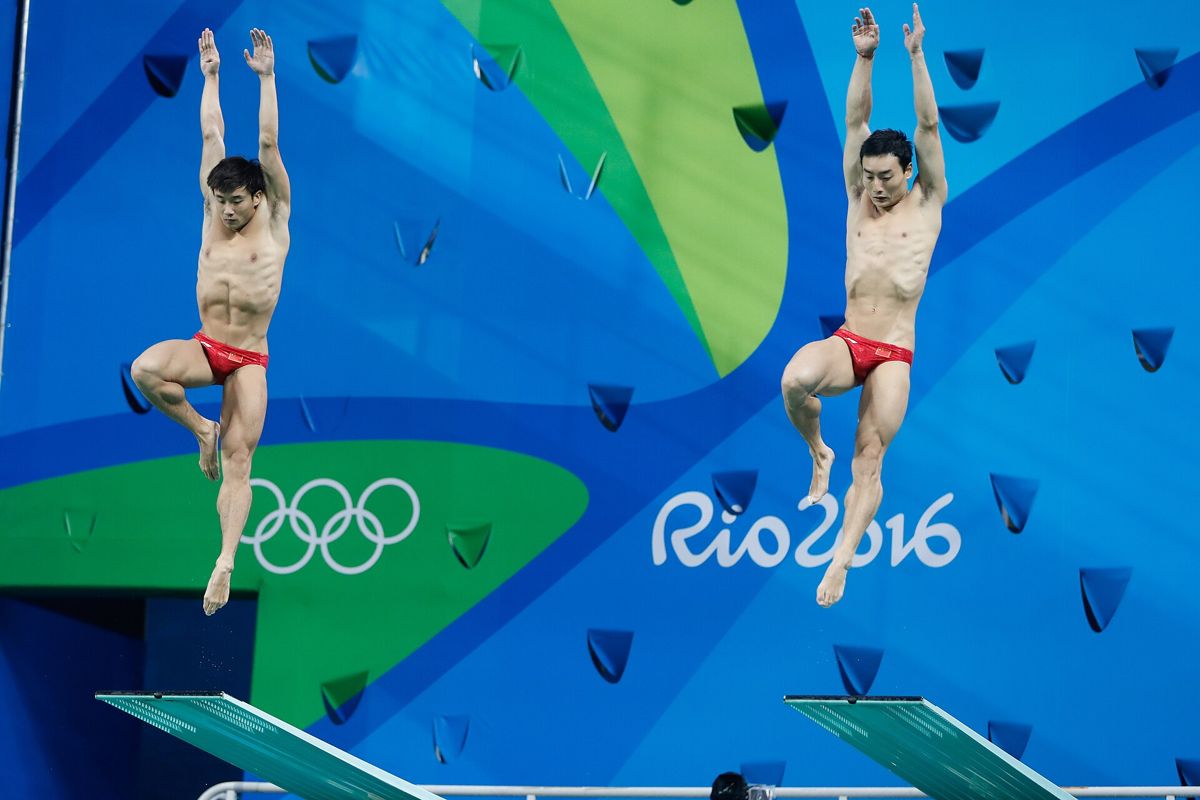
Two Chinese divers rising side by side, arms raised, above twin springboards
Cao Yuan and Qin Kai of China at the take-off in synchronised 3 m springboard, Rio 2016. They won bronze.
Fernando Frazão / Agência Brasil · CC BY 2.0 · Wikimedia Commons
What the judges never decide is how hard a dive was. That number is printed before the competition starts.
05Where it is dived
Diving needs a deep pool and a tower. That makes it a sport of cities with large aquatic centres, more than of small clubs.
The United States led for much of the twentieth century. Greg Louganis won both men's events in 1984 and again in 1988. China won its first Olympic diving gold in 1984 and has since become the standard. At Paris in 2024 it won all eight events.
Mexico has a long diving tradition. Great Britain, Germany, Canada and Australia win medals regularly.
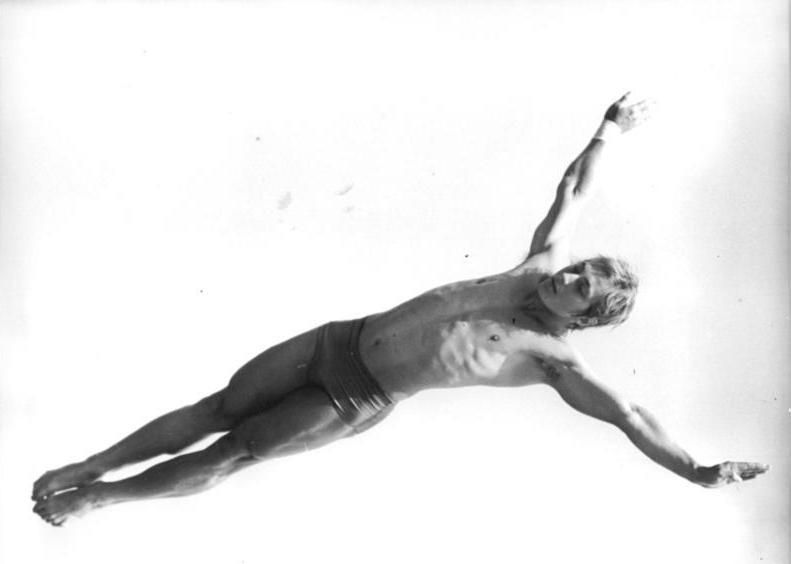
A diver photographed from below, arms spread in a layout position
Falk Hoffmann at the East German championships in Leipzig, 1973. He won the Olympic platform title in 1980.
Wolfgang Kluge · CC BY-SA 3.0 de · Wikimedia Commons
Beyond the Games
The world championships hold more events than the Olympics: the one-metre springboard, mixed synchronised pairs and a mixed team event. Since 2013 they have also held high diving, from 27 metres for men and 20 for women. None of these is on the Olympic programme, which has stayed at eight events since 2000.
High diving is done from cliffs and from temporary towers. It has its own circuit, and it grew up largely outside the federation before the world championships took it in.
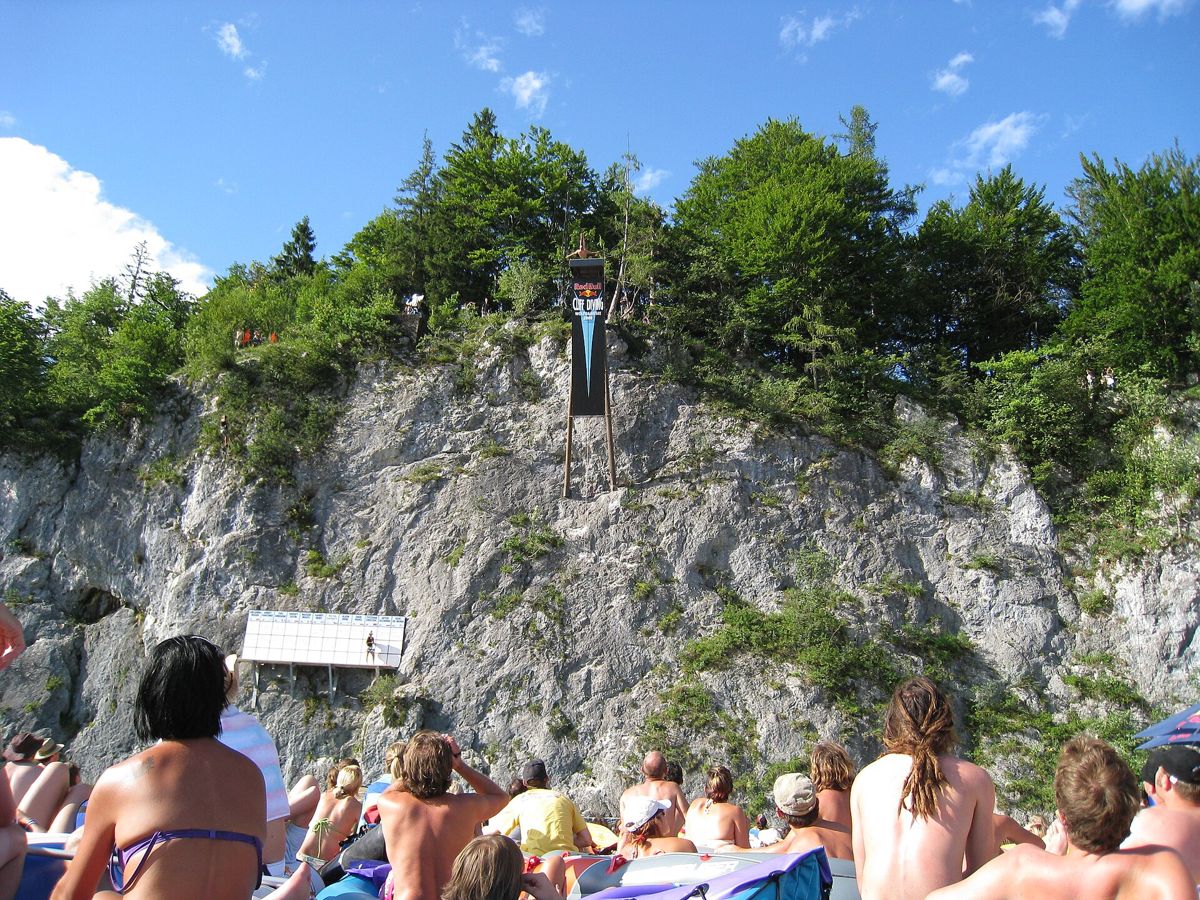
A rock face over a lake with a diving platform near the top and spectators in the water
High diving from a cliff platform at Wolfgangsee, Austria, 2008.
Tigerente · CC0 · Wikimedia Commons
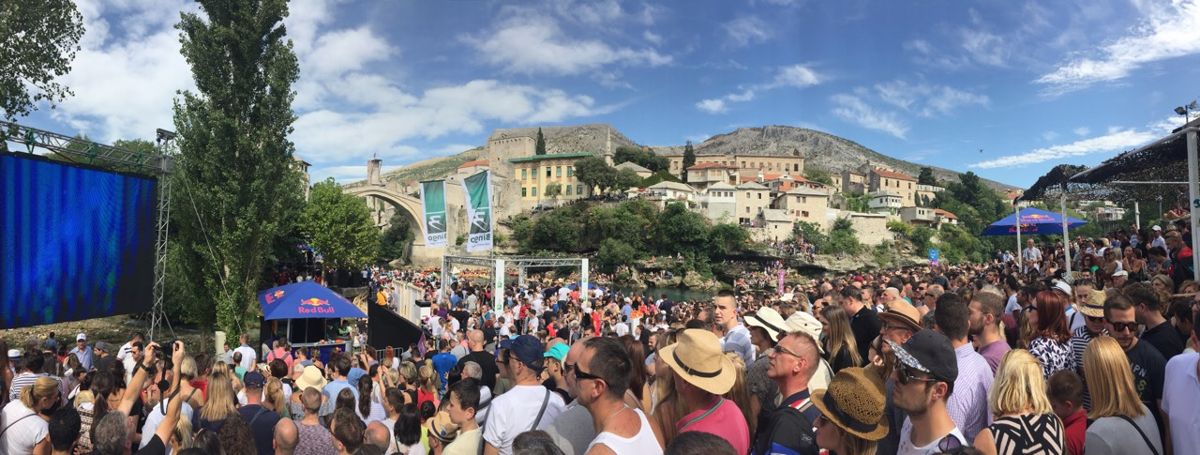
A large crowd on a riverside in a stone town watching a cliff diving event
The crowd at a Red Bull Cliff Diving World Series event in Mostar, 2017.
A. Omanović · CC BY-SA 4.0 · Wikimedia Commons
06Learning curve
Diving's most dangerous apparatus is water, and the sport's whole development pathway is built around making a ten-metre fall survivable before making it scorable.
Editorial — the site’s reading, not a sourced claim
Barrier to entry
How hard is it to get to a real game?
A pool with deep water and a board, a coach, and years of dryland work first.
A first dive off a one-metre board is easy. Everything after it needs a diving pool, which is rarer than a swimming pool because of the depth, and a coach, because the safe way to learn a somersault entry is on a trampoline and in a harness before it is in the water.
The sport sets a minimum age of fourteen for the Games and senior world championships, but its divers start years earlier, usually from gymnastics.
Evidence
- Depth needed under 3 m3.70 mobserved
- Minimum senior age14rule1992 — the rule this rests on
- Usual backgroundGymnasticsestimate
Barrier to the top
How hard is it to be good at?
Two seconds of flight, judged by people who have seen thousands of them.
The difficulty table is public, so elite divers know exactly what each dive is worth; the margin is in the entry, which judges mark harshly for a splash. A clean entry from ten metres at around fifty kilometres an hour is the hardest part of the sport and the least visible.
Synchronisation adds a second judgement on top of execution, and the Chinese programme has set the standard so far ahead that the rest of the world's divers are measured against it.
Evidence
- Marks countedMiddle 3 of 7observed
- Synchronised panel11 judgesrule2000 — the rule this rests on
- China at Paris 20248 of 8 goldsobserved
Why the two differ
Diving's gap is the opposite of most judged sports'. Because difficulty is computed rather than judged, a beginner can read exactly what the best divers are attempting — and the published numbers make it plain how far away that is.
The historyhow it got here · sections 7 to 10
07From the gymnasium to the pool
Diving began as a way for gymnasts to land. In Germany and Sweden in the nineteenth century, gymnasts took their somersaults outdoors over water. Over time, what they did in the air came to matter more than how they got there.
The Olympic Games took the sport up a piece at a time. St Louis in 1904 held a platform event and a plunge for distance. In the plunge, a diver pushed off and floated face down as far as possible without moving. It was never held again.
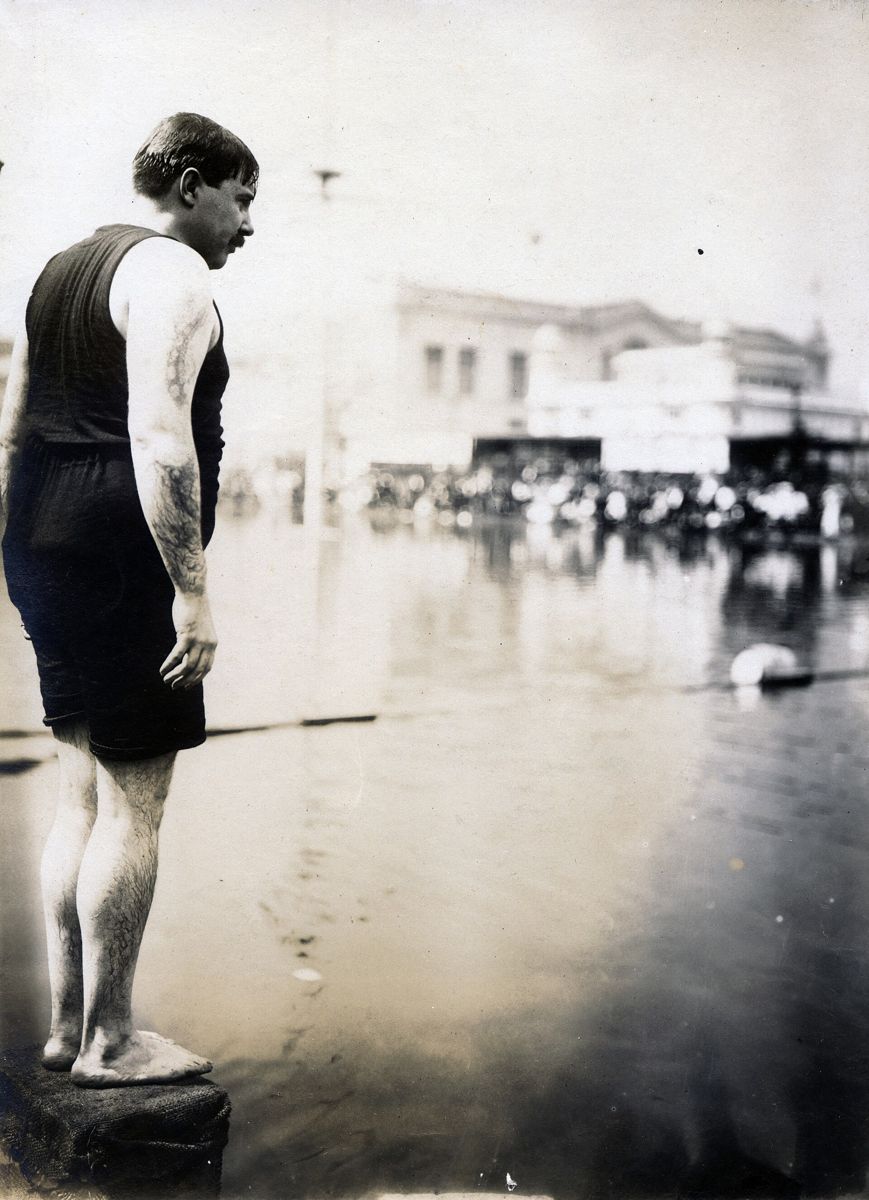
A man in a dark swimming costume standing on a block above the water, 1904
W. E. Dickey of the New York Athletic Club, winner of the plunge for distance at St Louis in 1904 with 62 feet 6 inches — an event held at the Games only once.
Jessie Tarbox Beals (attributed) · Public domain · Wikimedia Commons
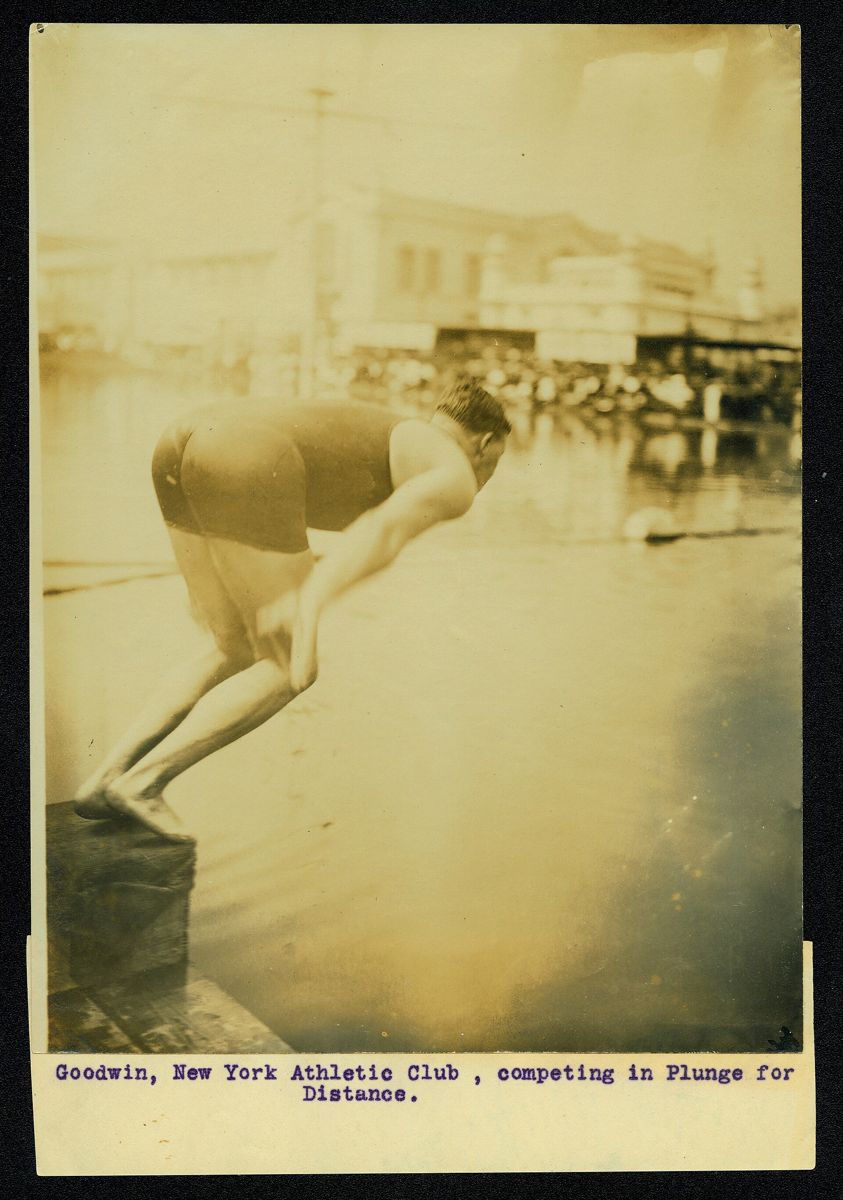
A man crouched on a post at the water's edge about to push off
Goodwin of the New York Athletic Club competing in the plunge for distance at the 1904 Olympics.
Unknown author · Public domain · Wikimedia Commons
London added the springboard in 1908. Stockholm held the first women's event in 1912, from the platform, and Greta Johansson of Sweden won it.
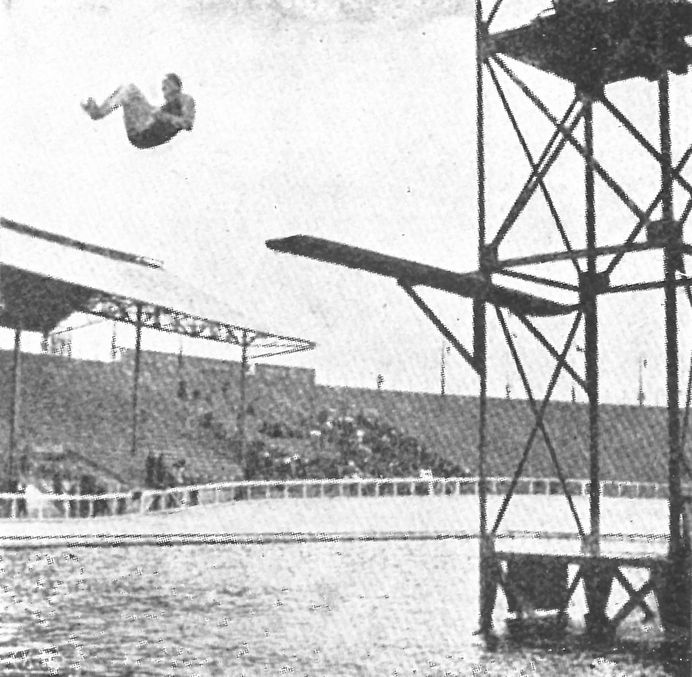
A diver tucked in mid-air beside a tall wooden tower over an open-air pool
Oskar Wetzell of Finland diving at the 1908 London Olympics, where diving was held in a pool built inside the main stadium.
Unknown author · Public domain · Wikimedia Commons
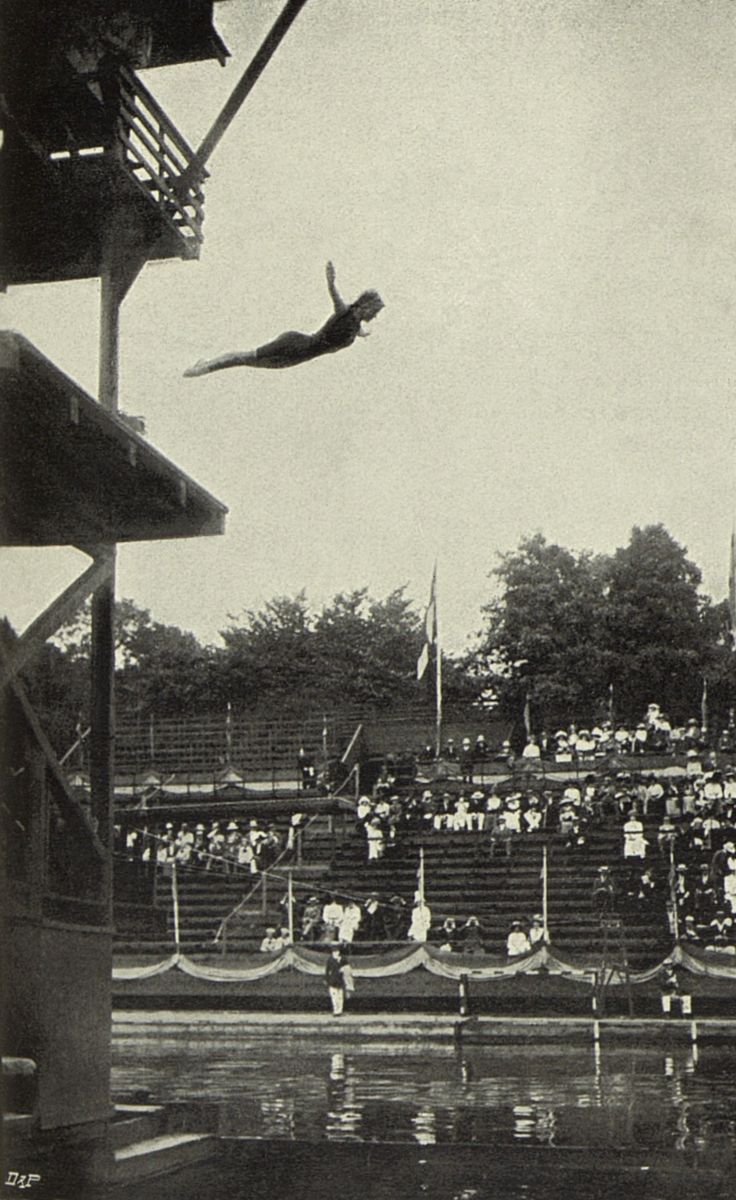
A diver in a swallow position high above the water, beside a tower
Greta Johansson of Sweden at Stockholm in 1912, the first Games with a women's diving event. She won it.
Jaroslav Kalva · Public domain · Wikimedia Commons
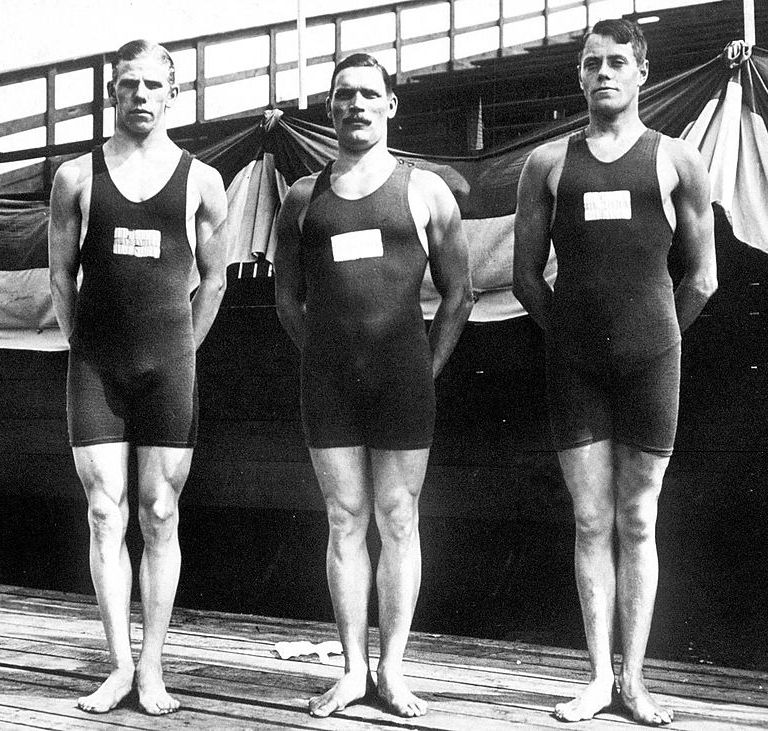
From 1912 to 1924 the Games also held plain high diving, which allowed only simple headers from the platform. It was then dropped. From 1928 there were four events: springboard and platform, for men and for women. That programme stayed the same until 2000, when four synchronised events were added.
Three Swedish divers in costumes with numbers, standing on a wooden deck
The plain high diving medallists at Stockholm in 1912: Erik Adlerz, Hjalmar Johansson and John Jansson. The event was dropped after 1924.
Unknown author · Public domain · Wikimedia Commons
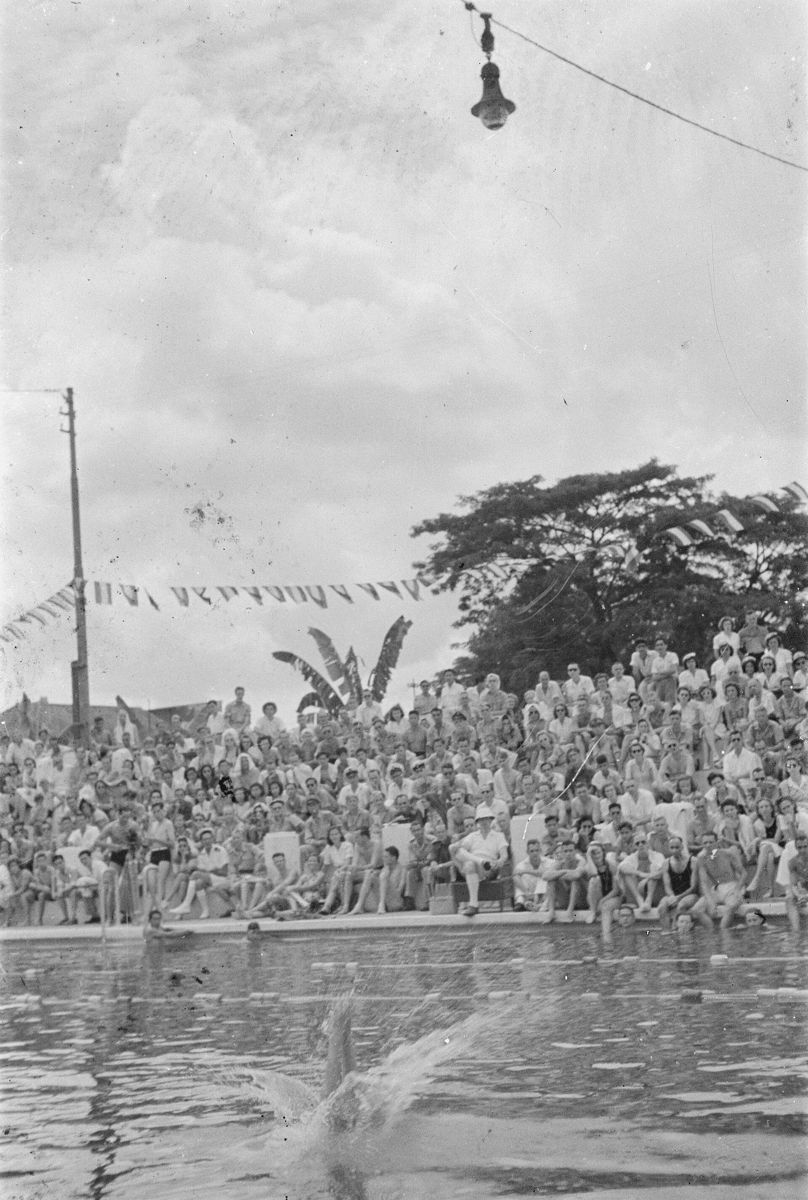
A crowd lining a pool as a diver enters the water
Diving at an Easter sports meeting held by the Dutch army in the Dutch East Indies, April 1947.
Nationaal Archief / DLC · CC0 · Wikimedia Commons
Diving has been governed together with swimming since FINA was founded in London in 1908. The federation has been called World Aquatics since 2023. Its technical diving committee writes the diving rules and keeps the tables of difficulty.
Those tables make the sport partly a matter of arithmetic. Every dive has a degree of difficulty, worked out by adding five published values. Its worth is known before the diver leaves the board, and the judges mark only how well it is done. Gymnastics did not separate the two until 2006.
08Rule timeline
The sport’s own lane, expanded. Every entry carries a cause from the closed vocabulary and a citation, and says so where the citation is incomplete.
- 1992Fairness and eligibility
Divers must be at least fourteen in the year of the competition to take part in the Olympic Games and the senior world championships. The rule now reads fourteen by 31 December of the competition year.
Trigger and citation
Trigger
Fu Mingxia of China won the 1991 world platform title at the age of twelve. The diving authorities responded by setting a minimum age; Fu herself competed at Barcelona in 1992 because she turned fourteen twenty days after the platform final.
Competition Regulations, Part Four — Diving Rules (in force from 9 November 2024) · Competition Regulations Part Four, 2024 (current text) · article Part Four, 1.4
- 2000Broadcast and pacing
Four synchronised events — men's and women's 3 m springboard and 10 m platform — added to the Olympic programme at Sydney, doubling it from four events to eight. The four-event programme had stood since 1928. Synchronised diving is judged by eleven officials: five on synchronisation and three on each diver's execution.
Trigger and citation
Trigger
Olympedia records that the events were added "purportedly … because television asked for more diving events". Synchronised diving had been performed as an exhibition since at least 1939.
No IOC or FINA statement of reasons has been obtained, and the account above is reported rather than official.
Competition Regulations, Part Four — Diving Rules (in force from 9 November 2024) · Competition Regulations Part Four, 2024 (current text) · article Part Four, 3.6, 5.2.1
09The board, the water and the table
The board is the main piece of equipment in diving, and each diver tunes it. A springboard must be at least 4.8 metres long. Its fulcrum must move easily, so a diver can set the spring before every dive. Moving it forward makes the board stiffer. Moving it back gives more lift.
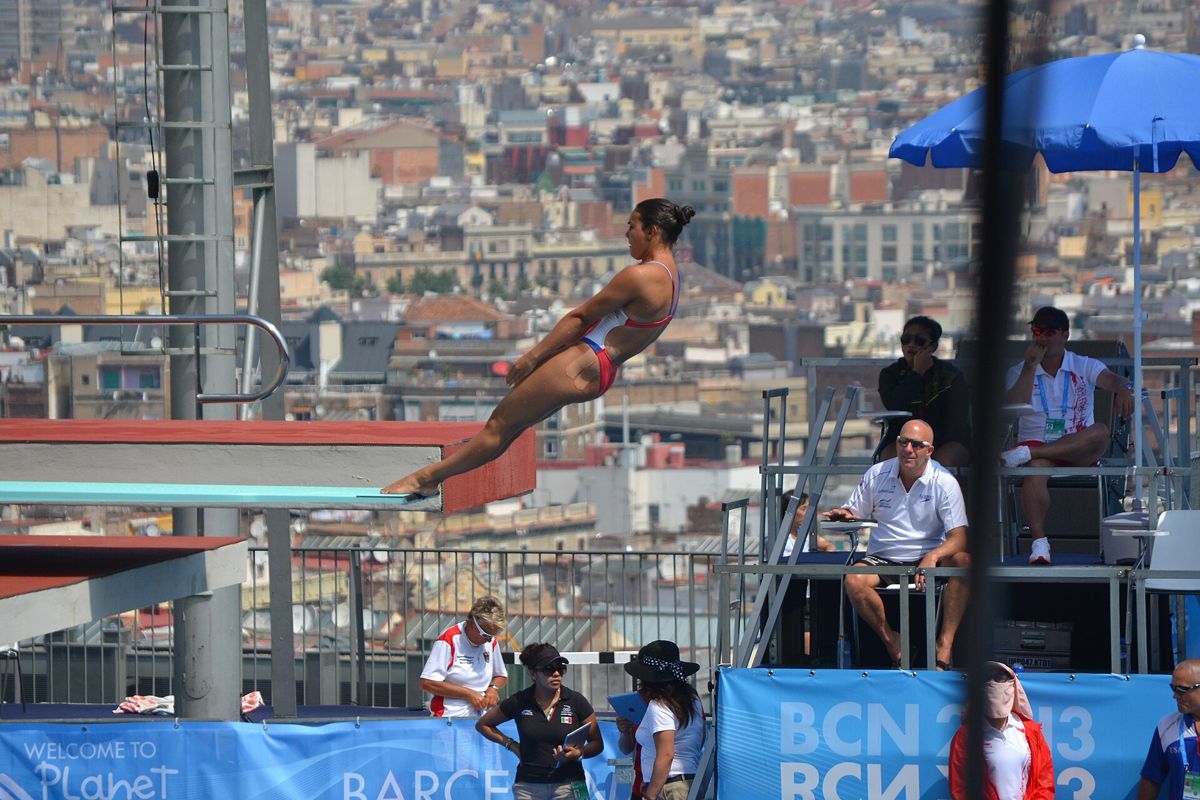
A diver leaving a platform over a city skyline, judges seated below
A platform diver at the 2013 world championships in Barcelona, with officials seated below.
Xavier Vergés · CC BY 2.0 · Wikimedia Commons
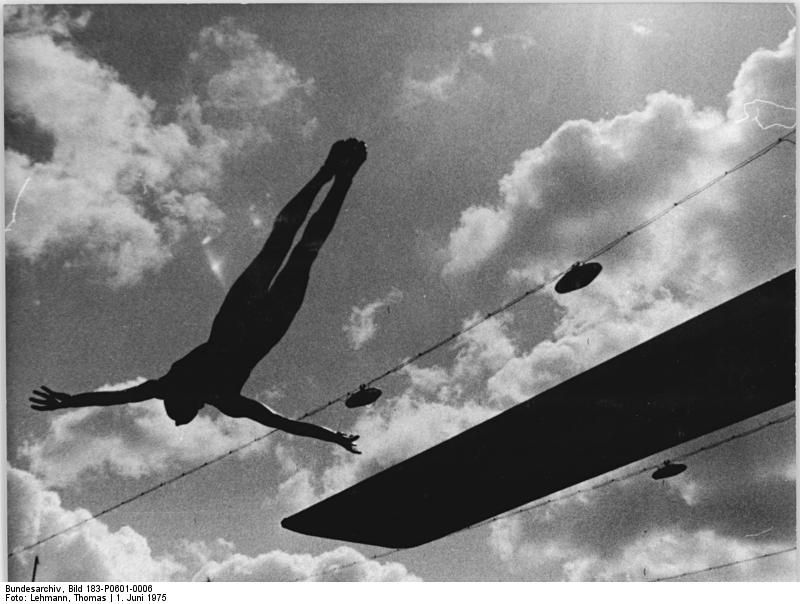
A diver silhouetted against clouds below the end of a platform
A platform diver at the East German championships in Berlin, 1975.
Thomas Lehmann · CC BY-SA 3.0 de · Wikimedia Commons
Wooden boards gave way to aluminium in the second half of the twentieth century. The rules now ask only that a board be of an approved type, with a surface that does not slip. The platform at ten metres is fixed and gives no spring at all.
The pool matters as much as the board. Under a ten-metre platform the water must be at least 4.5 metres deep. The rules also require the surface under the boards to be moved by a machine, such as a sprinkler or gentle bubbles. A diver turning at speed cannot see a perfectly still surface.
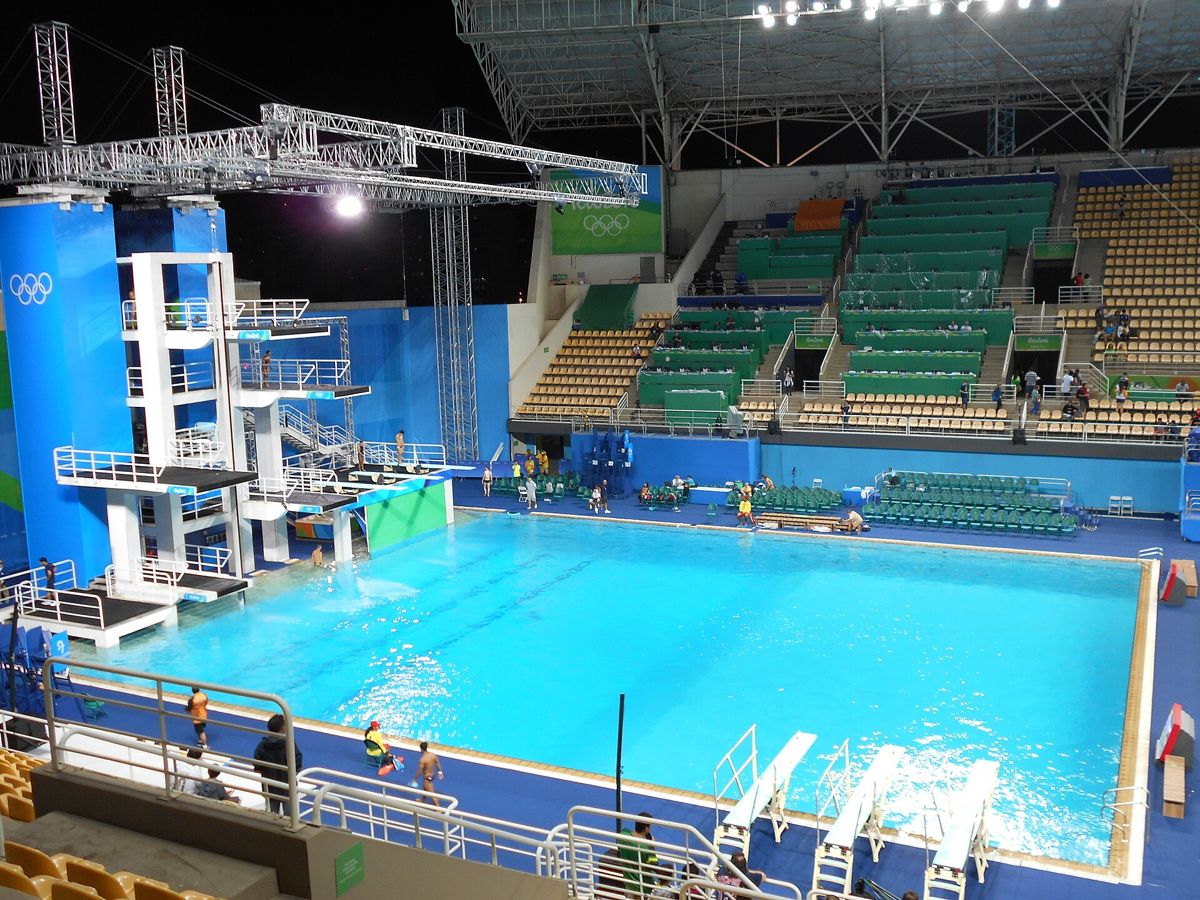
An indoor diving pool with a tower and boards, empty seats around it
The Maria Lenk Aquatics Centre, Rio de Janeiro, the diving venue for 2016.
Luã Leal · CC BY-SA 4.0 · Wikimedia Commons
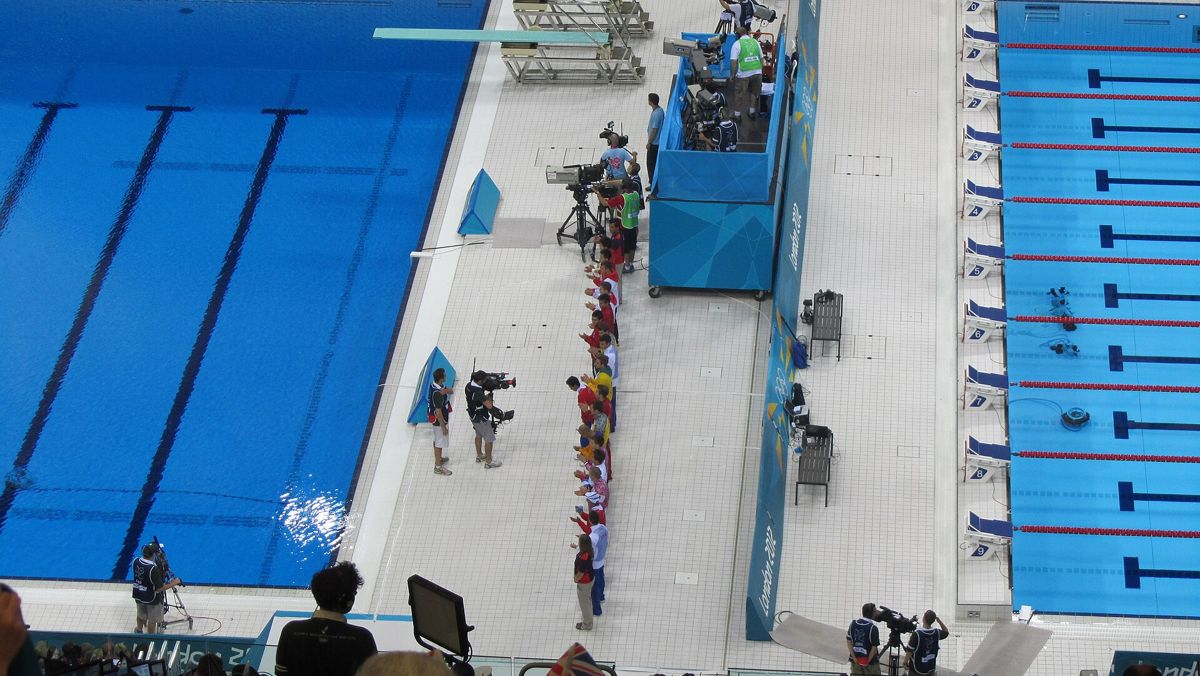
The poolside at London 2012, with cameras and officials during a diving session
The men's 10 metre platform semi-final at London 2012.
David Jones from Isle of Wight, United Kingdom · CC BY 2.0 · Wikimedia Commons
There is no ball, no racket and no measuring device. In their place the sport has a published table. Each dive has a number and a letter. 107B is a forward three and a half somersaults in pike, and from three metres it is worth 3.1.
10Three episodes at the pool
A world champion at twelve
Perth, 1991. Fu Mingxia of China won the world platform title at the age of twelve. The diving authorities responded by setting a minimum age of fourteen for the Games and the senior world championships. Today the rule counts age at 31 December of the competition year.
Fu still dived at Barcelona the following year. She turned fourteen twenty days after the platform final, and she won gold.
The head on the board
Seoul, 1988. In the preliminary round of the springboard, Greg Louganis struck his head on the board. He was stitched, came back, and won the event. Then he won the platform as well. In 1995 he said that he had known at the time that he was HIV-positive. The episode changed no rule.
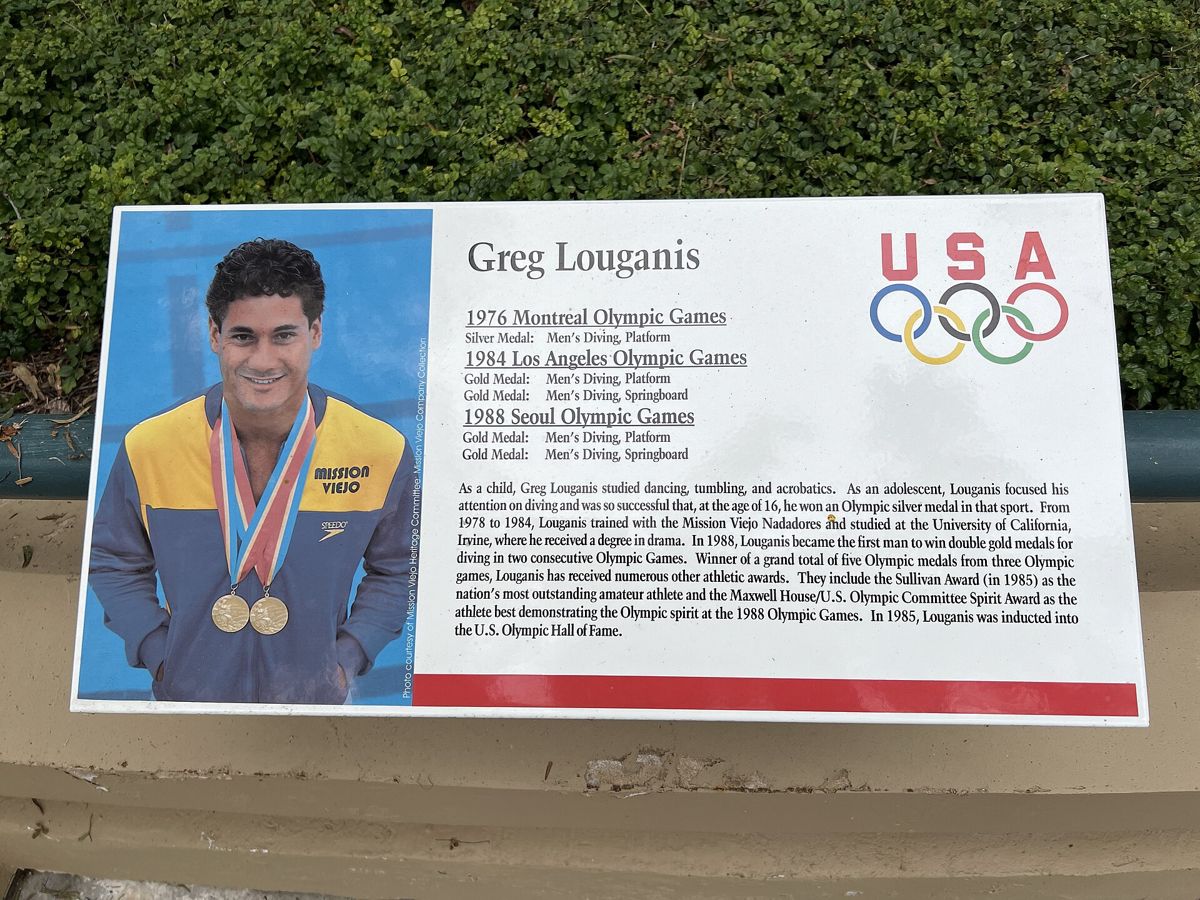
A plaque with a photograph of Greg Louganis wearing medals
A plaque for Greg Louganis in Mission Viejo, California, listing his Olympic medals of 1976, 1984 and 1988.
Sewageboy · CC0 · Wikimedia Commons
The green pool
Rio de Janeiro, 2016. Midway through the Games, the diving pool at the Maria Lenk Aquatics Centre turned green. The water polo pool beside it followed. Officials blamed the water chemistry. No diving rule changed, but for many people watching that summer it became the picture of the sport.
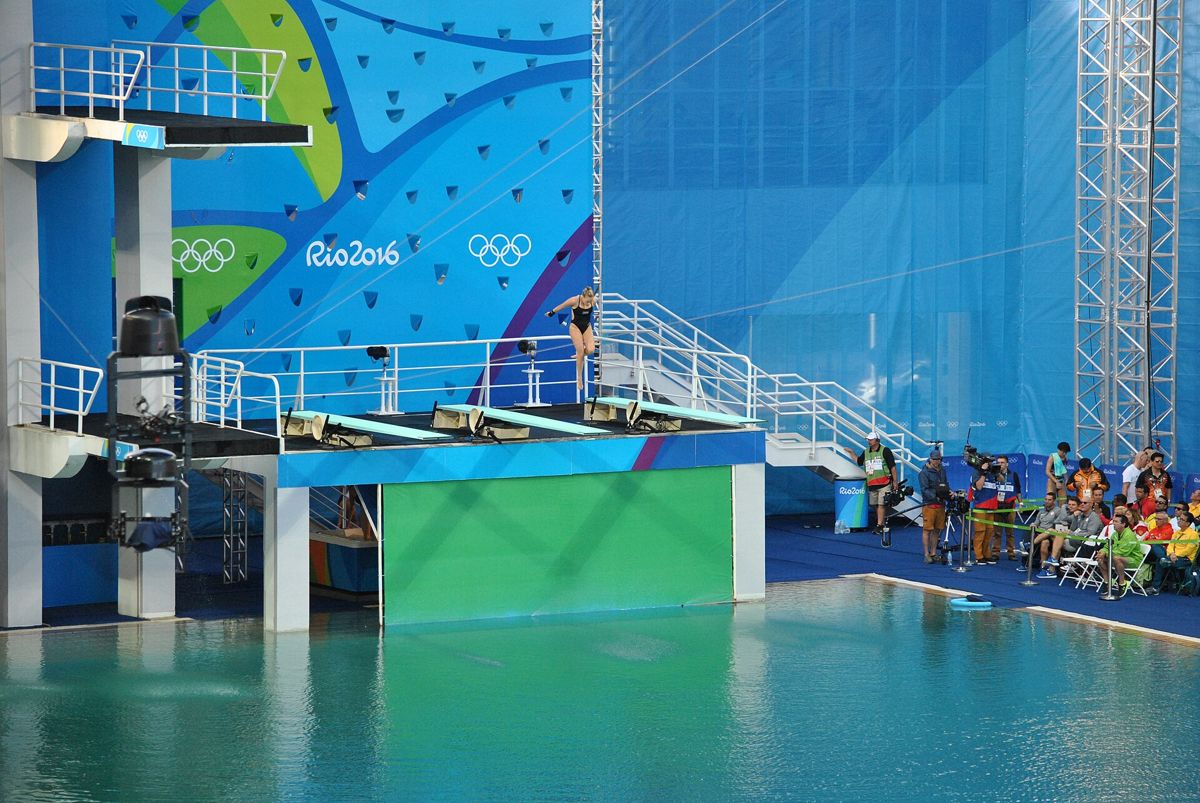
A diving tower above water that has turned visibly green
The diving pool at the Maria Lenk Aquatics Centre at Rio 2016 after it turned green.
Leandro Neumann Ciuffo · CC BY 2.0 · Wikimedia Commons
Where it standsthe record, and what is still open · sections 11 to 12
11Series
No series has been assembled for this sport.
12What is still argued about
How young is too young. The minimum age is fourteen in the year of competition, and champions are still often at the bottom of that range. Quan Hongchan won the platform at Tokyo in 2021 at fourteen.
High diving at the Games. It has been on the world championship programme since 2013. It is not on the Olympic one, including for 2028.
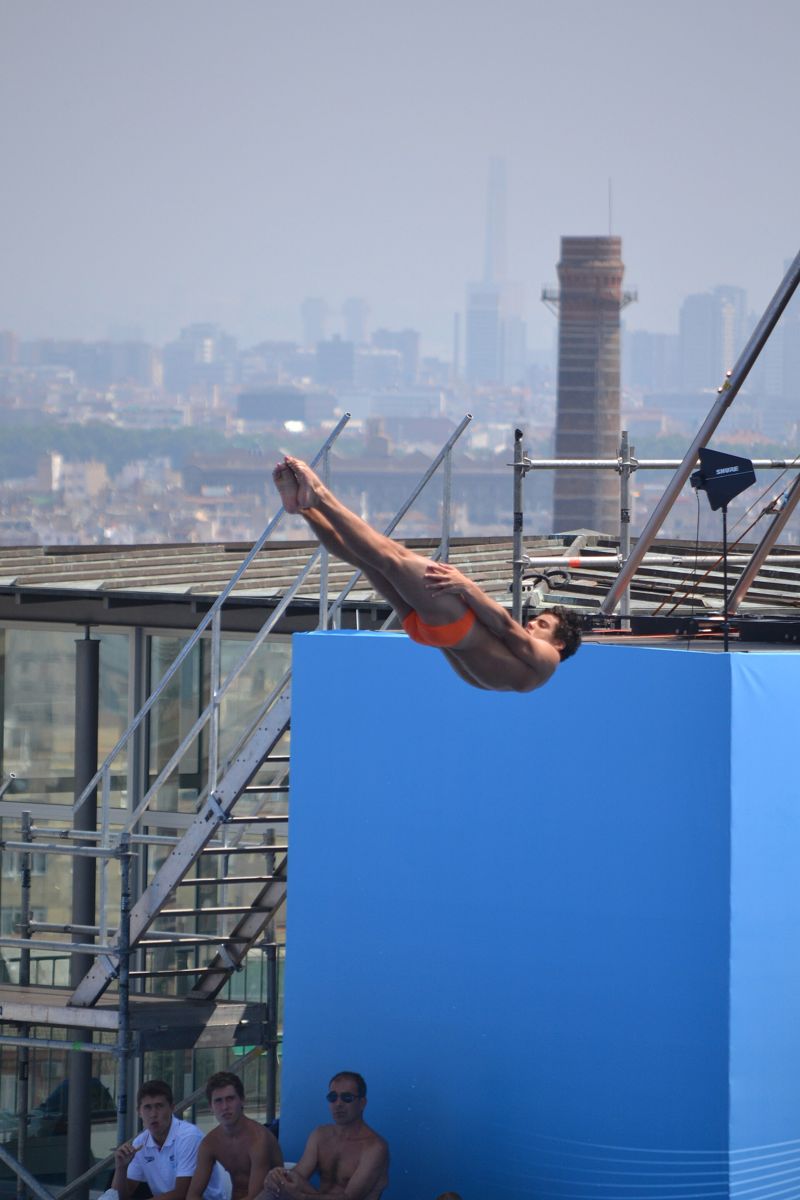
A diver in a pike position in mid-air over Barcelona
A pike position from the platform at the 2013 world championships in Barcelona.
Xavier Vergés · CC BY 2.0 · Wikimedia Commons
The splash. The entry is the hardest part of a dive to judge from the side, and the part judges weigh most visibly. Whether seven judges, cut to three, mark it consistently is the sport's oldest open question.
The table itself. Because difficulty is computed, every change to the values in the formula changes which dives are worth attempting. Divers plan their lists around the tables.