 AFM Studio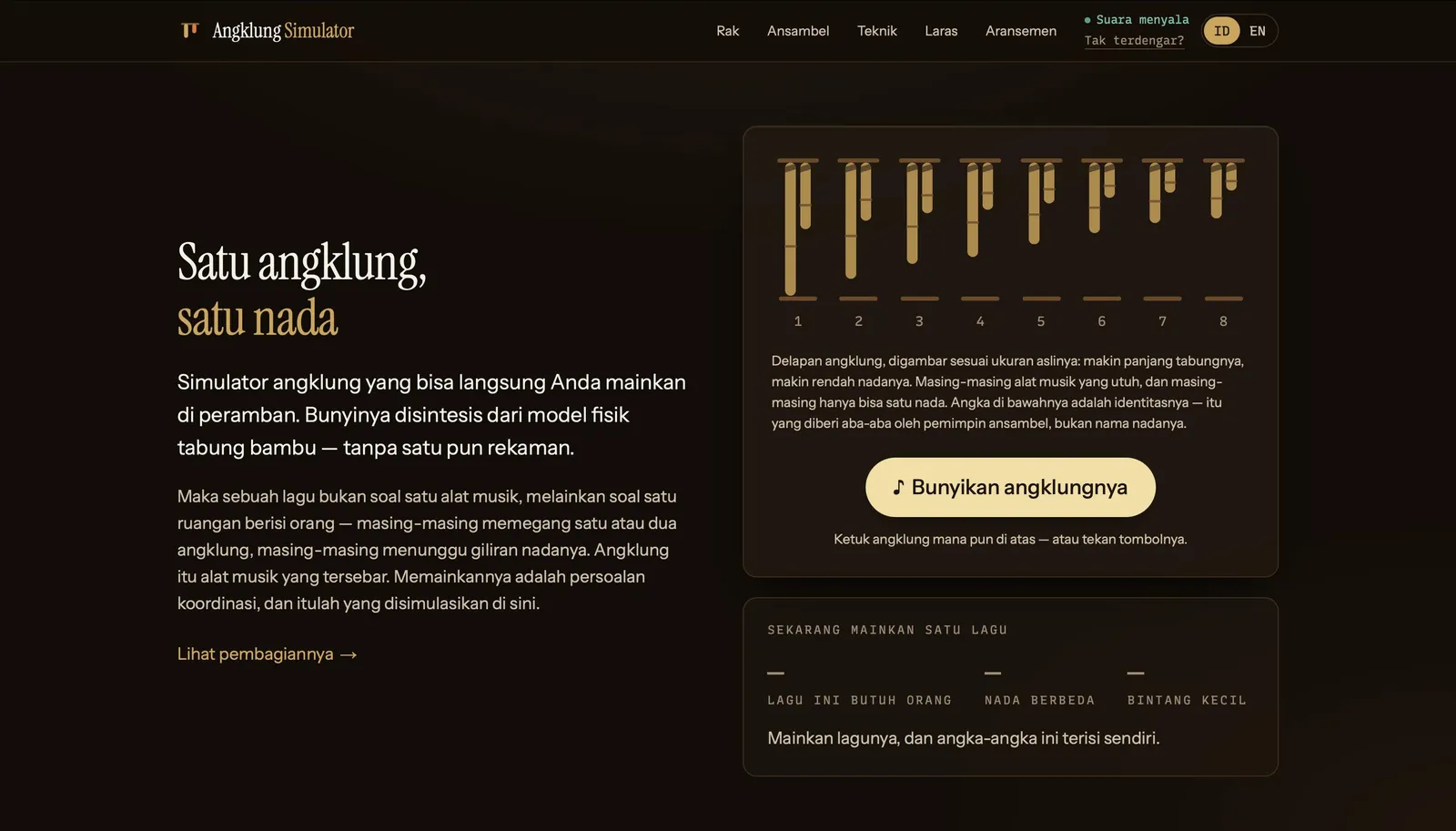

Angklung Simulator
A browser angklung that models the instrument's real constraint — one angklung plays exactly one note, so a song has to be shared across a room of people — with every sound computed from a physical model of a bamboo tube, not played back from a recording
Solo Developer
Aug 2026
On this page
The problem
Every angklung app online is a soundboard: tap a picture of bamboo, hear a note. That reproduces the sound and misses the instrument. A real angklung is distributed — each player holds one or two notes and spends most of a performance waiting for their moment, watching a conductor signal numbers by hand. The coordination is the instrument, and nothing on the web simulates it.
Two secondary gaps: the techniques are taught as three sounds — kurulung (shake), centok (sharp pull), tengkep (shake with one tube held) — when they're actually three ways of exciting the same resonator, and three audio files would teach nothing about why they differ. And tengkep on an accompaniment angklung is a chord-quality switch: four tubes sound a dominant seventh; the player's little finger holds one and it becomes a major triad. It's the most interesting fact about the instrument's design, and no simulator models it.
The approach
A bamboo tube is a bank of resonant modes, not a recording
Each mode is a two-pole resonator whose impulse response is a decaying sinusoid — what a struck mode physically does. A tube is closed at the node and open at the cut, so it behaves as a stopped pipe: odd partials dominate and there's nothing strong at twice the fundamental. That absence is what makes tengkep provable — the octave tube's fundamental is the only thing at 2f, so removing the tube removes the partial outright. Technique lives entirely in the excitation, never in the resonator: centok is one hard impulse; kurulung is a strike train (a 2–3 Hz shake with small seeded jitter so it sounds alive, not like a machine tremolo); tengkep uses the same train and differs only in which resonators get summed. Adding a technique means adding a pattern, not a branch.
The sound is measured, not judged by ear
The synthesis core is a pure function — (params) → Float32Array, no Web Audio, no DOM, no clock — that renders offline in Node, which is the decision the rest of the project rests on: pitch is asserted by FFT within a cents tolerance, tengkep is asserted in both directions (partial absent when held, present when not), centok is asserted as exactly one onset, and the same seed renders byte-identically. And what you hear is the buffer the tests measured — the Web Audio layer plays back the rendered array rather than re-implementing the model in oscillator nodes, so there aren't two instruments with only one of them tested. Scheduling is absolute against the audio clock (startTime + eventTime, never accumulated), so nothing drifts however long the piece runs.
The ensemble is the product, and infeasibility is named
Distribution is a small constraint problem that reports failure instead of hiding it: every note needs a player who holds that angklung and is free at that instant, and infeasibility comes back as a named discriminated union — note outside the set, one player needed twice at once, not enough players — with the offending note indexes attached, plus the piece's peak instant so the minimum ensemble size is a checkable number. It never truncates an arrangement to make it fit, and it's verified against a brute-force oracle.
Cultural material handled with declared caveats
Padaeng (the 1938 diatonic-chromatic tuning), salendro, and pelog degung ship as editable JSON interval sets, each with a source and a required caveat field stating where the figure stops being verified — the salendro and pelog numbers are structural models, not measurements — and the data validator refuses to build if a caveat is missing. Daeng Soetigna and Udjo Ngalagena are credited on the page, not in a footnote.
Outcome
Live and public, bilingual, fully static with zero audio files (a postbuild guard fails the build if one appears). It ships the rack (angklung graduated by pitch, swaying at the same shake rate that drives the audio, technique selector plus press-and-hold); the ensemble view — load a melody, choose a set and a player count, see who holds what and when they come in, with rests drawn as space because for an angklung player the waiting is the job; the distribution solver with named infeasibility; a technique lab exposing the strike train feeding the resonator bank; the accompaniment chord switch shown as tubes; a laras comparison with editable cents and citations on screen; a conductor lane; and an on-device diagnostics page.
Built solo in one ~37-hour build — ~13,100 lines of TS/TSX/JSON, 132 tests, on three runtime dependencies and no audio, synthesis, or DSP library. It's honest about two open gaps: audio startup hasn't been tested on a real iPhone, and the timbre — provably correct in pitch, partials, and chord identity — hasn't yet been judged against a real angklung by ear.
- 0
- 3
- 132
- 3
Have a project like this?
If you need a system built with the same care — clear scope, solid execution — let's talk.
Start a project